
AFRICA MUST STAND ON ITS OWN PRINCIPLES
🌍 You’re reading Africa’s innovation network
EcoTech is a growing space for farmers, innovators, scientists, investors and contributors building practical sustainability solutions.
Development Without Political Allegiance — Unlocking the Capabilities Africa Already Possesses
A changing world, an important question for Africa
On 7 October 2026, United States Secretary of State Marco Rubio delivered a speech in Athens, Greece, defending Western civilisation, national sovereignty, economic strength and the importance of protecting Western interests.
His address renewed debate about the place of civilisation, history and national power in international relations.
Supporters regarded the speech as a defence of cultural identity, national confidence and the right of countries to protect their interests. Critics questioned its treatment of colonial expansion, historical dispossession and the idea of Western global primacy.
Africa need not take a political side in that debate to recognise the question it raises.
If other nations and civilisations have the right to define their interests, preserve their identities and pursue their development, should Africa not exercise that same right?
Africa's answer should not require hostility towards the West, allegiance to the East or dependence on any competing geopolitical bloc.
It should begin with the recognition that Africa possesses its own people, knowledge, resources, institutions, cultures and productive capabilities.
Its future must be shaped through those foundations.
Not in isolation from the world, but through independent and constructive participation within it.
Political independence was the beginning, not the completion
Political independence established the sovereignty of African nations and their authority to govern themselves under their respective constitutional systems.
Yet political sovereignty does not automatically produce economic independence.
Across the continent, countries continue to confront challenges involving industrial capacity, agricultural processing, technology, financing, logistics, infrastructure and access to regional and international markets.
Some of these challenges reflect historical economic structures. Others arise from domestic institutional weaknesses, limited investment, fragmented markets, insufficient infrastructure or failures in implementation.
The causes differ, but the development question remains:
How can African nations strengthen their ability to transform the resources and capabilities they possess into sustainable economic and social value?
It is a question that cannot be answered by political allegiance alone.
Nor can it be solved merely by changing the origin of external investment.
An economy dependent on one international partner does not automatically become independent by replacing that partner with another.
Real independence requires productive capabilities, trustworthy institutions, informed decisions, accountable leadership and the freedom to enter relationships that advance African development priorities.
Africa's overlooked wealth: the connections that have never been established
When discussing Africa's wealth, attention frequently turns to minerals, agricultural land, energy resources, forests, water and its growing population.
These resources are important.
But perhaps one of Africa's greatest untapped development opportunities lies somewhere less visible.
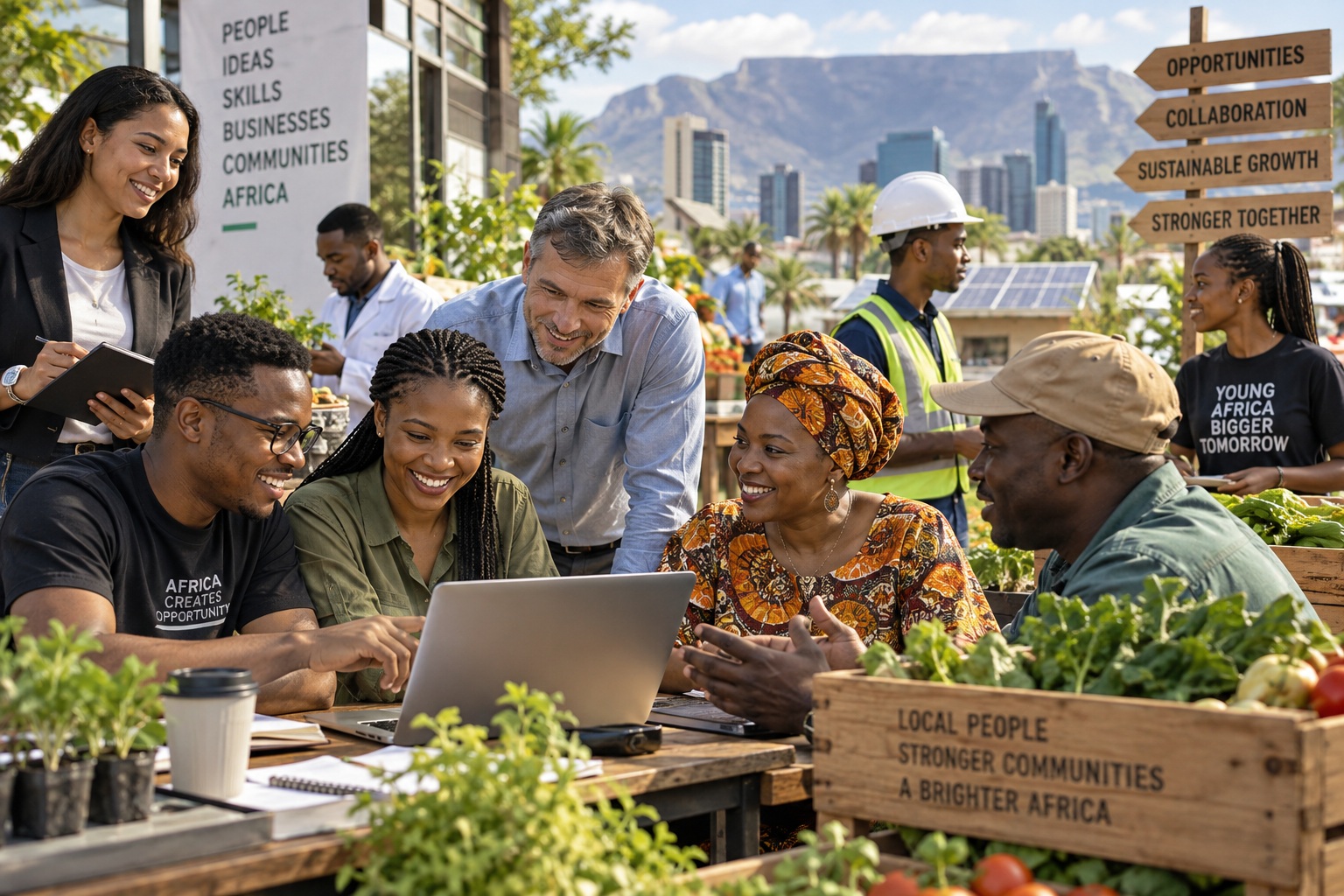
Africa's greatest untapped potential may lie not only in the resources it possesses, but in the productive connections that have never been established between its existing capabilities.
Consider a farmer with productive land but limited access to processing equipment.
Elsewhere, a processor may possess suitable equipment but lack a reliable source of agricultural supply.
A researcher may have the technical knowledge to improve the product, while a distributor already understands the market.
An investor may be seeking precisely such an opportunity but cannot identify trustworthy participants or a viable project.
Each participant possesses something valuable.
Yet independently, each may experience limitations that prevent progress.
The opportunity emerges when someone recognises that these capabilities are complementary.
What previously appeared to be separate problems can become the foundation of a productive relationship.
This principle applies far beyond agriculture.
It applies to mineral value chains, manufacturing, renewable energy, research, education, logistics, healthcare, digital infrastructure and community development.
Africa does not always need to begin by creating entirely new resources.
Sometimes development begins by recognising what already exists, identifying what is missing and connecting the right capabilities at the right time.
Recognising opportunity requires understanding the wider system
Development opportunities rarely exist in isolation.
They emerge through relationships between people, resources, knowledge, circumstances, markets and time.
A resource that cannot be used productively today may become valuable when a missing capability becomes available.
A research finding may remain unused until it connects with a manufacturer.
A small enterprise may remain constrained until it develops a relationship with a dependable supplier or customer.
A community project may become viable when the required expertise, finance, technology and institutional support are brought together.
The challenge is to recognise these relationships before their potential becomes obvious.
This requires looking beyond individual industries, organisations and geographic boundaries.
It requires asking not only what is available, but what could become possible through cooperation.
It also requires understanding timing.
An opportunity is not necessarily ready merely because it has been recognised.
Successful development may first require trust, feasibility research, infrastructure, financing, skills or access to a market.
Recognising those gaps is not a reason to abandon the opportunity.
It is the beginning of understanding what must be developed.
The EcoTech Principle of Connected Development
EcoTech Africa approaches development through a principle that can be expressed simply:
Recognise existing capabilities. Identify the gaps. Connect complementary resources. Organise participation. Develop measurable outcomes.
This approach begins with observation rather than assumption.
What knowledge already exists?
Which enterprises possess useful equipment, skills or production capacity?
Where are resources underutilised?
Which communities, researchers, investors or institutions are seeking relationships that could complement those capabilities?
What prevents them from working together?
And what would be required to turn a possible connection into a functioning project?
The objective is not to create connections merely for their own sake.
A relationship becomes developmentally meaningful when it contributes to productive activity, knowledge advancement, improved livelihoods, stronger institutions or measurable economic and social value.
Not every apparent opportunity will prove viable.
Some connections may face unsuitable market conditions, insufficient funding, technical limitations or competing priorities.
That is why imagination and opportunity recognition must be followed by investigation, planning, implementation and accountability.
Development requires both the ability to see possibilities and the discipline to test them.
Leadership is the bridge between potential and action
Connecting capabilities requires something more than technology.
It requires responsible leadership.
Not leadership defined only by position, political influence or institutional authority.
But leadership demonstrated through the ability to recognise opportunities, bring people together, understand their contributions and help organise practical action.
A development leader may identify a relationship between agricultural producers and processors.
Another may recognise how researchers and manufacturers could collaborate.
Someone else may see the potential for small suppliers to participate in a larger project, provided their capabilities and responsibilities can be established.
These forms of leadership do not require ownership or control over the participating resources.
They require an understanding of how separate capabilities could become productive together.
The purpose of development leadership is not to command the capabilities of others. It is to help create the conditions in which those capabilities can work together.
That means respecting the independence of individuals, businesses and institutions.
It means recognising that participants remain responsible for their own assets, decisions and commercial relationships.
It also means organising projects in ways that establish clear responsibilities, agreements, expectations and accountability.
Africa needs leaders capable of recognising overlooked possibilities.
It equally needs institutions that allow those possibilities to be investigated, developed and implemented responsibly.
Cooperation without subordination
Africa's development should remain open to international cooperation.
Knowledge, investment, technology and trade do not become less valuable because they originate outside the continent.
African enterprises should be free to establish productive relationships with partners in America, Europe, Asia, the Middle East and elsewhere.
The issue is not where a partner comes from.
The issue is whether the relationship is legitimate, equitable, transparent and capable of contributing to sustainable development.
Partnership is not ownership. Cooperation is not political allegiance. Investment does not automatically confer authority over a nation's development priorities.
African countries possess their own constitutional systems, laws and sovereign institutions.
Continental cooperation must respect those foundations.
International agreements and development frameworks may provide valuable opportunities for cooperation, but they should not be confused with a requirement to subordinate African identity or self-determination to another country's constitutional or political system.
Africa can learn from the world without being required to become a reflection of another civilisation.
Equally, institutional independence should not become an excuse for isolation, weak governance or rejection of useful knowledge.
True independence includes the confidence to cooperate, the ability to negotiate and the responsibility to make informed decisions.
From continental aspirations to practical implementation
The African Union's Agenda 2063 establishes a continental vision for prosperity, integration, peace, good governance, cultural identity and a stronger African position in global affairs.
Its Second Ten-Year Implementation Plan, covering 2024–2033, advances seven major development ambitions known as the Moonshots.
These priorities include greater economic prosperity, regional connectivity, responsive public institutions, peaceful conflict resolution, cultural development, empowered citizens and increased African influence internationally.
The objectives are substantial.
But long-term development visions become meaningful when they are translated into practical participation.
Agricultural development requires productive relationships between growers, researchers, processors, logistics providers and markets.
Industrial development requires suppliers, manufacturers, technical capabilities, finance and customers.
Knowledge development requires environments in which researchers, institutions and enterprises can discover one another and apply relevant expertise.
Regional economic integration requires more than agreements.
It requires functioning relationships between the individuals and enterprises expected to participate.
The distance between a development aspiration and a development outcome is often the distance between disconnected capabilities and organised cooperation.
Bridging that distance is a practical responsibility shared by public institutions, businesses, researchers, communities and development partners.
EcoTech Africa — Our editorial and development position
EcoTech Africa is founded on the belief that African development can be advanced by making existing capabilities more visible, trustworthy, connected and productive.
Our purpose is to support participation through verified identities, enterprise relationships, knowledge exchange, publishing, opportunity discovery, documents and structured project collaboration.
We recognise the importance of political decisions and public institutions in shaping development.
We also recognise that participants may hold different political, cultural, philosophical and economic views.
Those differences should not automatically prevent lawful, constructive cooperation.
For this reason, we state our development position clearly.
EcoTech Africa — Editorial and Development Policy
EcoTech Africa is politically non-partisan, institutionally independent and committed to practical African development.
We do not exist to promote political parties, endorse political leaders or advance the geopolitical agenda of any government or international bloc.
We support the right of African nations, communities and enterprises to pursue development within their respective constitutional systems, laws, cultural identities and legitimate economic priorities.
We welcome cooperation with governments, businesses, research institutions, investors, civil society and international partners where such relationships are lawful, transparent, mutually beneficial and consistent with responsible development.
We do not recognise any foreign political ideology, constitutional identity or civilisation as an authority under which Africa must define its collective future.
We respect legitimate international obligations while supporting African participation and sovereign decision-making in the development of the continent.
Our editorial work may examine economic policies, political decisions, institutional performance, international relationships and structural barriers to development.
Such examination does not constitute political endorsement or opposition.
We will seek evidence, distinguish fact from interpretation, consider different perspectives and remain open to correction.
We will investigate challenges without allowing political disagreement to become an obstacle to identifying practical solutions.
We believe that development leadership should enable participation rather than control it.
Individuals and enterprises remain the owners of their capabilities, resources, knowledge and legitimate opportunities.
Our allegiance is not to a political movement. Our commitment is to African development, institutional independence, trustworthy participation and the productive potential of African people.
Making connected development practical
Development cannot be achieved through principles alone.
It requires working systems.
EcoTech Africa's participation framework seeks to provide infrastructure through which people and enterprises can establish trusted identities, present their capabilities, discover opportunities and collaborate within structured environments.
Its development approach is built around a straightforward process:
First, identify and verify the participants.
Then establish the capabilities, knowledge and resources they can contribute.
Recognise relationships that could create value.
Investigate the gaps preventing those relationships from becoming productive.
Organise appropriate participants into accountable projects.
Finally, evaluate whether the collaboration produces meaningful outcomes.
A research project may demonstrate a new agricultural application.
A manufacturing relationship may help strengthen local supply chains.
A supplier connection may create market access for a small enterprise.
A knowledge partnership may help transform research into commercial or community benefit.
These outcomes must be assessed on their merits.
EcoTech does not replace governments, investors, research institutions or the responsibilities of participating enterprises.
It seeks to strengthen the infrastructure through which those different capabilities can meet and work together.
Technology may facilitate the connection.
People, enterprises and responsible leadership create the development.
An Africa that can stand on its own foundations
The world will continue to experience geopolitical competition.
Countries will defend their economic interests, industries, technologies and international relationships.
Africa must understand these realities without allowing them to determine the limits of its ambitions.
It need not choose permanent allegiance to one geopolitical bloc as the condition for progress.
Nor should it assume that every development challenge originates beyond its borders.
Africa's future will also depend on the effectiveness of its own institutions, enterprises, researchers, communities and leaders.
The continent must recognise the resources it already possesses, investigate its development gaps and strengthen the connections capable of producing sustainable value.
It must build the confidence to negotiate internationally and the capability to deliver domestically.
Above all, it must understand that economic independence is not achieved merely by possessing resources.
It is strengthened when people can transform those resources into productive opportunities, functioning enterprises, useful knowledge and lasting social benefit.
The opportunity before us
Perhaps Africa's greatest development challenge is not simply a shortage of possibilities.
Perhaps many possibilities remain unseen because the knowledge, people, enterprises and resources required to realise them have never been properly connected.
That is a challenge that can be investigated.
It is a challenge that leadership can help address.
And it is a challenge that trustworthy participation infrastructure can support.
Africa does not need permission from another civilisation to develop.
Neither does it need hostility towards another civilisation to establish its independence.
It needs the confidence to recognise its own potential, the institutions to organise that potential and the leadership to help transform it into meaningful development.
Africa's future should not be defined by whose political umbrella it stands beneath, but by the foundations it builds through the capabilities, responsibilities and productive relationships of its own people.
And perhaps the most important question we can begin asking is no longer simply:
What does Africa lack?
But rather:
What does Africa already possess that could become something greater if we learned to connect it?
That is the development philosophy EcoTech Africa is committed to advancing.
EcoTech Insight
Africa's greatest untapped development potential may lie in the connections missing between its existing resources, knowledge, people and enterprises. By identifying those gaps, connecting complementary capabilities and organising accountable participation, Africa can strengthen economic independence and create measurable value without political allegiance to competing geopolitical interests.



Comments (0)
Join the Conversation
What do you think about this story? Share your view, a practical example, or a respectful challenge.
Comments are part of the EcoTech participation layer. Join from R49 once-off to participate, or log in if you already have an account.