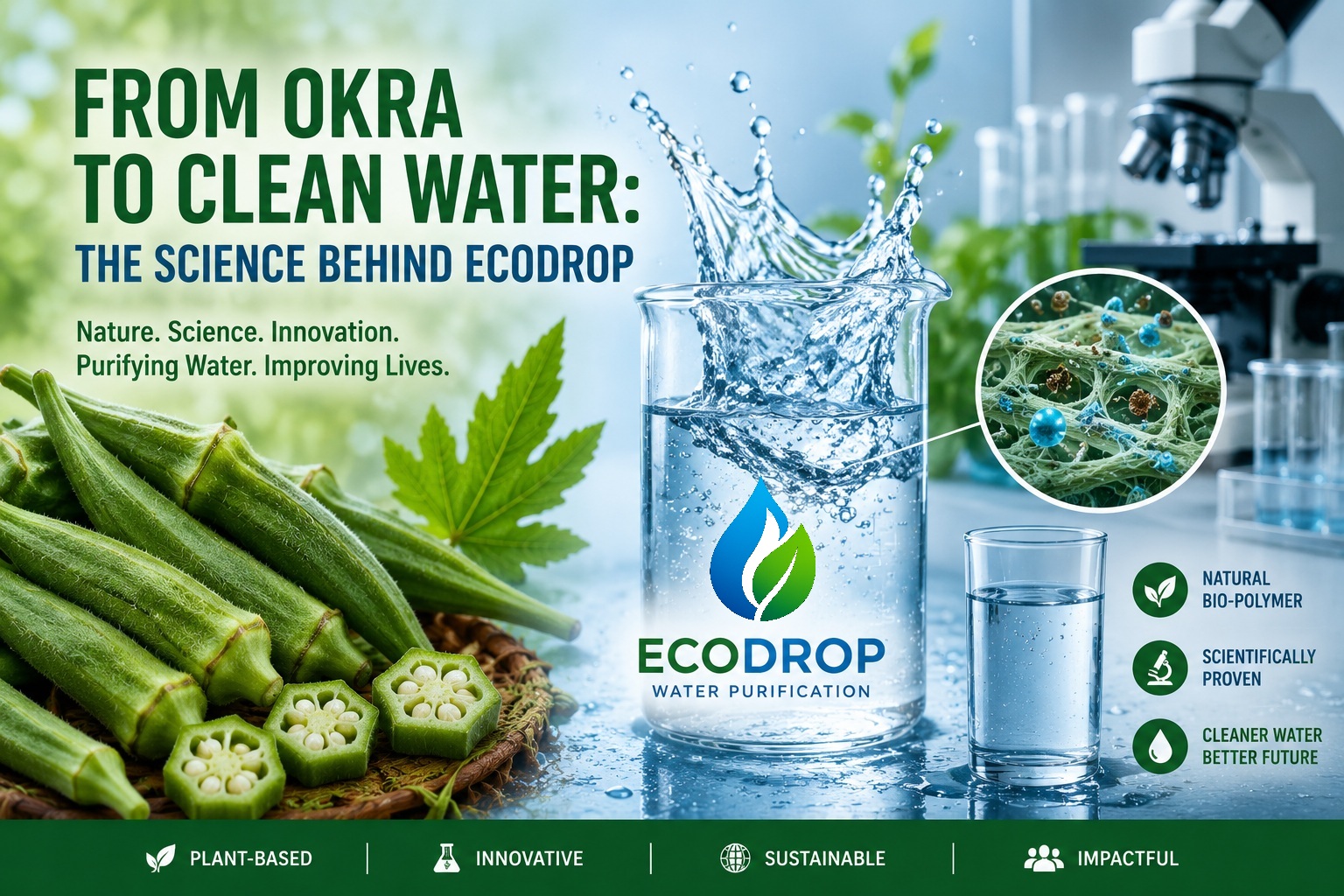
From Okra to Clean Water: The Science Behind EcoDrop
🌍 You’re reading Africa’s innovation network
EcoTech is a growing space for farmers, innovators, scientists, investors and contributors building practical sustainability solutions.
🌍 East Africa Okra Sourcing
EcoTech members can access participation opportunities linked to this article.
View Participation PathwayAround the world, access to safe drinking water remains one of the most pressing challenges for communities, particularly in rural or resource-constrained environments.
While large-scale municipal treatment systems can effectively purify water, they often require significant infrastructure, chemicals, and operational costs. In many regions, decentralized and low-cost solutions are urgently needed.
One promising area of research involves plant-derived polymers and natural mucilage, substances produced by plants that have remarkable binding and filtration properties.
EcoDrop was developed from this line of thinking.
Discovering Natural Water-Binding Properties
Many plants produce mucilage — a thick, gel-like substance composed of natural polysaccharides.
These compounds help plants retain moisture, protect tissues, and interact with their environment.
Interestingly, these same properties can also interact with suspended particles in water.
When introduced into untreated water, certain plant mucilages can help bind fine particles together, allowing them to aggregate and settle. This process is similar to coagulation and flocculation, which are fundamental steps in conventional water treatment.
Among the plants known for their strong mucilage properties is okra (Abelmoschus esculentus).
Why Okra?
Okra pods contain a natural mucilage that has long been recognized for its thick, viscous texture.
This mucilage is composed of complex carbohydrates that can form structured networks in water. Researchers have explored how these natural polymers may interact with suspended particles and impurities.
The idea behind EcoDrop was to investigate whether this natural material could be processed and stabilized into a practical purification medium.
Rather than relying on synthetic chemicals alone, the concept focuses on harnessing the binding characteristics of plant-based polymers.
Toward Practical Applications
Transforming a natural material into a usable purification product requires significant experimentation and engineering.
Several key questions must be addressed:
• How can the active compounds be extracted or processed?
• How can the material be stabilized for storage and transport?
• How can it be delivered in a convenient form for users?
• What treatment performance can be achieved under different water conditions?
EcoDrop represents an attempt to explore these questions through research, prototyping, and field experimentation.
While natural materials alone are not a universal solution for all water treatment challenges, they may play an important role in hybrid purification systems that combine biological materials with filtration and other treatment processes.
Decentralized Water Solutions
One of the motivations behind EcoDrop is the need for small-scale purification solutions.
In many parts of the world, communities rely on untreated or partially treated water sources.
Solutions that are:
• affordable
• portable
• simple to use
• environmentally compatible
could help improve water safety in situations where centralized treatment infrastructure is not available.
Plant-derived materials offer an intriguing possibility because they can potentially be sourced from agricultural systems and integrated into localized supply chains.
Research and Collaboration
Developing new environmental technologies requires collaboration across many fields.
EcoDrop is part of a broader exploration into natural materials, biomaterials, and sustainable purification methods.
Researchers, engineers, farmers, and innovators all contribute to this evolving field.
Platforms like EcoTech provide an opportunity to share insights, experiments, and lessons learned along the way.
By bringing together ideas from agriculture, chemistry, engineering, and environmental science, new solutions may emerge that combine nature-inspired materials with modern engineering.
Looking Ahead
The future of water purification will likely involve a combination of technologies.
Advanced filtration systems, biological treatments, and innovative materials may all play a role.
Natural polymers and plant-derived substances are only one piece of that puzzle — but they represent an exciting area of exploration.
EcoDrop is one example of how inspiration from the natural world can lead to new ideas for solving complex environmental challenges.
And in many cases, the next breakthrough begins not in a large industrial laboratory, but with a simple observation about how nature already works.
🚀 East Africa Okra Sourcing
EcoTech members can access participation opportunities linked to this article.
This pathway is linked directly to this published story. Browse EcoTech Opportunities to see this and other active participation pathways alongside CloudFeed opportunities.
Comments (0)
Join the Conversation
What do you think about this story? Share your view, a practical example, or a respectful challenge.
Comments are part of the EcoTech participation layer. Join from R49 once-off to participate, or log in if you already have an account.