How Can African Farmers Become More Visible — and More Bankable?
🌍 You’re reading Africa’s innovation network
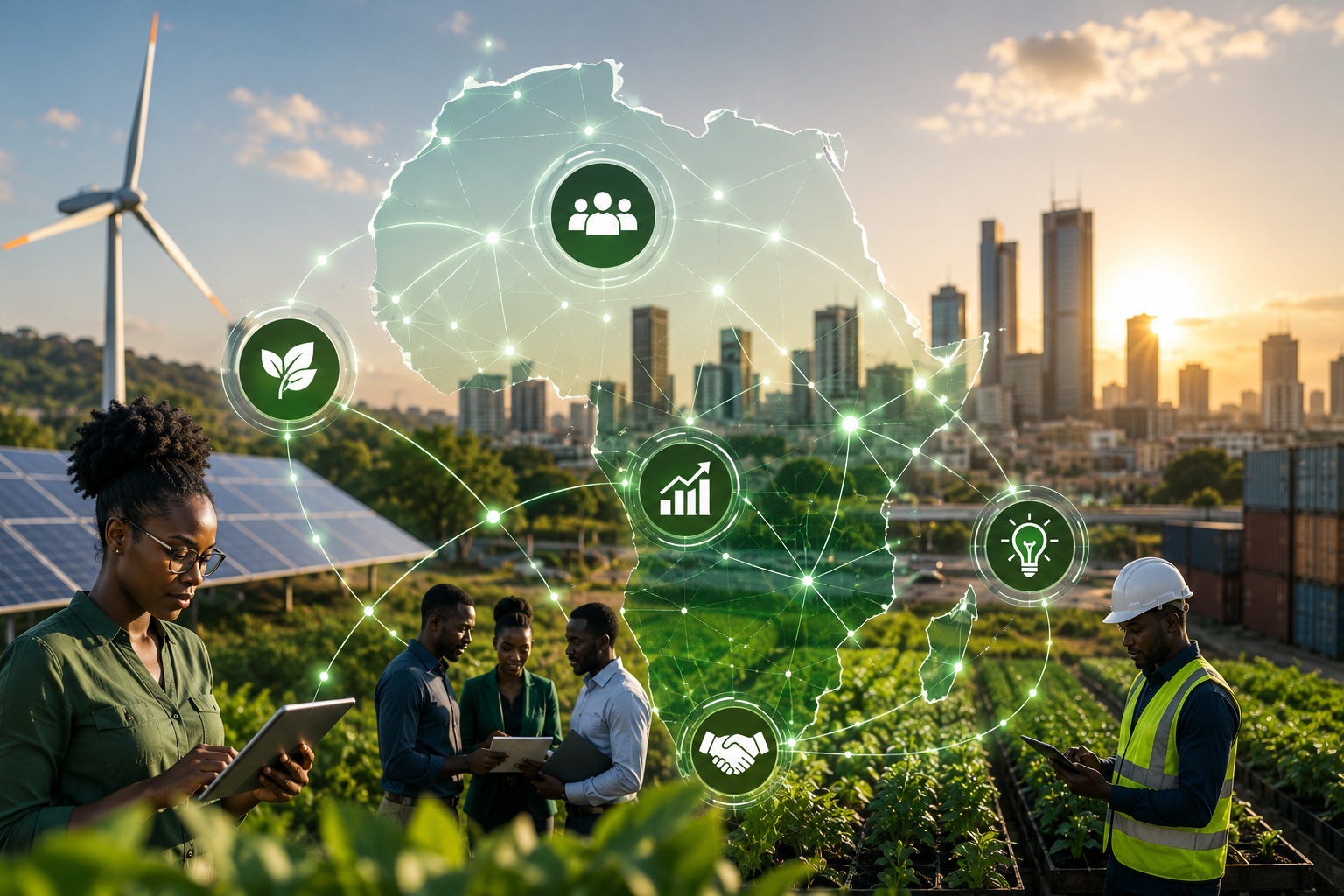
EcoTech is a growing space for farmers, innovators, scientists, investors and contributors building practical sustainability solutions.
🌍 Help Make African Agricultural Capability More Visible
EcoTech invites farmers, cooperatives, buyers, financial institutions, researchers, insurers and agricultural partners across Africa to identify the records, relationships and Areas of Activity that could make farming enterprises easier to understand, finance and connect to markets.
View Participation PathwayAcross Africa, millions of farmers produce food, support rural economies and sustain communities.
Yet many remain largely invisible to the financial systems that could help them grow.
The farmer may exist.
The land may exist.
The crop may exist.
The buyer may exist.
The production history may exist.
But if those pieces are not connected, documented and visible, the farmer can still appear difficult to finance.
That is one of the contradictions facing African agriculture.
The issue is not always that farmers are unproductive.
It is often that their economic activity is difficult for banks, investors, insurers, buyers and development institutions to see clearly.
And that raises a different question:
How can African farmers become more visible — and through that visibility, more bankable?
This is a continental issue
The challenge appears differently from country to country.
A maize farmer in Zambia faces different conditions from a horticulture producer in Kenya.
A rice farmer in Senegal operates differently from a cattle farmer in Botswana.
A cocoa producer in Ghana is different from a coffee farmer in Ethiopia.
A smallholder in Malawi may depend heavily on seasonal rainfall.
A commercial grower in South Africa may operate within a far more formal supply chain.
A farmer in Rwanda may work through a cooperative.
A producer in Nigeria may sell through several intermediaries before a product reaches its final market.
The crops differ.
The climate differs.
The scale differs.
The financial systems differ.
But the underlying problem is often similar:
economic activity exists without enough structured evidence around it.
Financial institutions see risk where farmers see normal farming
Traditional banking systems generally prefer predictable income.
Monthly salaries.
Regular deposits.
Formal employment.
Assets that can be valued.
Documented financial statements.
Agriculture does not always fit that model.
A farmer may spend money for months before receiving income.
Inputs are purchased first.
Land is prepared.
Crops are planted.
Water is supplied.
Labour is paid.
Pests are controlled.
Produce is harvested.
Transport is arranged.
Only then does money begin returning to the farm.
That may happen once or twice a year.
A farmer with irregular monthly income is therefore not necessarily an unreliable borrower.
The cash-flow cycle is simply agricultural.
Visibility changes the conversation
Consider two farmers producing the same crop on similar land.
The first farmer approaches a financial institution and says:
I farm vegetables and need money for irrigation.
The second farmer can demonstrate:
- verified identity;
- farm location;
- land or production arrangement;
- crops produced;
- historical planting cycles;
- previous harvest volumes;
- input purchases;
- irrigation requirements;
- buyer relationships;
- quotations;
- invoices;
- delivery history;
- payment records;
- expected production dates.
The farming activity may be almost identical.
But financially, the two farmers appear very different.
One presents a request.
The other presents an economic record.
That is the power of visibility.
Bankability begins before the loan application
Farmers should not have to become visible only when they need money.
Financial evidence should grow naturally as the farm operates.
Every quotation.
Every input purchase.
Every delivery.
Every invoice.
Every buyer.
Every contract.
Every production record.
Every certification.
Every insurance document.
Every payment.
Together they begin building a financial identity around the farm.
Over time, the farmer is no longer asking a lender to believe a story.
The activity begins showing its own history.
The buyer matters as much as the borrower
One of the strongest indicators of agricultural viability is not simply what a farmer can produce.
It is whether somebody intends to buy it.
That makes market relationships critically important.
If a farmer has a recognised off-taker, processor, retailer, cooperative, wholesaler or exporter, the financing conversation changes.
The lender can begin asking:
How much is expected?
When will it be delivered?
At what price?
Who pays?
Where does the payment flow?
Can repayment be linked to the transaction?
This is why value-chain finance can be powerful.
The farmer is no longer assessed entirely in isolation.
The surrounding economic relationship becomes part of the assessment.
Different African markets require different financing models
There will never be one agricultural finance product suitable for every African country.
Nor should there be.
The continent contains vastly different agricultural systems.
Some farmers operate commercially.
Others farm primarily for household and local markets.
Some produce export crops.
Some raise livestock.
Some operate under irrigation.
Others depend almost entirely on rainfall.
Some belong to organised cooperatives.
Others operate independently.
Financial products therefore need to reflect the activity.
That might mean:
Input-linked finance
Funding seed, fertiliser, irrigation, equipment or production inputs directly.
Value-chain finance
Financing structured around buyers, cooperatives, processors or aggregators.
Asset finance
Funding tractors, pumps, cold rooms, solar systems or processing equipment.
Seasonal credit
Repayment aligned to harvest rather than monthly salary cycles.
Guarantee-supported lending
Sharing risk between banks, development institutions and other partners.
Insurance-linked finance
Combining credit with protection against specific agricultural risks.
Working-capital finance
Helping established farmers bridge the period between production and buyer payment.
The important principle is that finance should respond to the economics of the farm.
Climate information increasingly matters
Across Africa, agricultural finance must also understand climate exposure.
Water availability.
Rainfall.
Drought.
Heat.
Flood risk.
Soil conditions.
Crop disease.
These factors directly affect production.
But climate risk should not simply become another reason to deny finance.
It should become part of how finance is designed.
A farmer with irrigation may carry a different risk profile from one entirely dependent on seasonal rainfall.
A farm with water storage may differ from one without it.
A diversified farming operation may differ from a single-crop operation.
Better information allows risk to be understood rather than simply feared.
Cooperatives and aggregators can help create visibility
Millions of African farmers may never individually maintain sophisticated financial systems.
They may not need to.
Cooperatives, farmer organisations, aggregators and value-chain partners can play an important role.
They can help capture:
production records,
deliveries,
input use,
farm locations,
buyer relationships,
training,
certifications,
and payment history.
This creates structured visibility without forcing every small farmer to operate like a large corporation.
Digital systems can reduce the distance between farmer and finance
Africa has already demonstrated how rapidly digital tools can reshape economic participation.
Mobile payments changed how people transact.
Digital identity is changing how people access services.
Online marketplaces are changing how businesses find customers.
Agricultural finance can benefit from the same transformation.
A farmer should increasingly be able to present a digital picture of the farming operation.
Not simply a social profile.
An economic profile.
The question should become:
What does this farm actually do?
Imagine a continental agricultural capability map
Now take the idea beyond individual finance.
Imagine being able to see agricultural capability across Africa by:
Country
then:
Industry
then:
Area of Activity
then:
Verified Participant
For example:
Agriculture
> Maize Production
> Poultry Farming
> Cattle Production
> Horticulture
> Aquaculture
> Irrigation Services
> Seed Production
> Agro-processing
> Cold Chain
> Agricultural Equipment
Then imagine seeing where those capabilities exist.
Not only at national level.
Across regions.
A buyer looking for horticultural producers could identify them.
An irrigation supplier could identify farming clusters.
A bank could better understand geographic agricultural activity.
An investor could see missing processing capacity.
A researcher could identify production areas.
A cooperative could find nearby service providers.
That is when agricultural visibility begins producing more than finance.
It begins producing connection.
Visibility can expose investment gaps
A better agricultural map would also reveal what is missing.
Perhaps a farming region produces large volumes of tomatoes but lacks processing.
Perhaps a cattle-producing area lacks adequate cold storage.
Perhaps irrigation potential exists but financing is unavailable.
Perhaps farmers have buyers but insufficient transport.
Perhaps a country imports equipment that could be manufactured regionally.
These are not only agricultural problems.
They are investment opportunities.
And they become easier to identify once economic activity is visible.
The farmer becomes part of a larger economic system
Agriculture should not be seen as the farmer standing alone in a field.
Every farm connects to other industries.
Seed.
Water.
Energy.
Transport.
Packaging.
Manufacturing.
Processing.
Retail.
Technology.
Finance.
Research.
Insurance.
Education.
When farmers become visible, these surrounding industries become easier to connect too.
That strengthens entire value chains.
Africa can build its own evidence of agricultural activity
One of the most important opportunities is for Africa to begin building stronger records of its own productive activity.
Not only national agricultural statistics.
Actual economic relationships.
Who is producing?
What are they producing?
Where?
At what scale?
Who buys from them?
What services do they need?
What equipment do they use?
What financing gaps exist?
Which businesses support them?
That information is valuable.
And the farmer should benefit from helping create it.
The objective is not surveillance
Visibility must not mean exposing private financial information publicly.
Nor should farmers lose control of their data.
There is an important distinction between being visible economically and being exposed personally.
A farmer should be able to demonstrate capability while sensitive financial and identity information remains protected.
Banks may need access to certain information.
Buyers may need different information.
The public may only need to see the farmer's business capability.
Good systems must respect those boundaries.
From invisible farmer to recognised economic participant
Perhaps the biggest shift is conceptual.
A farmer should not appear in the financial system only when asking for assistance.
The farmer should already exist as an economic participant.
With history.
Relationships.
Documents.
Production.
Markets.
Capability.
Once that happens, financing becomes one possible service around an existing economic identity.
That is very different from trying to create an identity at the point of application.
The question for Africa
Across the continent, agricultural finance will continue evolving.
Commercial banks will participate.
Development institutions will participate.
Fintech companies will participate.
Insurers will participate.
Investors will participate.
Governments and farmer organisations will participate.
But the fundamental problem remains:
finance cannot easily support economic activity it cannot clearly see.
So perhaps the next agricultural finance revolution in Africa will not begin with another loan product.
It will begin by making agricultural capability more visible.
Visible to markets.
Visible to buyers.
Visible to financiers.
Visible to investors.
Visible across borders.
And visible to Africa itself.
Because when the farmer's economic activity becomes easier to understand, document and connect, bankability stops being only a judgement made by a financial institution.
It begins becoming the natural result of an economic history that can be demonstrated.
And across Africa's farming communities, much of that history already exists.
Our challenge is to make it visible.
🚀 Help Make African Agricultural Capability More Visible
EcoTech invites farmers, cooperatives, buyers, financial institutions, researchers, insurers and agricultural partners across Africa to identify the records, relationships and Areas of Activity that could make farming enterprises easier to understand, finance and connect to markets.
This pathway is linked directly to this published story. Browse EcoTech Opportunities to see this and other active participation pathways alongside CloudFeed opportunities.


Comments (0)
Join the Conversation
What do you think about this story? Share your view, a practical example, or a respectful challenge.
Comments are part of the EcoTech participation layer. Join from R49 once-off to participate, or log in if you already have an account.