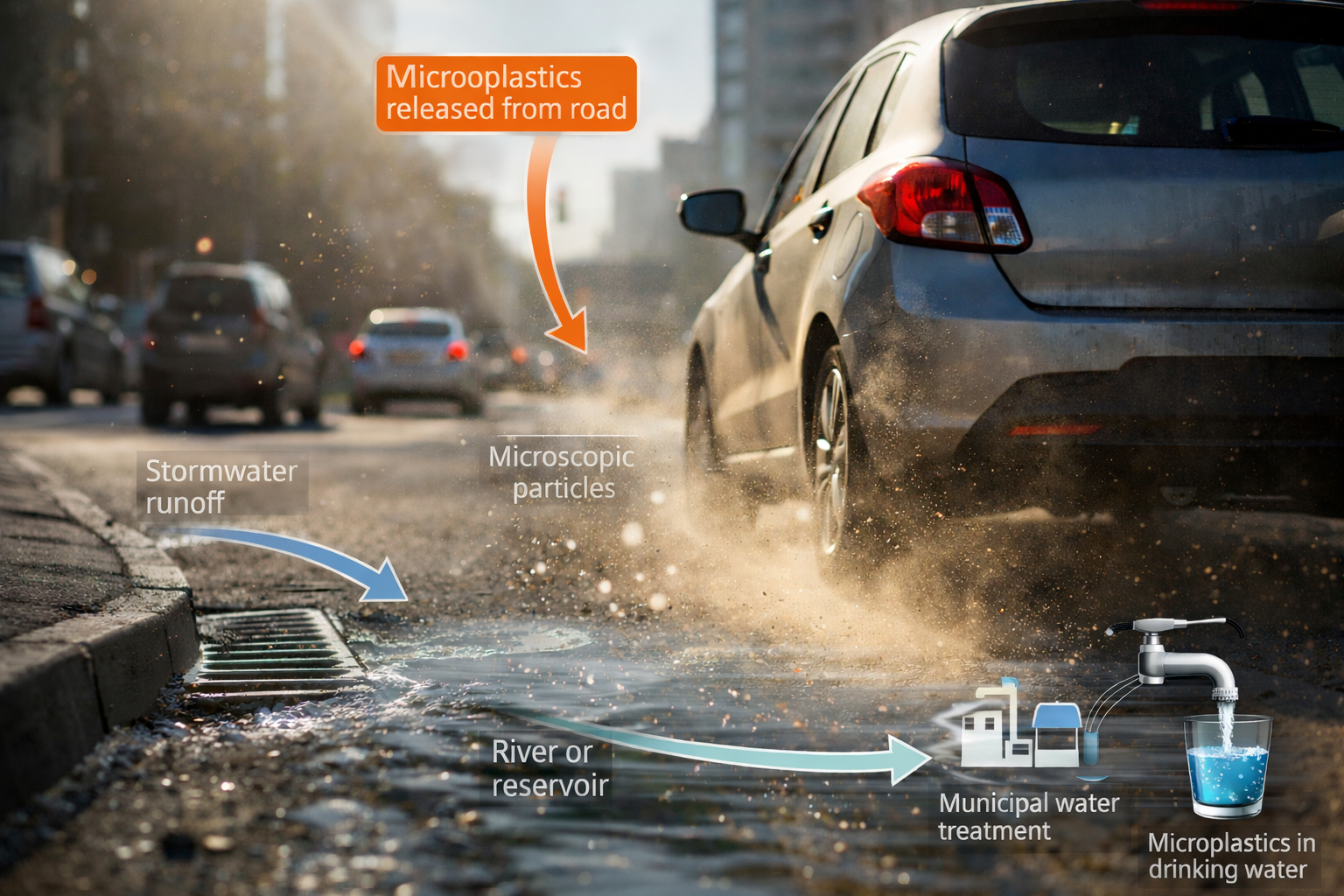
Invisible Pollution: How Microplastics from Transport Are Entering Our Drinking Water!
🌍 You’re reading Africa’s innovation network
EcoTech is a growing space for farmers, innovators, scientists, investors and contributors building practical sustainability solutions.
The Pollution You Cannot See across Africa and the World
Unlike visible waste, this pollution does not accumulate in landfills or float in obvious patches. Instead, it breaks down into microscopic particles that travel silently through air, soil, and ultimately — into our drinking water.
Where Do These Microplastics Come From?
The primary sources are not what most people expect.
Tyre Wear
Modern vehicle tyres are made from synthetic rubber compounds containing plastic polymers. As tyres wear down on road surfaces, they release fine particles — often referred to as tyre wear particles (TWPs).
These particles:
- Are extremely small (often less than 100 microns)
- Are easily carried by wind and rain
- Contain complex chemical additives
Brake Dust
Braking systems also release particulate matter, including metallic and synthetic compounds that can behave similarly to microplastics in the environment.
Road Surface Degradation
Road markings, asphalt binders, and synthetic materials used in infrastructure also contribute to microplastic generation over time.
How Do They Enter Our Water?
Once released, these particles follow a predictable but dangerous pathway:
- Rainfall washes particles off roads
- Stormwater systems carry them into rivers and dams
- Sedimentation occurs in water bodies
- Water treatment systems struggle to fully remove them
This means that even treated municipal water can still contain trace levels of microplastics.
Microplastics are not just inert particles. Research increasingly shows they can:
- Carry toxic chemicals and heavy metals
- Act as carriers for bacteria and pathogens
- Enter the human body through ingestion
- Accumulate over time
While long-term health impacts are still being studied, the global scientific community agrees on one point:
Microplastic contamination is a growing environmental and public health concern.
The Challenge with Current Treatment Systems
Traditional water treatment methods are designed to remove:
- Sediment
- Bacteria
- Large particulates
However, microplastics are often too small and too chemically complex to be completely removed using standard processes.
This creates a critical gap:
Water can appear clean, but still contain invisible contaminants.
A Nature-Based Opportunity
Interestingly, nature may already provide part of the solution.
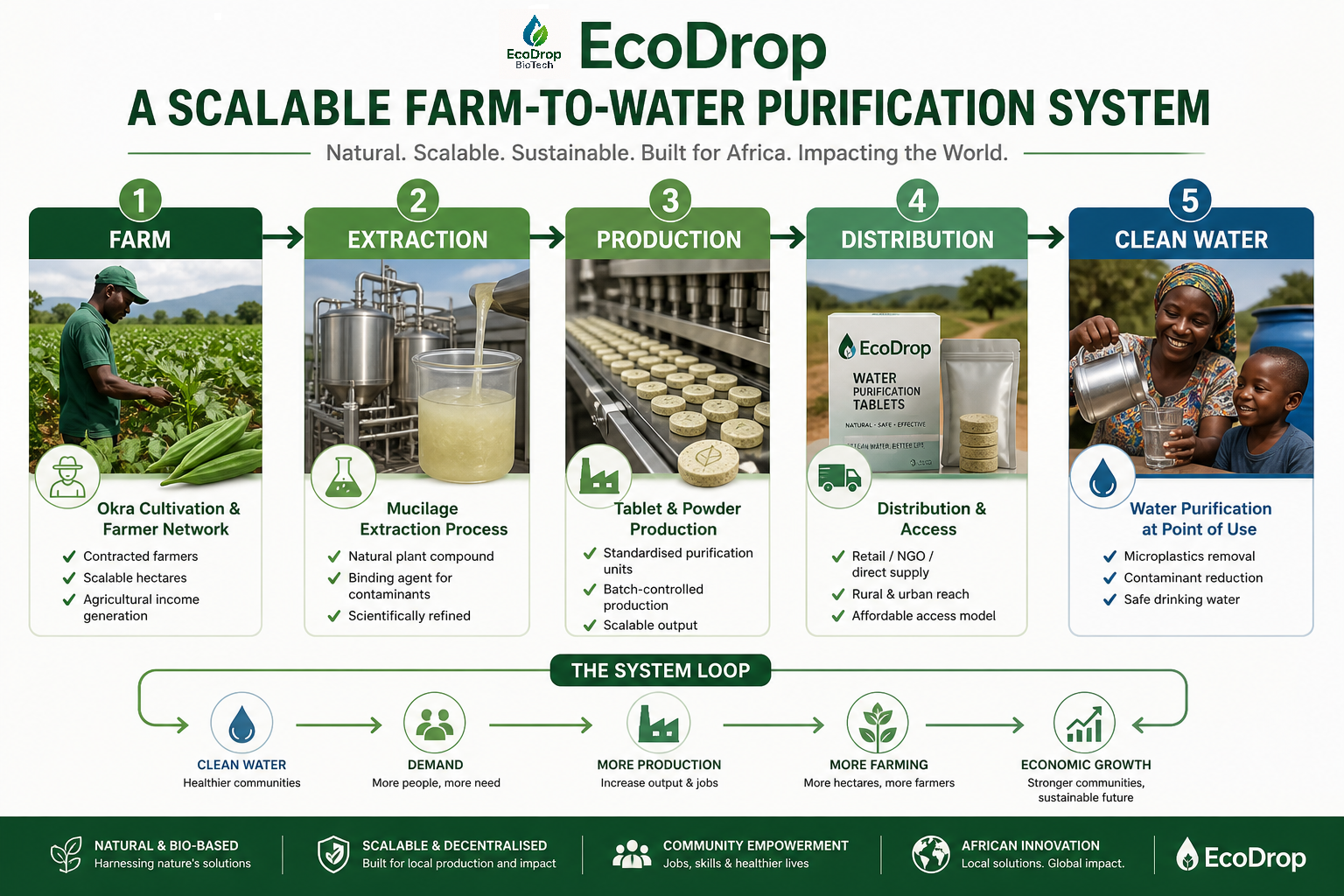
Certain plant-based compounds, particularly natural mucilage found in plants like okra — have shown the ability to bind with suspended particles in water, including microplastics and organic matter.
This process works through:
- Flocculation (binding particles together)
- Aggregation (forming larger removable clusters)
- Settling or filtration
This opens the door to:
- Low-cost purification systems
- Decentralised water treatment
- Scalable solutions for both households and bulk water systems
The Road Ahead
The reality is clear: modern transport systems are unintentionally introducing microplastics into the environment at scale.
But equally important is this:
The solution does not have to be complex, expensive, or chemical-heavy.
By combining:
- Scientific validation
- Natural materials
- Scalable production systems
…it becomes possible to rethink how we approach water purification, especially in regions where access to advanced infrastructure is limited.
Final Thought
Invisible pollution is one of the most difficult challenges of our time, not because it is unsolvable, but because it is easy to ignore.
Microplastics from transport are now part of our environment.
The question is no longer whether they exist, but how we respond to them.
EcoTech | Powered by EcoDrop BioTech (Pty) Ltd
Real-World Innovation for Water, Agriculture, and Sustainability




Comments (0)
Join the Conversation
What do you think about this story? Share your view, a practical example, or a respectful challenge.
Comments are part of the EcoTech participation layer. Join from R49 once-off to participate, or log in if you already have an account.