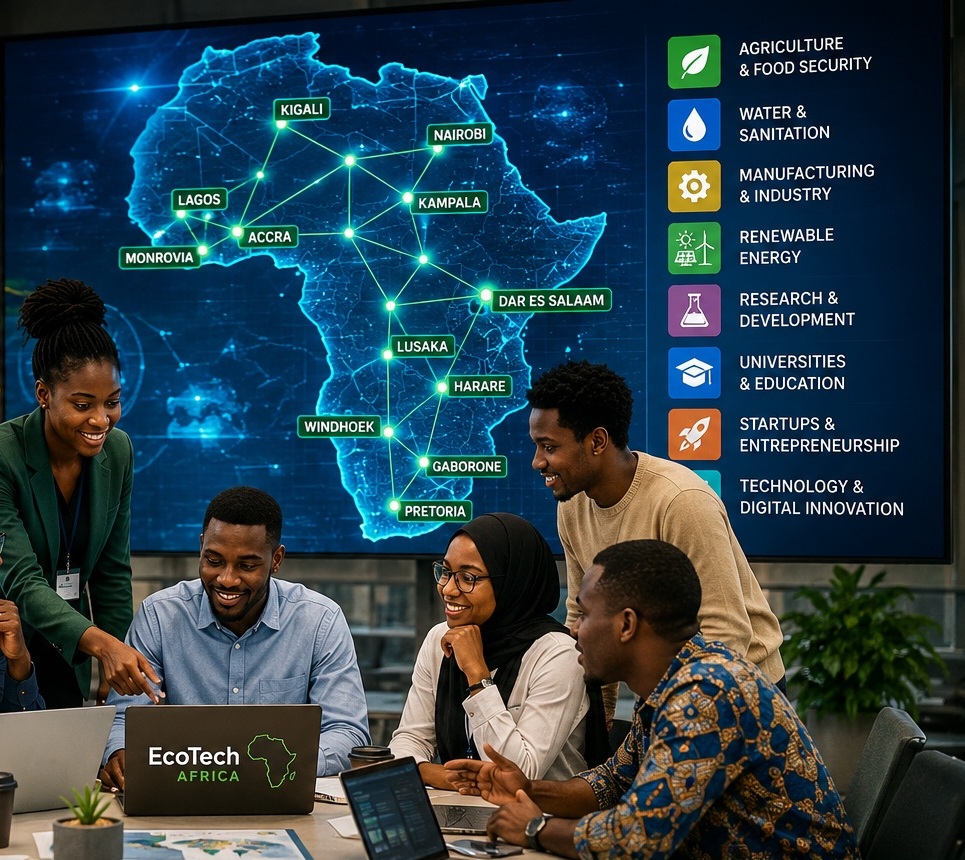
The Rise of African Startup Ecosystems
🌍 You’re reading Africa’s innovation network
EcoTech is a growing space for farmers, innovators, scientists, investors and contributors building practical sustainability solutions.
🌍 African Startup Ecosystem Collaboration Network
EcoTech Africa invites startup founders, innovation hubs, incubators, accelerators, universities, researchers and entrepreneurs to share opportunities, programmes, partnerships and initiatives that strengthen Africa's growing startup ecosystem.
View Participation PathwayAcross Africa, a new generation of entrepreneurs is building businesses, developing technologies and creating solutions that address some of the continent's most pressing challenges.
From financial technology and agriculture to healthcare, education and renewable energy, startups are becoming an increasingly important part of Africa's economic future.
What makes this transformation particularly significant is that startups rarely succeed alone.
They thrive within ecosystems.
What Is a Startup Ecosystem?
A startup ecosystem is a network of people, organisations and resources that support entrepreneurship and innovation.
This often includes:
- Entrepreneurs
- Investors
- Universities
- Researchers
- Innovation hubs
- Incubators
- Accelerators
- Industry partners
- Government support programmes
- Community organisations
When these groups work together, they create environments where ideas can develop into sustainable businesses.
Why Startup Ecosystems Matter
Many of Africa's challenges require new approaches.
Issues such as:
- Financial inclusion
- Water security
- Food production
- Healthcare access
- Skills development
- Energy availability
- Digital connectivity
create opportunities for entrepreneurs to develop innovative solutions.
Startup ecosystems provide the support structures needed to transform ideas into action.
The Growth of Innovation Hubs
Innovation hubs are appearing across the continent.
These spaces provide:
- Collaboration opportunities
- Mentorship
- Training
- Networking
- Technical support
- Access to investors
For many young entrepreneurs, innovation hubs serve as gateways into the startup ecosystem.
They also help connect startups with researchers, universities and industry experts.
Universities as Innovation Partners
Universities are becoming increasingly important contributors to startup ecosystems.
Research institutions generate knowledge.
Students generate ideas.
Entrepreneurs generate solutions.
When these groups collaborate, innovation becomes more practical and impactful. Universities can help bridge the gap between research and commercialization, creating opportunities for new products, technologies and businesses.
Investment and Entrepreneurship
Access to funding remains one of the biggest challenges facing startups. However, investment activity across Africa continues to grow.
Investors are increasingly interested in:
- Technology
- Agriculture
- Renewable Energy
- Healthcare
- Manufacturing
- Sustainability
- Artificial Intelligence
As startup ecosystems mature, they become more attractive to investors seeking long-term growth opportunities.
Building African Solutions
One of the most exciting aspects of Africa's startup ecosystems is their focus on solving local challenges.
Many successful African startups are built around questions such as:
- How can we improve access to clean water?
- How can farmers increase productivity?
- How can healthcare become more accessible?
- How can technology improve education?
By focusing on real-world challenges, entrepreneurs are creating solutions that generate both social and economic impact.
Collaboration Creates Opportunity
The strongest startup ecosystems are built on collaboration.
Entrepreneurs need researchers.
Researchers need industry partners.
Investors need opportunities.
Communities need solutions.
The more connected these groups become, the stronger the innovation ecosystem becomes.
This is why partnerships, networking and knowledge sharing are increasingly important.
The Future of African Innovation
Africa possesses many of the ingredients required for innovation:
- A young population
- Expanding digital connectivity
- Growing entrepreneurial activity
- Increasing research capacity
- Emerging innovation hubs
- Expanding investment interest
Together, these factors create an environment where startup ecosystems can continue to grow.
The future of African innovation will depend not only on individual entrepreneurs but also on the strength of the ecosystems that support them.
When entrepreneurs, universities, researchers, investors and communities work together, innovation becomes more than an idea.
It becomes a force for development.
The rise of African startup ecosystems is not simply about creating businesses.
It is about creating opportunities.
Creating solutions.
And building a more innovative future for the continent.
Participate. Innovate. Impact.
🚀 African Startup Ecosystem Collaboration Network
EcoTech Africa invites startup founders, innovation hubs, incubators, accelerators, universities, researchers and entrepreneurs to share opportunities, programmes, partnerships and initiatives that strengthen Africa's growing startup ecosystem.
This pathway is linked directly to this published story. Browse EcoTech Opportunities to see this and other active participation pathways alongside CloudFeed opportunities.




Comments (1)
Join the Conversation
What do you think about this story? Share your view, a practical example, or a respectful challenge.
Comments are part of the EcoTech participation layer. Join from R49 once-off to participate, or log in if you already have an account.
If we can't identify and connect these innovations, how can we expect investors, partners and neighbouring countries to discover them?
Africa's next unicorn may already exist—we simply haven't built enough bridges for the continent to see it.