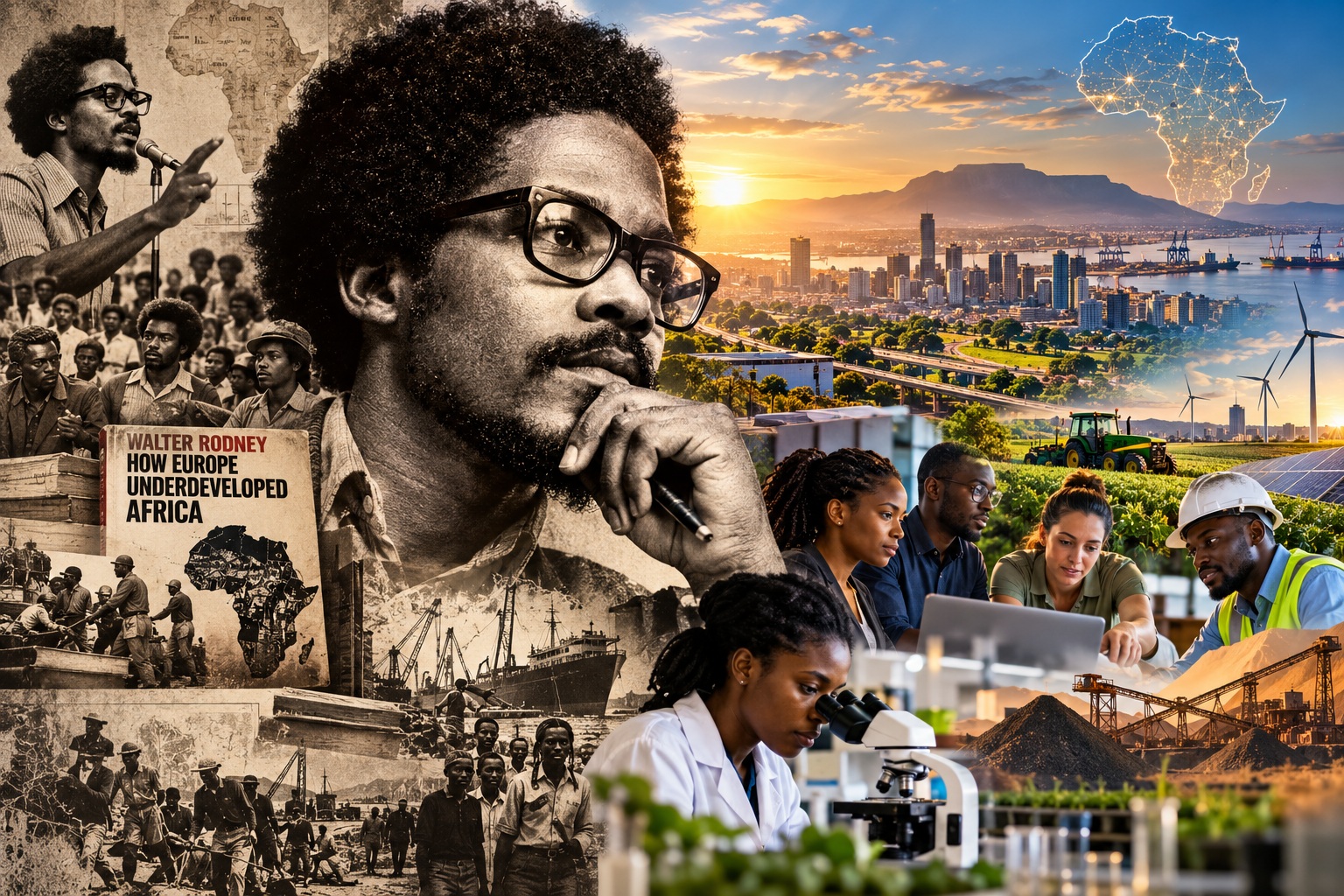
Walter Rodney: What Has Changed, What Has Not; and Why His Work Still Matters
🌍 You’re reading Africa’s innovation network
EcoTech is a growing space for farmers, innovators, scientists, investors and contributors building practical sustainability solutions.
🌍 From Rodney’s Questions to African Participation
Africa Upfront invites researchers, businesses, institutions and participants across the continent and diaspora to share practical examples of African-led initiatives that strengthen local production, knowledge, enterprise, value chains and economic participation.
View Participation PathwayContent Scope: Continental / Pan-African
Why this matters to Africa:
Walter Rodney’s work remains influential because many of the questions he raised about production, ownership, labour, trade, knowledge and economic power are still relevant. Africa has changed dramatically since Rodney wrote, but the deeper question remains: how much of the value created from African people, resources and knowledge is retained, owned and directed from the continent itself?
Walter Rodney: What Has Changed, What Has Not — and Why His Work Still Matters
Walter Rodney’s name still appears wherever serious discussions about Africa, colonialism, development and economic power take place.
That alone is remarkable.
He died in 1980 at only 38 years old.
Yet his books continue to be republished.
His lectures are preserved.
His archives are studied.
His arguments are debated.
And new generations continue to encounter How Europe Underdeveloped Africa as if it were written to provoke questions about the present.
That does not mean every conclusion Rodney reached should be accepted without challenge.
It means the questions he raised have proved difficult to bury.
A life shaped by history, scholarship and participation
Walter Rodney was born in Georgetown, Guyana, in 1942.
He studied history and became deeply involved in examining colonialism, slavery, labour, African history and the economic relationships created through European expansion.
During the 1960s, his academic work brought him into close contact with Africa.
He taught at the University of Dar es Salaam in Tanzania, at a time when the university had become an important intellectual centre for debates around African liberation, socialism, dependency and post-colonial development.
Rodney was not interested only in academic discussion.
He believed knowledge had to connect to ordinary people and real political and economic conditions.
That approach became especially visible during his time in Jamaica, where he engaged directly with working-class and Rastafarian communities.
In 1968, after attending the Black Writers’ Conference in Montreal, Rodney was prevented from re-entering Jamaica.
The decision triggered major protests that later became known as the Rodney Riots.
By then, Rodney had already become more than a historian.
He had become a scholar whose work constantly moved between research, public education and political participation.
1972: How Europe Underdeveloped Africa
In 1972, Rodney published the work for which he became most widely known:
How Europe Underdeveloped Africa.
The argument was broader than simply saying colonialism damaged Africa.
Rodney argued that European development and African underdevelopment were historically connected.
Africa was not simply “left behind.”
Its labour, resources, trade structures and political institutions were deliberately reorganised within a global economic system that benefited Europe far more than Africa.
That was the uncomfortable part of Rodney’s analysis.
He was asking people to stop seeing development and underdevelopment as separate stories.
One society could become richer partly because another had been reorganised around supplying labour, raw materials and markets.
That relationship was central to his thinking.
Political independence changed Africa — but not everything
Africa today is not the Africa Rodney was describing in the early 1970s.
That distinction matters.
Most African countries are politically independent.
African governments control national institutions.
African-owned banks, telecommunications companies, manufacturers, universities, technology firms and financial institutions operate across the continent.
AfCFTA is creating a continental trade framework.
African entrepreneurs operate internationally.
Regional institutions have grown stronger.
African professionals occupy senior positions across major industries.
That is real change.
Rodney’s work should not be used to pretend that nothing has changed.
But the more difficult question is whether the underlying economic relationships have changed enough.
Raw materials still leave. Value still often returns
Across many African economies, raw materials remain central.
Minerals.
Agricultural commodities.
Oil.
Gas.
Timber.
Primary products.
The continent produces enormous economic value.
But processing, financing, intellectual property, branding, manufacturing, technology and global distribution often remain concentrated elsewhere.
A mineral may be extracted in Africa.
Processed elsewhere.
Financed elsewhere.
Insured elsewhere.
Engineered elsewhere.
Branded elsewhere.
And eventually sold back into African markets as part of a finished product.
The resource originated here.
The largest share of the value may not remain here.
That does not mean the structure is identical to the one Rodney described.
It does mean his underlying question still matters:
Who participates in the full value created from African resources?
Rodney’s argument was really about relationships
One of the reasons Rodney remains relevant is that his work was not only about individual countries.
It was about relationships.
Between producers and owners.
Between colonies and imperial powers.
Between labour and capital.
Between resource-producing economies and industrial economies.
Between those who created value and those who controlled the systems around that value.
That allows us to ask a modern version of the same question:
If Africa owns the resource, but somebody else controls the processing, finance, technology, data, market access and commercial relationship, how much of the structure has really changed?That question can now be applied far beyond mining.
It applies to agriculture.
Technology.
Artificial intelligence.
Digital infrastructure.
Payments.
Energy.
Publishing.
Research.
Data.
Knowledge.
The economic system has changed.
But relationships still determine who captures value.
The timeline did not stop in 1980
Rodney returned to Guyana and became increasingly involved in political activity there.
On 13 June 1980, he was killed when a bomb exploded in Georgetown.
Decades later, the circumstances surrounding his death continued to be investigated and debated.
His death ended his life.
It did not end the work.
His family and supporters continued preserving his writings, speeches, correspondence and scholarship.
In 2003, the Rodney family donated a major collection of his papers to the Atlanta University Center.
The Walter Rodney Foundation was established in 2006.
Since then, the Foundation has worked to preserve his scholarship, support education, make archival material accessible, engage younger generations and keep his intellectual legacy alive.
Major works have been republished.
Previously unavailable lectures and writings have been assembled.
Students and researchers continue to study his work.
That raises an interesting question of its own.
Why did the Foundation keep his legacy alive?
The obvious answer is preservation.
Rodney was an important historian.
His work influenced generations of scholars and activists.
His papers have historical value.
But preservation alone does not explain why his work continues to attract attention.
The Walter Rodney Foundation has repeatedly emphasised the use of historical analysis, education and scholar-activism to support social change and youth development.
That suggests something deeper.
The objective was not simply to remember the man.
It was to preserve a way of questioning the world.
Who produces?
Who owns?
Who benefits?
Who controls?
Who writes the history?
Who determines what counts as development?
Who participates?
Those questions remained relevant long after Rodney died.
And perhaps that is why the legacy survived.
A legacy survives when the questions survive
A legacy becomes most powerful when the conditions that produced the original questions have not entirely disappeared.
Rodney wrote about a world in which African economies had been shaped around extraction.
Today, Africa is trying to build regional value chains.
Rodney wrote about history being written largely through the perspective of colonial power.
Today, Africa faces a new version of that problem through data and artificial intelligence:
Who builds the knowledge environments from which intelligence about Africa is produced?
Rodney wrote about ordinary working people being central to historical change.
Today, much of Africa’s economic life still happens through small businesses, informal workers, farmers, traders and local enterprises that remain poorly represented in formal economic systems.
Rodney argued that political independence without deeper economic transformation was incomplete.
Today, sovereignty increasingly includes control over processing, payments, technology, energy, data, knowledge and commercial relationships.
The context has changed.
The question of participation has not.
Rodney should be tested, not worshipped
There is another point worth making.
Serious scholarship should not become scripture.
Africa does not honour Walter Rodney by agreeing with every conclusion he reached.
Some of his political and economic arguments can be challenged.
Historical conditions have changed.
New industries now exist.
Technology has transformed production.
African governments and businesses have agency that cannot simply be explained through colonial history.
The world Rodney studied is not identical to the world Africans live in today.
But that does not make the work irrelevant.
It makes it testable.
The useful question is not:
Was Rodney right about everything?
It is:
Which of the structures he identified still exist, which have changed, and what new structures have replaced them?
That is how serious intellectual work remains alive.
From diagnosis to participation
There is one danger in reading Rodney badly.
It is possible to become very good at explaining why Africa was underdeveloped without becoming any better at changing what exists now.
Analysis matters.
History matters.
Understanding exploitation matters.
But diagnosis cannot become a permanent substitute for participation.
Africa now needs people who can build.
People who can manufacture.
People who can organise.
People who can farm.
People who can process.
People who can finance.
People who can create technology.
People who can publish knowledge.
People who can connect businesses.
People who can build institutions capable of surviving beyond one generation.
The argument must eventually move from:
What happened to Africa?
to:
What are Africans building now?
The next argument cannot only be spoken from outside Africa
There is another lesson worth carrying forward from Rodney.
He did not treat Africa as an abstract subject to be discussed comfortably from a distance.
His work repeatedly brought history back to ordinary people, production, political organisation and participation.
That matters today.
Africa has no shortage of commentary about what Africa should do.
There are conferences.
Reports.
Panels.
Podcasts.
Speeches.
International institutions.
Consultants.
Influencers.
And increasingly, powerful African voices based in Europe, North America and elsewhere who speak passionately about the continent.
Those voices can contribute knowledge, capital, networks and experience.
But ultimately, Africa cannot be developed by commentary alone.
At some point, participation has to happen here.
Businesses have to be built here.
Relationships have to be formed here.
Farmers have to produce here.
Researchers have to work here.
Young people have to create opportunity here.
African institutions have to strengthen here.
And African people have to participate in initiatives designed, operated and sustained from the continent itself.
There is an important distinction between speaking for Africa and building with Africans.
A person can accumulate a large audience explaining Africa from London, New York, Paris or Washington.
They may make valid arguments.
They may identify genuine injustice.
They may influence global opinion.
But a continent cannot transform primarily through people describing its problems from places where the consequences of those problems are not lived every day.
The difficult work happens closer to the ground.
It happens when an entrepreneur has to make payroll.
When a farmer has to find a market.
When a business has to cross a border.
When a community has to organise around a real problem.
When an African institution has to build something that works with the resources it actually has.
When people decide that participation is more useful than permanent commentary.
This does not mean Africa should turn away from its diaspora.
Quite the opposite.
The diaspora can be one of Africa’s greatest sources of knowledge, relationships, investment and global reach.
But the relationship should increasingly move from:
speaking about Africa
to
participating with Africa.
And participation must strengthen initiatives that are actually rooted on the continent.
Perhaps this is the modern Rodney question
Rodney’s work asked how Africa became underdeveloped.
Our generation has the responsibility to ask what happens next.
Do not only explain the structure.
Enter the work of changing it.
Do not only describe African underdevelopment.
Build African production.
Do not only criticise dependency.
Create relationships that reduce it.
Do not only celebrate African potential.
Participate in turning that potential into economic activity.
Do not only demand African ownership.
Build institutions capable of holding that ownership responsibly.
Do not only call for continental integration.
Participate in the systems that make integration useful to ordinary people and businesses.
History explains how we arrived here.
It cannot do the work for us.
EcoTech Insight
Walter Rodney’s lasting relevance lies not only in his diagnosis of colonialism, but in the questions he asked about participation, ownership, production and power.
For EcoTech, those questions lead naturally to the present.
A continent becomes more economically independent when its people can establish trusted identities, build enterprises, form relationships, create and preserve knowledge, discover opportunity and participate in value chains that are rooted in Africa.
The answer to dependency is not isolation.
It is stronger African participation.
And participation must become something that happens through real people, businesses and institutions operating from the continent — not only through commentary about what Africa should become.
Conclusion
Walter Rodney died at 38.
More than four decades later, his books are still being republished, his lectures preserved, his archives studied and his ideas argued over.
Perhaps that is the real measure of a legacy.
Not whether every generation agrees with every conclusion.
But whether the questions remain difficult to ignore.
And perhaps the question for this generation is no longer only:
Why was Africa underdeveloped?
It is also:
What are we prepared to build, participate in and sustain from Africa now?
🚀 From Rodney’s Questions to African Participation
Africa Upfront invites researchers, businesses, institutions and participants across the continent and diaspora to share practical examples of African-led initiatives that strengthen local production, knowledge, enterprise, value chains and economic participation.
This pathway is linked directly to this published story. Browse EcoTech Opportunities to see this and other active participation pathways alongside CloudFeed opportunities.


Comments (0)
Join the Conversation
What do you think about this story? Share your view, a practical example, or a respectful challenge.
Comments are part of the EcoTech participation layer. Join from R49 once-off to participate, or log in if you already have an account.