
Africa's Mineral Wealth: Who Controls the Value Chain?
🌍 You’re reading Africa’s innovation network
EcoTech is a growing space for farmers, innovators, scientists, investors and contributors building practical sustainability solutions.
🌍 Building African Mineral Value Chains — Industry Collaboration
An invitation to African mining suppliers, manufacturers, processors, logistics providers, researchers and industry professionals to explore opportunities for collaboration across mineral value chains. The focus is on African production, local procurement, technical capabilities and regional industrial development. This is an invitation to connect and explore opportunities, not an advertised tender or confirmed project.
View Participation PathwayAfrica in the Making — From Resources to Participation | Part 2
Africa's mineral wealth is attracting renewed international attention. Governments, mining companies, investors and technology firms are positioning themselves around the continent's copper, cobalt, platinum, lithium, graphite and rare earth deposits.
Yet beneath the growing competition lies a question that deserves greater attention: How much of the economic value generated from Africa's minerals will remain in Africa?
Recent developments across Mali, Malawi, Zimbabwe and the Lobito Corridor, together with Australia's experience in rare earth processing, reveal that control over mineral wealth extends far beyond ownership of the land beneath which it lies.
It involves geological knowledge, mining rights, processing technology, infrastructure, commercial agreements and the ability to participate in international markets.
Africa's development challenge is therefore not simply to extract more minerals. It is to strengthen its position throughout the value chain.
The value of knowing what lies beneath
On 28 October, Russia's state-owned geological company Rosgeologiya announced agreements with Mali to produce geological maps covering more than half the country's territory and establish a digital system for managing mineral information, licensing and regulatory oversight.
The agreement illustrates how geological information has become a strategic economic resource.
Before minerals can be extracted, someone must identify their location, determine their quality, estimate their commercial potential and establish how they can be developed.
That information influences investment decisions, mining licences, infrastructure planning and future negotiations.
Foreign expertise can contribute significantly to these activities, particularly where African institutions require additional technical capacity.
However, governments must retain effective authority over their geological records, including access, security, ownership rights and decisions concerning their commercial use.
The question is not whether international partners should assist Africa in discovering its resources.
The question is whether African institutions will possess the information and capabilities needed to negotiate from a position of knowledge.
Mining billions, but retaining how much?
Malawi provides another important perspective.
A World Bank minerals roadmap estimates that the country's mineral exports could exceed $30 billion cumulatively between 2026 and 2040 under its development scenarios.
The opportunities include uranium, graphite, rutile and rare earths.
But export value does not represent the amount of money retained by the country.
Capital investments, operating expenses, imported equipment, debt repayments and returns to international investors all affect how much economic value remains available domestically.
An analysis published by CNBC Africa on 26 October argues that Malawi's future mineral wealth will be determined as much by commercial negotiations and institutional capacity as by the deposits themselves.
Electricity availability, railway access, technical skills, mineral processing requirements and transparent fiscal arrangements will influence the eventual outcome.
This distinction matters across Africa.
A mine can generate substantial export revenue while contributing a much smaller amount to domestic public finances.
Equally, a mineral project can create lasting value through employment, local procurement, infrastructure development and skills transfer that cannot be measured through royalties alone.
For African governments, success must therefore be assessed through the wider economic contribution of mining, not simply the value of minerals leaving their borders.
Processing changes the economics
Australia's Lynas Rare Earths demonstrates another dimension of the value chain.
On 29 October, the company reported a 55% increase in quarterly revenue to A$310.1 million.
The increase occurred despite a decline in sales volumes, supported by substantially higher realised prices and commercial agreements providing minimum prices for much of its production.
Lynas operates within a strategically important rare earth supply chain in which processing capability, reliable production and secure supply arrangements carry considerable commercial value.
Its experience illustrates that extracting or selling larger quantities of minerals is not the only route to increased earnings.
Technology, processing capacity, market access and contractual protection can substantially influence commercial returns.
For Africa, the implication is significant.
The continent possesses many of the minerals required for batteries, renewable energy systems, industrial equipment and advanced manufacturing.
But the greatest opportunities will not necessarily arise from exporting additional raw materials.
They may emerge through developing processing facilities, manufacturing inputs, technical services, research capabilities and regional industrial partnerships.
This does not mean every African country must immediately establish every stage of mineral refining and manufacturing.
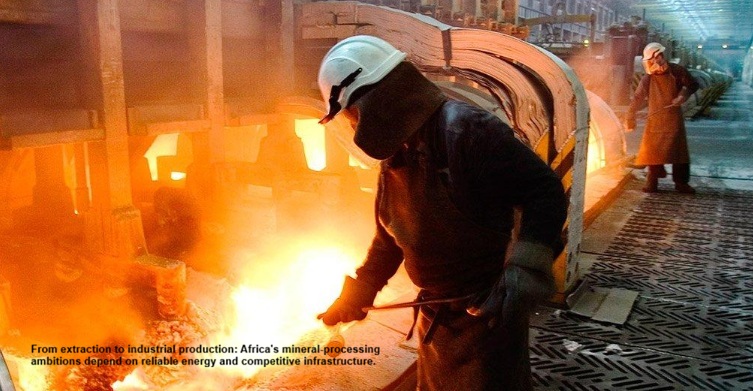
Some processes require enormous investment, dependable electricity, specialised technology and sufficient production volumes to operate competitively.
A practical African industrial strategy must recognise these constraints while progressively expanding local and regional processing capabilities.
Beneficiation must become an economically sustainable development strategy, rather than simply a restriction on raw mineral exports.
Zimbabwe: When mineral wealth meets community reality
Zimbabwe's platinum industry exposes perhaps the most important measure of mineral development: the conditions experienced by communities living alongside the mines.
Reporting published by Al Jazeera on 28 October describes residents in platinum-producing districts calling for improved roads, schools, water services and local economic opportunities.
Zimbabwe's mining sector reportedly generated $8.5 billion in export earnings during 2025.
Yet some communities near major platinum operations continue to face serious infrastructure and service delivery challenges.
Residents described children travelling long distances to school, pressure on local facilities and concerns about water conditions.
Mining companies have also reported investments in boreholes, education, housing and community development, demonstrating that contributions are being made.
The issue is whether the scale, effectiveness and accountability of these investments are keeping pace with mining activity and community needs.
This raises responsibilities for governments, municipalities and mining operators alike.
Mining royalties and tax revenues must be managed transparently. Local infrastructure planning must account for population growth. Communities should have meaningful opportunities to participate in decisions affecting their livelihoods.
And local enterprises should be able to compete for legitimate economic opportunities created by mining operations.
Mineral wealth should be measured not only by what leaves a mine, but also by what remains after the mine has operated.
A lasting mining legacy should include functioning infrastructure, improved capabilities, productive businesses and communities better positioned for the future.
The Lobito Corridor: Transporting minerals or building industries?
The latest progress on the Lobito Corridor brings these questions together.
On 27 October, Africa Finance Corporation announced preferred engineering and construction bidders for an approximately 830-kilometre railway connecting Zambia's Copperbelt with Angola's existing Atlantic transport network.
The project forms part of a broader corridor linking important mineral-producing areas in Zambia and the Democratic Republic of Congo to international markets through Angola.
Improved rail connectivity could reduce transport costs, strengthen regional trade and support investment in previously underserved economic areas.
But the corridor's long-term developmental value will depend on more than its ability to move copper and cobalt efficiently towards the coast.
Will African manufacturing industries develop alongside the railway?
Will agricultural producers gain access to more reliable markets?
Will local transport operators, engineering businesses, suppliers and service providers participate in the economic activity it creates?
Will new industrial zones strengthen processing and production within the region?
These questions are especially important as international powers seek more secure access to critical minerals.
The commercial interests of foreign investors and the development ambitions of African countries need not be mutually exclusive.
But alignment does not happen automatically.
It requires deliberate policy, investment, transparent agreements and active participation by African businesses.
The Lobito Corridor could become an important example of regional economic integration under the African Continental Free Trade Area.
Its greatest contribution would be to connect African production and consumption, while strengthening the continent's ability to trade competitively with the rest of the world.
From resources to participation
These developments reveal a common economic reality.
Africa's mineral future is being shaped through decisions occurring at multiple stages of the value chain.
Geological surveys establish what can be developed.
Mining agreements determine the commercial and fiscal terms.
Processing infrastructure influences where additional value is created.
Railways and ports determine how production reaches markets.
And public institutions, businesses and communities determine how successfully the resulting opportunities contribute to development.
The challenge is to connect these activities into a more productive African economic system.
This requires investment in technical education, dependable infrastructure, local enterprise development, transparent resource governance and cooperation between African countries.
The African Continental Free Trade Area provides an important framework for expanding regional industrial relationships.
Rather than expecting every country to reproduce the entire mineral value chain independently, African economies can develop complementary capabilities.
One country may supply raw materials, another provide specialised processing, and another contribute manufacturing, engineering, logistics or research expertise.
The resulting economic relationships can create opportunities across national borders while strengthening Africa's collective position in global markets.
Digital infrastructure also has a role to play by making African businesses, skills, industries and commercial opportunities more visible and accessible to one another.
But participation must extend beyond visibility.
It must lead to productive relationships, competitive enterprises, stronger institutions and measurable improvements in economic opportunity.
Africa must negotiate its future
Africa does not need to reject foreign investment to exercise greater economic influence over its resources.
International partnerships can provide capital, advanced technology, skills and access to markets.
What matters is the framework within which those partnerships operate.
African governments must be capable of negotiating agreements that protect legitimate national interests while offering commercially viable conditions for investors.
African industries must increasingly participate in processing, supplying and manufacturing.
And communities must experience tangible development from economic activity taking place around them.
The five developments examined here are not identical. They concern different minerals, countries, commercial structures and stages of industrial development.
But together they expose the same fundamental question.
Who controls the knowledge, the production, the processing, the infrastructure and the commercial relationships through which Africa's mineral wealth becomes economic value?
The answer will help determine whether the continent remains primarily a supplier of resources or becomes a stronger participant in the industries those resources sustain.
Africa's future mineral wealth cannot be measured by export statistics alone.
It must also be measured by the African enterprises that grow, the capabilities that develop, the infrastructure that remains and the communities whose lives improve.
Africa possesses the resources. The next challenge is to build and retain more of the value.
Africa in the Making — From Resources to Participation continues.
Source references
- Reuters / Mining Weekly, 29 October 2026 — Lynas posts 55% revenue jump on record prices, flags plant shutdowns.
- Al Jazeera, Enos Denhere, 28 October 2026 — Zimbabwe's platinum boom: Where is the wealth?
- Reuters, 28 October 2026 — Russian state firm to create geological map of Mali, build mining data system.
- CNBC Africa, James Woods, 26 October 2026 — Malawi's mineral wealth will be settled at the negotiating table.
- Africa Finance Corporation, 27 October 2026 — AFC Announces Preferred EPC Contractors for Zambia Lobito Railway.
🚀 Building African Mineral Value Chains — Industry Collaboration
An invitation to African mining suppliers, manufacturers, processors, logistics providers, researchers and industry professionals to explore opportunities for collaboration across mineral value chains. The focus is on African production, local procurement, technical capabilities and regional industrial development. This is an invitation to connect and explore opportunities, not an advertised tender or confirmed project.
This pathway is linked directly to this published story. Browse EcoTech Opportunities to see this and other active participation pathways alongside CloudFeed opportunities.
This Story Is Just the Beginning.
Discover the countries, industries and opportunities connected to what you have just read. Explore freely, and participate when you are ready.
Comments (0)
Join the Conversation
What do you think about this story? Share your view, a practical example, or a respectful challenge.
Comments are part of the EcoTech participation layer. Join from R49 once-off to participate, or log in if you already have an account.