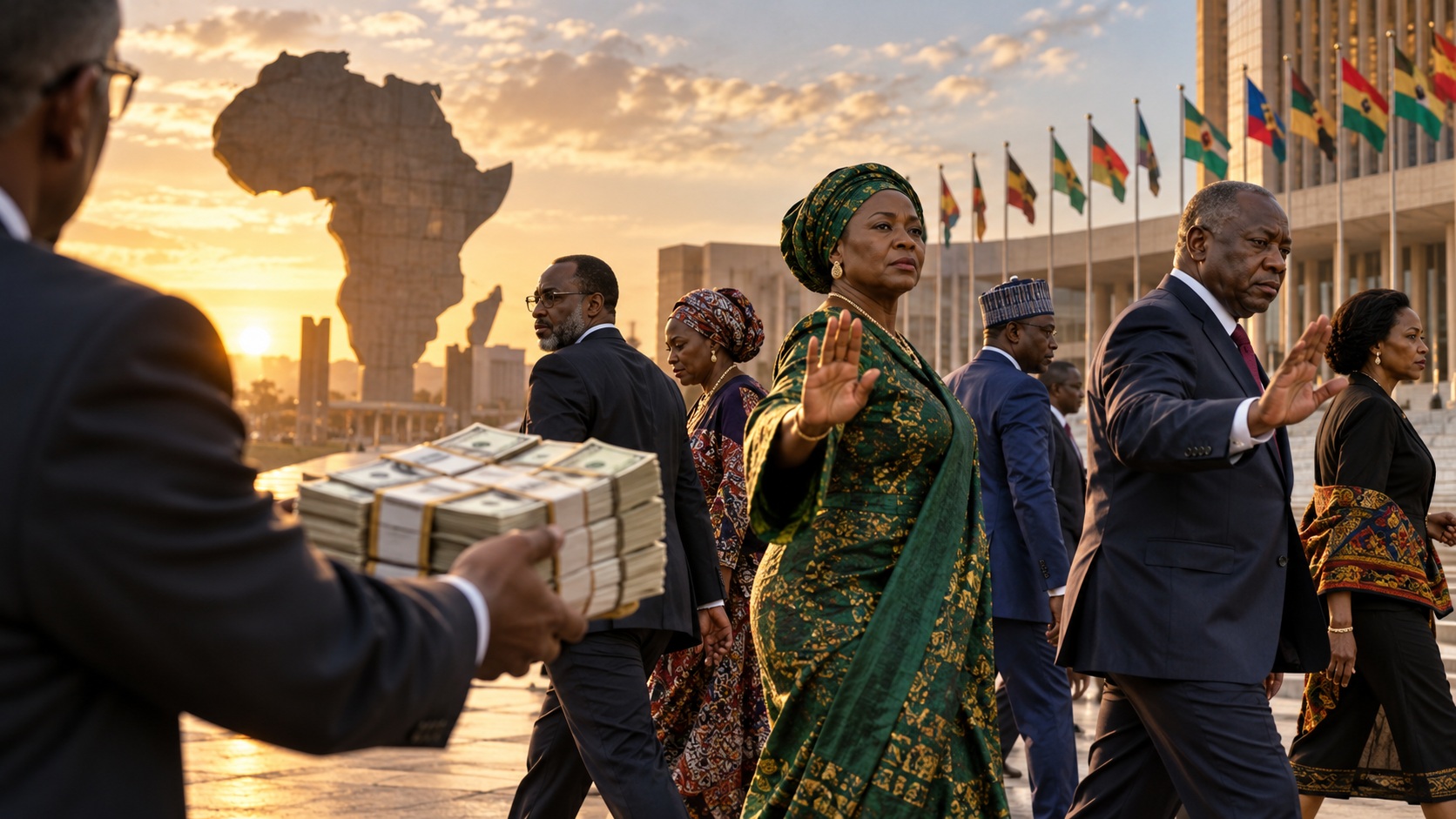
AFRICAN FREEDOM — Why Africa Must Move Beyond Comprador Leadership
🌍 Vous lisez le réseau africain de l’innovation
EcoTech est un espace en croissance pour les agriculteurs, innovateurs, scientifiques, investisseurs et contributeurs qui construisent des solutions pratiques de durabilité.
Understanding Comprador Leadership — And Why Africa's Development Must Serve Africans
Political independence established the right of African nations to govern themselves. Economic freedom raises another question: who benefits from the decisions made in their name?
Across Africa, independence remains one of the continent's most significant historical achievements. African nations gained the right to determine their political futures, establish their own institutions and participate in international affairs as sovereign states.
Yet political independence and economic independence are not always the same thing.
A country may control its government while remaining heavily dependent on exporting raw materials, importing manufactured products, accessing external financing and relying on foreign-controlled value chains.
Understanding this distinction introduces an important term in political economics: comprador.
What does comprador mean?
The word comprador comes from Portuguese, meaning buyer.
Historically, it described local commercial intermediaries who facilitated trade between foreign merchants and domestic markets.
Over time, political economists began using the term comprador class to describe sections of a country's economic elite whose commercial interests are closely connected to external capital rather than the development of domestic production.
The related expression comprador leadership is sometimes used to describe political or economic leadership that favours arrangements benefiting external interests or connected intermediaries without securing sufficient lasting benefits for the wider population.
It is important to understand that this is an analytical and sometimes contested political-economic description, not a formal classification of governments or individuals.
Cooperation with foreign businesses does not, by itself, make a leader or businessperson a comprador.
The real question concerns the structure and outcomes of the relationship.
Does it strengthen domestic capabilities, create employment, transfer knowledge and build local enterprises? Or does it leave the country primarily dependent on intermediaries and external decision-makers?
How can this affect African development?
Consider a simplified example.
An African country produces agricultural commodities or valuable minerals. These resources are exported with limited local processing.
Other countries transform the materials into higher-value products, develop associated technologies, establish manufacturing industries and participate in international distribution networks.
The finished products may eventually return to African markets at substantially higher prices.
The African country may earn valuable export revenue, but it has captured only part of the potential economic value.
The wider opportunities associated with processing, engineering, packaging, technology, logistics, research and manufacturing may develop elsewhere.
This is one way an economy can remain dependent despite possessing substantial natural resources.
It is not necessarily evidence of misconduct by a particular leader. Infrastructure limitations, investment requirements, energy costs, market access, technical capacity and historical trade arrangements can all contribute to the outcome.
Nevertheless, the structure deserves examination.
When economic intermediation becomes a development concern
Intermediaries are a normal and often valuable part of international trade.
They connect producers with buyers, arrange financing, organise logistics and reduce commercial uncertainty.
Problems arise when intermediary arrangements become more profitable or politically influential than efforts to build domestic productive capacity.
For example, development may be weakened when:
- Resource agreements lack transparency or sufficient public accountability.
- Domestic producers cannot participate fairly in supply chains.
- Investment arrangements provide limited opportunities for local skills and enterprise development.
- Public procurement favours connected intermediaries rather than competitive delivery.
- Revenue from national resources is not effectively translated into infrastructure, education and productive investment.
These risks are not unique to Africa. They are governance and economic-development challenges that can arise in many countries.
Understanding them helps citizens ask better questions about how national wealth is managed.
What does the evidence tell us?
The United Nations Conference on Trade and Development reported in its 2022 Economic Development in Africa Report that 45 of Africa's 54 countries depended on commodities for more than 60% of their merchandise export earnings.
This level of dependence can expose economies to international price changes and make diversification more difficult.
The report emphasised the importance of business services, financial services, technology and stronger productive capabilities in helping African economies participate in higher-value activities.
This is a structural development challenge.
Africa does not need to withdraw from international trade to address it.
It needs stronger opportunities to participate in more stages of production and value creation.
Economic freedom does not mean economic isolation
Foreign investment, international trade, technology partnerships and development cooperation can contribute significantly to African progress.
The issue is not whether investment comes from Africa or elsewhere.
The issue is whether agreements are transparent, economically sound and capable of building lasting domestic value.
A productive partnership can connect international capital and technology with African entrepreneurship, employment, infrastructure and skills.
Such cooperation can benefit all participating parties.
The objective should not be to replace international relationships with isolation, but to ensure that African economies enter those relationships with stronger institutions, capabilities and negotiating positions.
What kind of development leadership does Africa need?
Development-oriented leadership can be judged through practical outcomes rather than political labels.
Does public policy strengthen agriculture and manufacturing?
Are small and medium enterprises able to access opportunities?
Are public contracts transparent?
Are young people gaining productive skills?
Are infrastructure investments supporting local industries?
Are African countries building trade relationships with one another?
These questions make development measurable.
They also shift attention from personalities toward institutional performance.
An accountable institution should continue serving the public regardless of who occupies political office.
From political independence to productive participation
The African Union's Agenda 2063 already recognises the importance of economic diversification, industrialisation, value addition, continental integration and capable institutions.
The African Continental Free Trade Area also offers opportunities to develop stronger regional markets and cross-border value chains.
However, declarations alone cannot transform economic structures.
Implementation requires enterprises, researchers, producers, financial institutions, public authorities and communities to participate in practical economic activity.
Africa's future will be strengthened when its resources contribute to industries, its knowledge contributes to innovation, and its enterprises can establish productive relationships both within the continent and internationally.
A question for every African citizen
When a development agreement is announced, we can ask:
What lasting capability will this create for the country and its people?
That question moves the discussion beyond the nationality of the investor or the political identity of the leader.
It focuses instead on jobs, knowledge, infrastructure, production, fair returns and long-term development.
The concept of comprador leadership is useful when it helps us examine relationships between political authority, external capital and domestic economic interests.
It becomes less useful when employed merely as an accusation against individuals.
Africa benefits more from understanding economic arrangements than from exchanging political labels.
The next chapter of African freedom must be measured not only by who governs African countries, but by how effectively African societies build, produce, exchange knowledge and retain the benefits of their development.




Commentaires (0)
Rejoindre la conversation
Que pensez-vous de cet article ? Partagez votre point de vue, un exemple pratique ou une objection respectueuse.
Les commentaires font partie de la couche de participation EcoTech. Rejoindre à partir de R49, paiement unique to participate, or se connecter si vous avez déjà un compte.