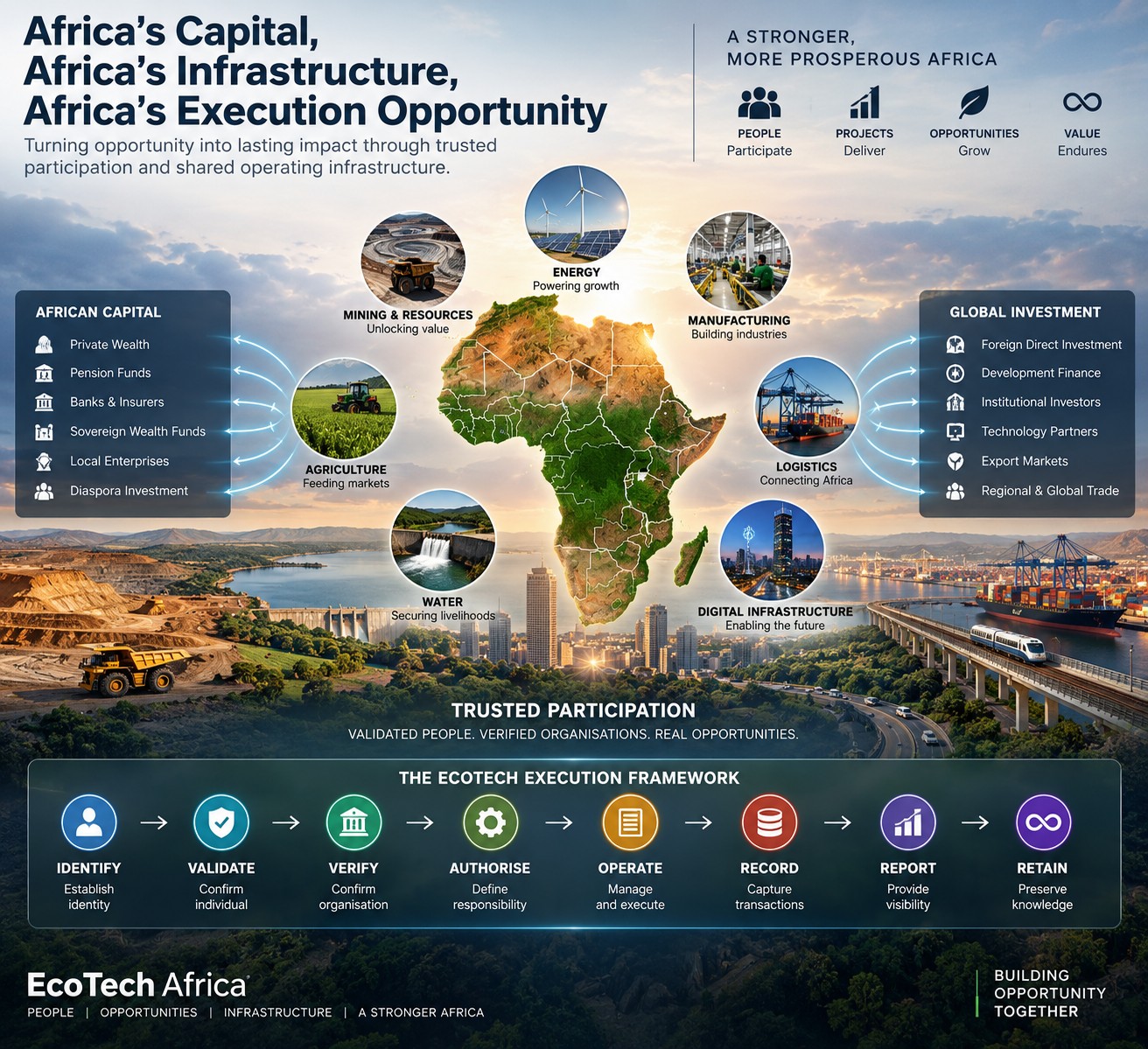
Africa’s Capital, Africa’s Infrastructure, Africa’s Execution Opportunity
🌍 Vous lisez le réseau africain de l’innovation
EcoTech est un espace en croissance pour les agriculteurs, innovateurs, scientifiques, investisseurs et contributeurs qui construisent des solutions pratiques de durabilité.
The continent’s next infrastructure chapter will require more than money. It will require trusted participants, country-level opportunity frameworks, strong records, accountable project administration and systems capable of carrying execution from idea to institution.
Africa’s infrastructure conversation is often reduced to a single question:
Where will the money come from?
That question matters. But it is no longer enough.
The African Development Bank estimates that Africa needs between US$130 billion and US$170 billion every year for infrastructure, with an annual financing gap of approximately US$68 billion to US$108 billion. At the same time, the Bank estimates that African banks, pension funds, insurers, sovereign wealth funds and other financial institutions collectively hold more than US$4 trillion in domestic savings and financial assets.
Africa is also receiving substantial international capital.
UN Trade and Development reports that the continent attracted approximately US$70 billion in foreign direct investment in 2025, the third-highest annual level since 1990. Investment continues to target sectors including energy, logistics, infrastructure, critical minerals and selected manufacturing activities.
And Africa possesses significant concentrations of private entrepreneurial wealth.
Forbes’ 2026 Africa billionaires ranking identifies 23 African billionaires with combined estimated wealth of US$126.7 billion, up 21% from the previous year. South Africa has the largest number on the list, followed by Egypt, Nigeria and Morocco. The fortunes themselves span manufacturing, mining, finance, telecommunications, construction, energy, food, retail and other productive sectors.
These numbers should not be interpreted as an argument that African billionaires should simply finance Africa’s infrastructure.
They reveal something more important.
Capital exists inside Africa. Capital exists outside Africa. And enormous infrastructure opportunities exist between them.
The challenge is turning those three realities into projects capable of being understood, trusted, financed, administered and carried through execution.
The opportunity is bigger than the financing gap
Infrastructure capital does not move simply because a country needs a road, power plant, processing facility, water system or data centre.
Investors need identifiable opportunities.
Governments need credible counterparties.
Financial institutions need bankable structures.
Businesses need a way to participate.
Project teams need documents and records.
Authorities need clarity about responsibility.
Participants need to know who they are dealing with.
And the knowledge created throughout a project must survive beyond the people who happen to be involved at a particular moment.
This means Africa’s infrastructure challenge is not only a capital challenge.
It is also an execution infrastructure challenge.
The physical asset may be a mine, rail corridor, manufacturing facility, agricultural processing plant, electricity network, port, digital infrastructure hub or water project.
But behind every physical asset sits another infrastructure that is much less visible:
identity, authority, documentation, communication, accounting, records, permissions, responsibilities, institutional memory and trusted information.
Without that layer, even well-funded projects can become fragmented.
Start with countries, not abstractionsAfrica should not be treated as a single undifferentiated investment destination.
Each country possesses a different combination of resources, industries, institutions, financial capacity, infrastructure requirements, skills and regional advantages.
A practical African infrastructure framework therefore begins country by country.
The questions can remain consistent even when the answers differ.
What does the country already have?
Natural resources.
Agricultural production.
Industrial capacity.
Skills.
Existing enterprises.
Universities and research institutions.
Energy resources.
Transport infrastructure.
Financial institutions.
Entrepreneurs.
Export markets.
Regional trade relationships.
What is preventing greater value creation?
Insufficient electricity?
Water infrastructure?
Processing capacity?
Industrial machinery?
Transport?
Storage?
Digital infrastructure?
Working capital?
Skills?
Administrative capacity?
Access to markets?
What could be built locally?
Processing.
Manufacturing.
Storage.
Logistics.
Energy.
Water infrastructure.
Digital services.
Industrial supply chains.
Agricultural value chains.
Mineral beneficiation.
Export capacity.
Who can participate?
Local SMEs.
Larger African companies.
Financial institutions.
Chambers and business organisations.
Universities.
Municipalities and governments.
Development finance institutions.
African investors.
Diaspora capital.
International investors.
Technology partners.
Zambia will not require the same framework as Malawi
A copper-producing economy may identify a pathway such as:
Mining ? processing ? components ? manufacturing ? energy infrastructure ? logistics ? regional exports.
An agriculture-intensive economy may instead identify:
Agriculture ? storage ? processing ? packaging ? manufacturing ? water infrastructure ? logistics ? regional markets.
Another country may build its opportunity around tourism, pharmaceuticals, digital services, energy, forestry, transport or critical minerals.
The framework is shared.
The opportunity remains local.
This is important because infrastructure becomes more understandable when people can see how it connects to the economy immediately around them.
It also allows global investors to encounter Africa through specific investable opportunities rather than broad continental generalisations.
African capital and global capital should complement one anotherThere is sometimes a tendency to frame infrastructure financing as a choice:
Should Africa finance itself?
Or should Africa seek international investment?
The strongest model is likely to involve both.
African capital can bring local knowledge, commitment, ownership and confidence.
International capital can bring additional scale, specialised financing, technology, technical expertise and access to global markets.
Development finance institutions can reduce risk and help projects reach bankability.
Governments can create enabling policy and infrastructure.
Businesses can execute commercially.
Communities and institutions can provide local participation and accountability.
UNCTAD’s latest investment data demonstrates why this matters. Strategic industries such as AI infrastructure, critical minerals, semiconductors and energy-transition technologies now represent a dramatically larger portion of global greenfield investment than only a few years ago. Yet those investments remain concentrated in relatively few countries.
Africa therefore does not merely need to attract investment.
It must increasingly become capable of capturing the industrial value surrounding that investment.
A mining investment should be able to stimulate processing.
Processing should create manufacturing opportunities.
Manufacturing should create suppliers.
Suppliers should create employment.
Infrastructure should connect these enterprises to markets.
Capital should circulate through a progressively stronger local economy.
But before execution comes trustA project involving hundreds of businesses, contractors, institutions, consultants and investors immediately encounters another problem:
Who exactly is participating?
A name in an email is not enough.
A company logo is not enough.
A registration number appearing on a document is not always enough.
Infrastructure execution depends on knowing:
Who is this person?
Does this business exist?
Who is authorised to represent it?
What responsibility does this individual carry?
What information may they access?
What are they authorised to approve or sign?
This is where participant validation and organisational verification become fundamental infrastructure themselves.
Identify ? Validate ? Verify ? AuthoriseA trusted project operating environment should begin with a clear sequence.
Identify
A participant establishes a known identity within the operating environment.
Validate
The individual’s identity is checked against appropriate evidence so that other participants are not simply relying on a self-created profile.
Verify
Businesses, institutions and enterprises are checked to establish that they exist and that the relationship between the organisation and the individual representing it is legitimate.
Authorise
The system establishes what that person is entitled to do on behalf of the organisation or project.
This distinction matters.
A validated individual may still not be authorised to approve expenditure for a company.
A verified company may have hundreds of employees, only some of whom can act contractually.
A consultant may require access to engineering documents but not financial records.
A chamber may represent businesses without owning those businesses.
An accountant may require records without having operational authority.
Trust therefore cannot end with identity verification.
It must extend into acting capacity, permissions and responsibility.
Infrastructure projects need operating infrastructure of their ownOnce trusted participants are established, the administrative burden begins.
Every serious project generates enormous amounts of information:
Feasibility studies.
Requests for information.
Contracts.
Company documentation.
Technical drawings.
Quotations.
Invoices.
Credit notes.
Payment records.
Minutes.
Correspondence.
Reports.
Environmental documentation.
Compliance records.
Procurement documents.
Supplier information.
Progress reports.
Photographs.
Approvals.
Policies.
Presentations.
Research.
Financial statements.
Versions of documents.
Thousands of individual decisions.
The project therefore requires a system capable of carrying not only files, but institutional continuity.
This is an area in which a shared African digital operating framework can become extremely valuable.
The role EcoTech Africa can carryEcoTech Africa is developing such an operating framework around African participation.
Its purpose is not to replace engineers, financiers, construction companies, governments, accountants or project managers.
It is to provide a shared trusted digital environment through which those participants can operate around a project.
That responsibility can extend across several layers.
Participant Validation
People participating within a trusted project environment can establish and validate their individual EcoTech identities.
This creates a clearer foundation for understanding who is interacting with a project.
Business and Enterprise Verification
Businesses and institutions can be verified separately from the individuals representing them.
This enables a distinction between:
the person
and
the organisation the person is authorised to represent.
That separation becomes increasingly important as projects involve chambers, contractors, suppliers, governments, investors and multiple organisational structures.
Authority, Roles and Responsibilities
Participants can operate within defined organisational and project responsibilities.
Finance personnel can work within finance.
Administrators can manage records.
Publishers can communicate project information.
Project leadership can retain oversight.
Business representatives can operate within their authorised organisation.
The objective is simple:
the right person, acting for the right organisation, with the right level of authority.
Publishing and public communicationInfrastructure projects need communication.
Communities need to understand what is being developed.
Suppliers need visibility of opportunities.
Investors require credible information.
Businesses need to know how they can participate.
Milestones need to be communicated.
EcoTech Publishing and Africa Upfront can provide a distribution environment for:
industry information,
country opportunity information,
project developments,
supplier opportunities,
institutional announcements,
research,
investment visibility,
and verified business participation.
Publishing therefore becomes more than publicity.
It becomes part of market formation.
Document managementProject information should not live permanently inside individual email accounts and scattered devices.
EcoTech Documents can provide an authorised repository in which project and organisational documentation remains attached to the operating environment.
This can include contracts, reports, correspondence, certificates, presentations, financial documents and other project records.
The underlying principle is important:
The project should retain its institutional knowledge even when individual participants change.Secure document sharingProjects frequently involve documents passing between businesses, consultants, financiers and institutions.
EcoTech's Shared With Me environment provides a model in which authorised documents can enter another participant’s operating context without losing their relationship to the originating environment.
That is considerably stronger than sending uncontrolled copies of sensitive files indefinitely through personal messaging systems.
Quotations, invoices and accounting recordsInfrastructure does not only involve billion-dollar contracts.
Thousands of smaller commercial relationships sit beneath major projects.
Local businesses quote.
Suppliers invoice.
Contractors issue credit notes.
Payments must be reconciled.
Records must reach accountants.
EcoTech QI is being developed to provide structured quotation and invoicing capability within the same broader environment.
Issued records can then form part of the project and Enterprise document history instead of existing as disconnected files.
Data retention and record keepingOne of the least visible risks in long-running projects is institutional memory loss.
People leave.
Consultancies change.
Employees move departments.
Companies are replaced.
Emails disappear.
Hard drives fail.
Project knowledge becomes fragmented.
A durable digital operating environment changes that.
Documents, records, transactions and authorised relationships can remain connected to the organisation or project rather than being dependent upon one particular person.
For projects that may operate for ten, twenty or fifty years, this is not an administrative luxury.
It is infrastructure.
Accounting and audit readinessGood project governance requires financial records that can eventually be reconstructed and understood.
Quotations, invoices, credit notes, payments, reports and supporting documents should form a coherent history.
This does not remove the role of professional accountants or auditors.
It gives those professionals better structured records with which to work.
Echo and institutional intelligenceAs the authorised record grows, another possibility emerges.
Information no longer needs merely to be stored.
It can become usable institutional intelligence.
EcoTech's Echo intelligence layer is intended to work across information that a participant is authorised to access.
Over time that can allow participants to ask questions such as:
What was agreed six months ago?
Which report contains the relevant technical recommendation?
What actions remain outstanding?
How does this quotation differ from the previous version?
Which documents relate to this supplier?
What changed between two project reports?
What records support this decision?
The value is not simply artificial intelligence.
The value comes from AI being able to work against trusted, retained and authorised context.
Record first. Intelligence follows.This distinction is fundamental.
Artificial intelligence cannot compensate for institutional information that was never retained.
It cannot reliably reconstruct an approval that disappeared with an employee’s inbox.
It cannot reason accurately over supplier information that was never organised.
It cannot understand who had authority if authority was never recorded.
The foundation therefore remains:
Identify ? Validate ? Verify ? Authorise ? Operate ? Record ? Report ? Retain
Only then does intelligence become significantly more useful.
A Local Africa FrameworkEcoTech therefore sees an opportunity to communicate African infrastructure possibilities through a common framework while allowing every country to determine its own priorities.
The public-facing framework can help make opportunity visible.
For each country:
Resources
What assets and productive strengths already exist?
Industry
Which industries can be strengthened?
Infrastructure
What physical systems would unlock greater production?
Local Enterprise
Which businesses could participate?
African Capital
Where can domestic and regional capital participate?
Global Investment
Where can international investment provide additional scale?
Trusted Participation
Who is participating and who do they represent?
Execution
What systems are needed to carry the project responsibly?
Retention
How will the project preserve the records and knowledge it creates?
This allows countries to communicate opportunity without requiring every country to reinvent the underlying operating framework.
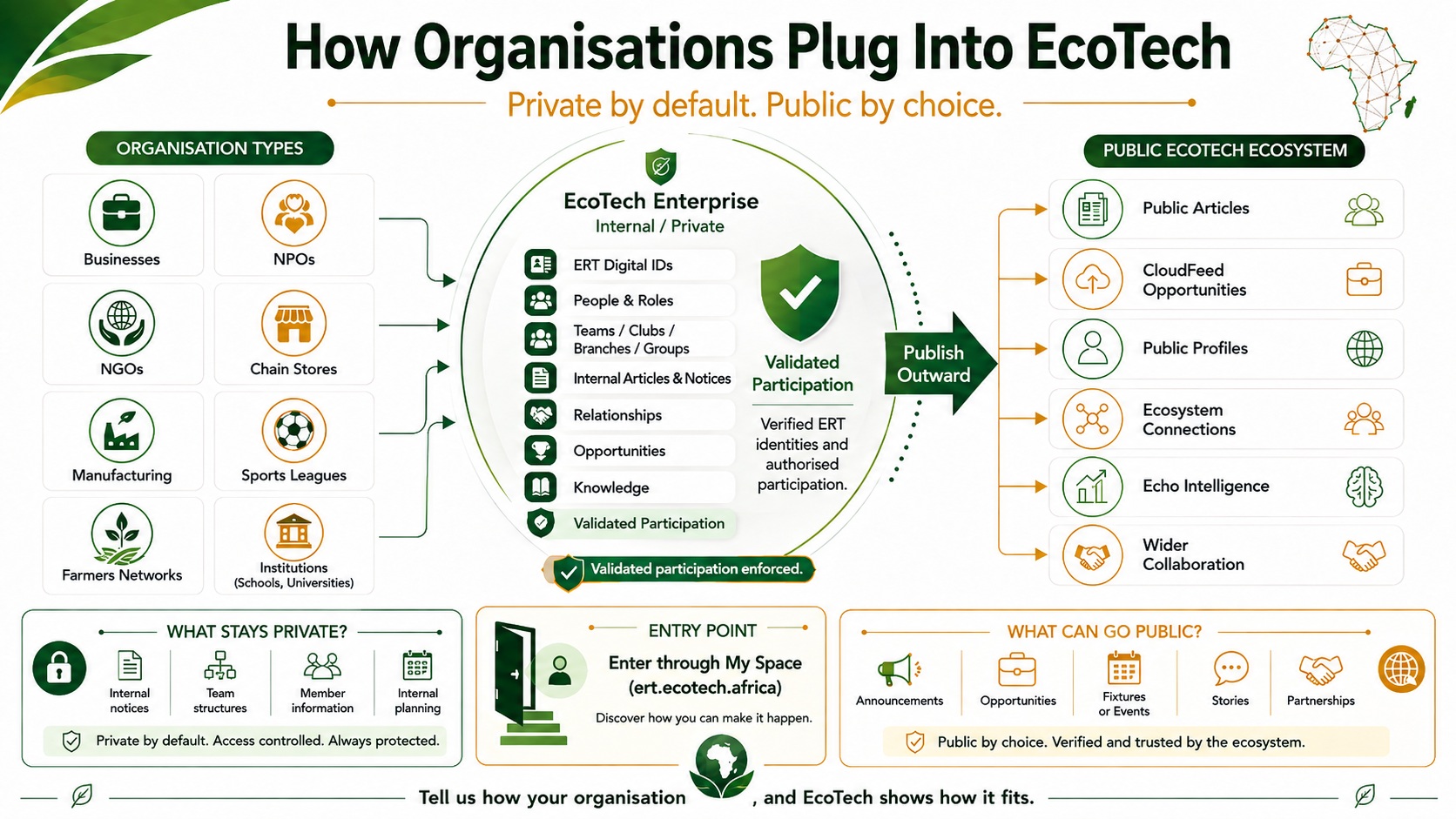
Awareness publicly. Execution responsibly.There is another important distinction.
Not every element of infrastructure execution belongs in the public domain.
Public communication should make opportunities understandable and visible.
But detailed project sequencing, partner strategies, investment negotiations, commercial structures, permissions and operating plans frequently belong inside authorised environments.
The public framework can therefore create:
Awareness ? Understanding ? Visibility ? Participation
while the internal project environment carries:
Validation ? Verification ? Authority ? Documentation ? Transactions ? Responsibilities ? Reporting ? Retention
This is how public opportunity can be connected to disciplined execution.
From infrastructure projects to African participationThe larger opportunity is not simply to build more infrastructure.
It is to allow more African enterprises to participate in building it.
A large infrastructure project can involve hundreds or thousands of suppliers.
Construction firms.
Engineering companies.
Transport businesses.
Equipment suppliers.
Farmers.
Manufacturers.
Professional services.
Software providers.
Accountants.
Security companies.
Training providers.
Maintenance businesses.
Local contractors.
Financial institutions.
Research organisations.
If those opportunities become visible earlier and local businesses can establish trusted identities and verified operating records, infrastructure investment can produce far broader economic participation.
This is where the question changes.
Instead of only asking:
Who will finance the project?
Africa can increasingly ask:
Who will participate in the value created around the project?
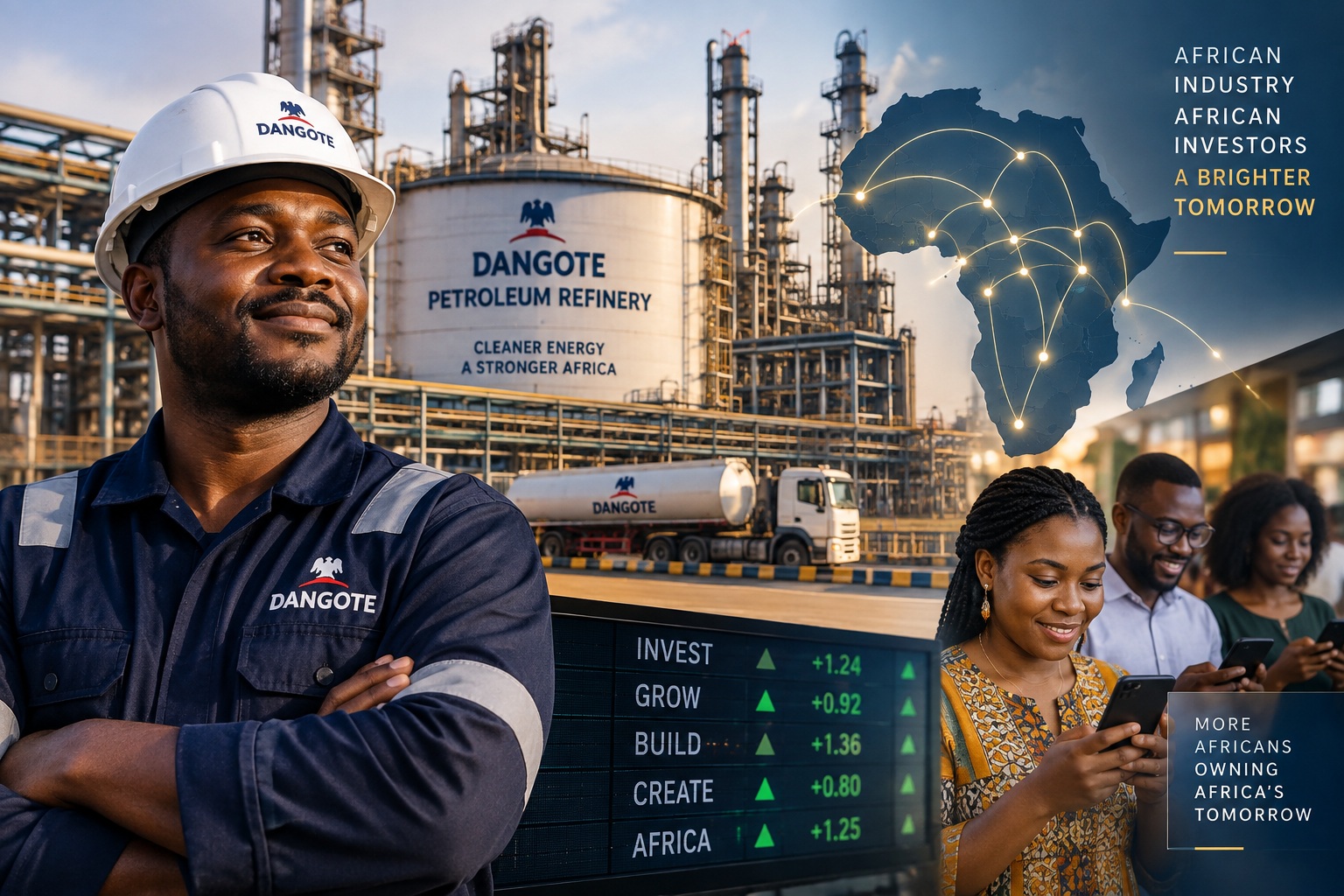
The billionaire number is a signal, not the solutionAfrica’s US$126.7 billion in billionaire wealth is striking, but it represents only a small part of the continental capital picture.
The more significant figure may be the US$4 trillion-plus sitting across Africa's broader domestic financial system.
And even that capital will not simply move because infrastructure needs exist.
It requires investable opportunities.
Risk structures.
Credible partners.
Clear records.
Governance.
Continuity.
Transparency.
Execution capacity.
Africa therefore needs both capital infrastructure and project infrastructure.
Global investors should see African systems, not only African assetsInternational investors have historically encountered Africa through specific resources or major projects.
Copper.
Oil.
Gold.
Agriculture.
Ports.
Telecommunications.
Energy.
Increasingly, Africa can present something more sophisticated:
an investable ecosystem surrounding those assets.
An ecosystem in which:
participants can be validated,
enterprises can be verified,
authority can be understood,
projects can retain records,
businesses can become visible,
documentation can remain accessible,
transactions can be recorded,
and institutional knowledge can survive.
That improves the environment for African capital and global capital alike.
Africa can build the physical and digital layers togetherMuch of Africa’s future infrastructure is still to be built.
That represents a challenge.
It also represents an unusual opportunity.
Countries with mature infrastructure frequently carry decades of disconnected legacy systems.
Africa has an opportunity to build physical infrastructure while simultaneously developing the digital administrative environments surrounding it.
The railway and the project record.
The factory and its supplier ecosystem.
The mine and its verified participants.
The water system and its institutional knowledge.
The power network and its project history.
The investment and its authorised documentation.
The infrastructure and the intelligence surrounding it.
The common layerEvery country will make different infrastructure decisions.
Every project will have different investors.
Every industry will require different expertise.
But several responsibilities remain remarkably consistent:
Know the participant.
Know the organisation.
Know who has authority.
Protect the documents.
Record the transaction.
Retain the history.
Communicate the opportunity.
Preserve institutional knowledge.
These are not country-specific problems.
They are shared operating requirements.
And that is where a common African framework begins to make sense.
Africa’s next infrastructure questionThe continent already knows it requires roads, energy, water, rail, manufacturing, processing, logistics and digital infrastructure.
The next question is increasingly:
What operating infrastructure will carry all of that development?
Capital alone cannot answer it.
Technology alone cannot answer it.
Governments alone cannot answer it.
Private businesses alone cannot answer it.
It requires an environment in which African institutions, enterprises, individuals and global partners can participate together while maintaining trust, authority, accountability and continuity.
That is a foundational part of Africa’s infrastructure future.
And it is the responsibility EcoTech Africa is preparing to help carry.
Closing thought
Africa’s infrastructure future may ultimately depend not only on what the continent builds, but on how effectively it can identify the people involved, verify the institutions participating, organise responsibility, mobilise capital, retain information and carry project knowledge from one generation of participants to the next.
Physical infrastructure creates capacity.
Trusted operating infrastructure helps that capacity endure.



Commentaires (0)
Rejoindre la conversation
Que pensez-vous de cet article ? Partagez votre point de vue, un exemple pratique ou une objection respectueuse.
Les commentaires font partie de la couche de participation EcoTech. Rejoindre à partir de R49, paiement unique to participate, or se connecter si vous avez déjà un compte.