
Africa’s Next Growth Question Is Not Potential — It Is Connection
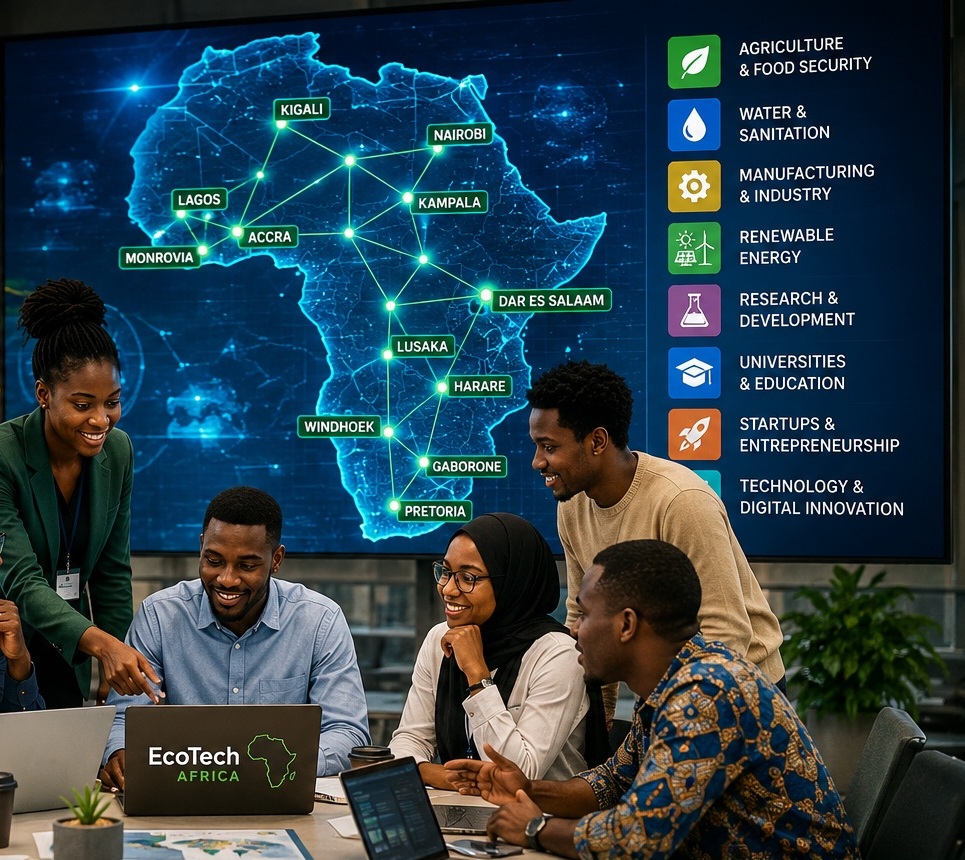
🌍 You’re reading Africa’s innovation network
EcoTech is a growing space for farmers, innovators, scientists, investors and contributors building practical sustainability solutions.
Africa already has talent, resources, businesses, research and ambition. The next challenge is whether those assets can find one another, trust one another and work together at continental scale.
For decades, Africa has been described through the language of potential.
Agricultural potential. Mineral potential. Renewable-energy potential. Youth potential. Digital potential. Entrepreneurial potential.
Much of that description is justified. But potential is not an economic outcome.
A resource becomes economically meaningful when somebody can use it. Research creates impact when it reaches industry. A farmer becomes commercially stronger when production connects to markets. A young entrepreneur becomes an employer when opportunity connects to capital, customers and infrastructure.
Increasingly, Africa's development question is therefore shifting.
It is no longer enough to ask what Africa possesses.
We must ask how well Africa is connected.
That question is particularly visible this week in Kigali, where the 20th Africa Food Systems Forum is bringing together more than 5,000 stakeholders from over 50 countries around the theme “Investing in Africa’s Agri-Food Systems: Nourishing Nations, Growing Jobs, Building Resilience.” The programme is deliberately moving beyond agricultural production alone into finance, irrigation, institutional demand, resilient seed systems, youth investment, artificial intelligence and food-system measurement.
That breadth matters.
A farmer can grow a crop, but without storage, logistics, finance or a buyer, production alone cannot create a functioning value chain.
A researcher can develop a more resilient cultivar, but without relationships with producers, processors and investors, knowledge can remain trapped inside institutions.
A government can establish an agricultural strategy, but implementation still depends on businesses, communities, financial institutions and infrastructure being able to participate.
Africa's challenge is therefore increasingly found between the pieces.
From production to systems
The discussions taking place in Kigali illustrate this clearly.
One of the programme areas focuses on irrigation investment and why water matters to African food systems. Another focuses on innovative financing and identifying investment gaps. There are sessions on climate-smart seed systems, institutional demand and investment, while the programme also includes an African agriculture large-language-model showcase and direct engagement between young innovators and investors.
Those are not isolated themes.
They are parts of one system.
Water connects to agriculture.
Agriculture connects to processing.
Processing connects to markets.
Markets connect to finance.
Finance connects to trusted businesses.
Research connects to innovation.
Data connects decision-makers to evidence.
And increasingly, digital infrastructure connects all of them.
The African Union's current agricultural ambitions are similarly substantial. The Kampala CAADP Strategy and Action Plan for 2026–2035 seeks major increases in agrifood output and investment while reducing post-harvest losses and significantly increasing intra-African agricultural trade.
The scale of those ambitions makes connection unavoidable.
Continental trade cannot grow if businesses in neighbouring countries remain invisible to one another.
Investment cannot move efficiently when investors cannot identify credible projects.
Research cannot scale if researchers cannot identify commercial partners.
Young innovators cannot participate meaningfully if opportunity remains concentrated inside disconnected networks.
Digital Africa faces the same question
The same pattern is emerging outside agriculture.
Nigeria is hosting GITEX Nigeria this week across Abuja and Lagos under a programme explicitly focused on digital governance, artificial intelligence, cloud infrastructure, cybersecurity, startups and future financial systems.
The event describes its ambition as moving “beyond connectivity” toward sovereign AI and innovation. Its programme brings policymakers, technology companies, investors and entrepreneurs together, with more than 750 startups expected across areas including fintech, health technology, agriculture technology, AI and education.
This is another example of Africa moving from isolated capability toward ecosystems.
Computing infrastructure by itself is not digital transformation.
Neither is an AI model.
Neither is a startup.
Neither is a policy document.
Transformation happens when infrastructure, policy, skills, businesses, finance and markets begin operating together.
MTN Group's recently announced plans to participate in AI-ready data-centre development in South Africa and Nigeria illustrate how serious this infrastructure layer is becoming. The initial phase of the planned venture targets 150 megawatts of data-centre capacity, alongside MTN's continued expansion into fintech and financial services.
Africa is therefore not standing still.
Infrastructure is being built.
Businesses are emerging.
Investment is moving.
Policy is evolving.
The question is whether the relationships between those developments can become as sophisticated as the individual projects themselves.
Trust is infrastructure too
Connection, however, requires more than discovery.
It requires trust.
A business in Zambia finding a supplier in Malawi is only the beginning.
Who owns the business?
Is it registered?
Who is authorised to act for it?
Can the people involved exchange documents securely?
Can a quotation become an invoice?
Can the relationship continue after the first transaction?
Can another organisation discover the same verified capability later?
These questions may appear administrative, but at continental scale they become economic infrastructure.
Roads reduce the friction of moving goods.
Payment systems reduce the friction of moving money.
Digital identity and trusted organisational relationships can reduce the friction of doing business with somebody you have never met.
That matters enormously in Africa, where cross-border opportunity frequently exists long before the relationship infrastructure required to exploit it.
The next generation of African digital systems therefore cannot merely connect devices.
They must increasingly connect people, businesses, knowledge and authority.
From African participation to African agency
This same shift is beginning to emerge in climate governance.
Next week, the United Nations Economic Commission for Africa will host the Fourteenth Conference on Climate Change and Development in Africa in Addis Ababa.
Its framing is notable.
UNECA argues that African climate leadership cannot simply mean articulating African priorities during negotiations. It increasingly requires African capacity to shape agendas, institutions, implementation systems and political agreements — in other words, moving from participation toward agency.
That distinction could apply far beyond climate policy.
Africa does not merely need access to systems built elsewhere.
It increasingly needs the ability to shape and operate its own systems.
Its own commercial relationships.
Its own knowledge networks.
Its own trusted digital infrastructure.
Its own continental pathways between research, enterprise, finance and opportunity.
The continent already has many of the pieces
Africa does not suffer from a shortage of initiatives.
Across the continent there are chambers of commerce, development agencies, universities, researchers, entrepreneurs, farmer organisations, multinational companies, NGOs, startups, investment funds, government programmes and regional institutions.
Many are doing valuable work.
The weakness is often visibility between them.
A researcher may not know the business looking for precisely that expertise.
A manufacturer may not know the farmer network capable of supplying feedstock.
An entrepreneur may not know that a funding opportunity exists across a border.
A company may want to expand into another African country but lack trusted relationships there.
The result is that Africa can simultaneously possess opportunity and isolation.
That is the contradiction the next generation of African infrastructure must address.
The real continental opportunity
Imagine instead a continent where a researcher in Zimbabwe can be discovered by an industrial partner in South Africa.
Where a farmer organisation in Malawi can establish trusted commercial relationships in Zambia.
Where a Nigerian technology company can identify customers, collaborators and investors across multiple African markets.
Where a verified business does not have to rebuild its identity from zero every time it crosses a border.
Where knowledge, opportunities, documents and commercial relationships remain connected to the people and organisations responsible for them.
None of that replaces roads, electricity, telecommunications, banking or traditional institutions.
It complements them.
Because infrastructure is ultimately about reducing the distance between possibility and action.
Africa already has enormous possibility.
The next frontier is making it actionable.
The continent's development story may therefore increasingly be defined not by how much potential Africa possesses, but by how effectively Africans can find one another, trust one another and work together.
Africa's next growth question is not potential.
It is connection.


Comments (0)
Join the Conversation
What do you think about this story? Share your view, a practical example, or a respectful challenge.
Comments are part of the EcoTech participation layer. Join from R49 once-off to participate, or log in if you already have an account.