FROM ORE TO INDUSTRY
🌍 You’re reading Africa’s innovation network
EcoTech is a growing space for farmers, innovators, scientists, investors and contributors building practical sustainability solutions.
Africa Wants to Process What It Mines. Power Will Decide Whether It Can.
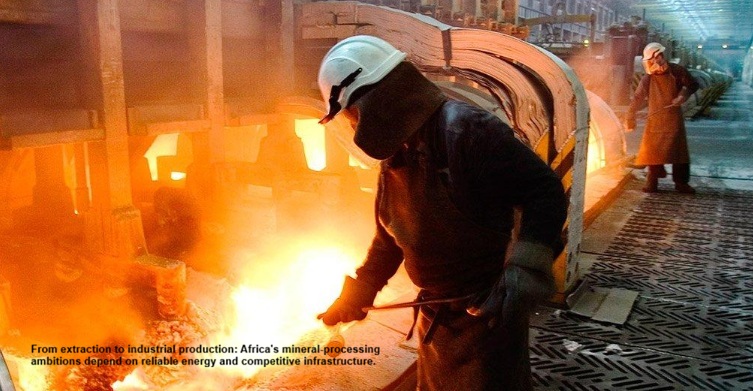
Across Africa, governments and investors are looking beyond the export of raw mineral resources towards domestic processing, refining and manufacturing. But the continent's industrial ambitions face a decisive test: whether the electricity, infrastructure and commercial systems needed to transform mineral wealth into lasting economic value can develop alongside them.
The Value Africa Has Yet to Capture
For generations, Africa's mineral wealth has supplied factories, industries and consumers around the world.
Bauxite from Guinea, cobalt and copper from the Democratic Republic of Congo, chrome from South Africa and lithium from Zimbabwe contribute to international supply chains that support construction, transport, electronics, renewable energy and modern manufacturing.
Yet a significant proportion of the value generated from transforming these resources into finished industrial materials continues to be created outside the countries where the minerals originate.
The distinction is important.
Extracting a mineral creates economic activity. Processing it introduces another level of industrial capability. Refining, manufacturing and supplying finished products can establish additional enterprises, technical professions, commercial relationships and long-term employment.
That progression is increasingly becoming a central consideration for African economies.
The question is no longer simply how much mineral wealth the continent possesses.
It is how much productive industry Africa can build around that wealth.
Guinea: A Country Preparing for Its Next Industrial Chapter
Guinea offers one of the clearest examples of this changing ambition.
The West African nation has become the world's leading producer and exporter of bauxite, the principal raw material used to manufacture alumina and subsequently aluminium.
Aluminium is essential to modern transport systems, construction, electrical equipment, packaging and numerous industrial applications.
However, exporting bauxite is only the beginning of that manufacturing chain.
Guinea wants a greater share of the processing activities that follow extraction.
According to Reuters reporting published on 19 October 2026, the country has three alumina refinery projects under construction and aims to establish five refineries by 2030, with a combined annual production capacity of approximately seven to eight million tonnes.
Further ambitions include aluminium smelting and greater domestic processing of iron ore.
This would represent a considerable expansion of Guinea's industrial capabilities.
Instead of relying predominantly on the export of raw materials, the country could develop a stronger network of processing facilities, technical suppliers, engineering services, transport operations and industrial employment.
But there is a fundamental obstacle.
Factories cannot operate on mineral deposits alone.
The Electricity Equation
Guinea's existing electricity generation is approximately 1,000 megawatts, according to government figures reported by Reuters.
Its wider industrial ambitions could require between 5,000 and 10,000 megawatts.
These are estimated system requirements, not a confirmed electricity allocation for the proposed refineries alone. Nevertheless, the scale of the difference illustrates the challenge.
The country must substantially expand and stabilise its energy supply if it is to support the industrial economy it envisions.
The issue is not limited to generation capacity.
Large processing facilities require dependable electricity throughout their operating cycles. Unplanned interruptions can damage equipment, disrupt production, increase costs and undermine delivery commitments.
Energy prices matter just as much.
A refinery may be technically capable of processing a mineral locally, but if its electricity costs make production substantially more expensive than competing international facilities, the business may struggle to remain commercially viable.
The calculation therefore extends beyond what can be mined.
It includes what can be powered, processed, transported and sold competitively.
This is the central challenge confronting Africa's mineral beneficiation ambitions.
South Africa: An Industrial Warning
South Africa demonstrates why the availability and affordability of electricity are not merely infrastructure concerns. They can determine whether established industries survive.
The country possesses extensive chrome resources and has historically maintained substantial ferrochrome processing capacity.
Ferrochrome is a crucial ingredient in stainless-steel manufacturing.
But the domestic smelting industry has come under severe pressure.
Reuters reported on 19 October that fewer than a dozen of South Africa's 66 ferrochrome smelters were operating, with electricity costs having risen approximately tenfold since 2008.
The consequence is significant.
A country can possess the mineral resources, industrial experience, trained workforce and physical processing facilities, yet still lose competitiveness when a critical operating input becomes too expensive.
South Africa's experience also illustrates that industrial capability, once lost, cannot always be restored quickly.
Facilities require capital to restart. Experienced workers may relocate. Suppliers lose contracts. Customers establish alternative relationships.
What begins as an electricity pricing problem can eventually become an industrial capacity problem.
The lesson extends across the continent.
Mineral ownership creates an opportunity. Competitive industrial systems determine whether that opportunity can be sustained.
A Continent Rich in Resources, Yet Seeking Greater Industrial Participation
The broader statistics underline the scale of Africa's opportunity.
In its 2025 report, Stepping Up the Value Chain in Africa, the International Energy Agency estimated that African production supplied approximately 70% of globally mined cobalt, around 75% of manganese and nearly 20% of copper.
Yet Africa captured less than 1% of the value generated by manufacturing clean-energy technologies and their components.
These figures do not imply that mineral production and manufacturing should be measured as identical activities. They demonstrate the contrast between Africa's importance as a source of raw materials and its comparatively limited participation in downstream manufacturing.
The opportunity is therefore substantial.
Copper can support electrical equipment and components. Manganese can supply specialised chemical and battery-material industries. Bauxite can underpin alumina refining and aluminium production.
However, each industrial step involves different technologies, capital requirements, skills, environmental obligations and markets.
Not every country needs to manufacture every finished product.
Some may specialise in mineral preparation or refining. Others may develop component manufacturing, machinery maintenance, testing, logistics or technical services.
Regional industrial cooperation can allow countries to participate at different stages of a connected value chain.
The objective should not be industrial duplication across the continent.
It should be the development of commercially sustainable African capabilities that complement one another.
Energy Infrastructure Is Industrial Infrastructure
Energy investment is often discussed separately from mining, manufacturing and trade.
In practice, these sectors are deeply connected.
A proposed refinery may create demand for new generating capacity. That generating capacity may require transmission lines, energy storage, control systems, maintenance services and long-term financing.
Transport corridors must connect mineral deposits to processing facilities, and processing facilities to markets.
Water supply and responsible waste management must also be considered, particularly for industrial activities involving chemical treatment and intensive material handling.
For investors, these are not secondary considerations.
They determine whether a project can reach construction, operate reliably and produce materials at competitive prices.
The IEA has estimated that approximately 600 million people across Africa lack electricity access, illustrating the wider development challenge.
Industrial expansion therefore presents both an opportunity and a responsibility.
New generating capacity should not simply serve isolated industrial facilities while surrounding communities and enterprises remain disconnected.
Where technically and commercially feasible, industrial energy investments can be designed to strengthen broader electricity networks, create opportunities for neighbouring businesses and support local economic development.
Achieving that outcome requires deliberate planning, transparent agreements and appropriate regulation.
The Investment Opportunity Extends Beyond the Mine
International financial institutions and development investors are showing greater interest in African mineral processing.
Africa Finance Corporation and the United States International Development Finance Corporation are among the institutions supporting investment in this field.
Meanwhile, development banks are placing renewed emphasis on helping mineral-producing countries move into processing, refining and manufacturing.
But financing a refinery is only one part of the equation.
A commercially viable industrial development may require investment in power generation, transmission infrastructure, railways, ports, equipment, technical training and supplier development.
These connected requirements create opportunities for a much wider range of enterprises.
Engineering businesses may provide maintenance and fabrication services. Renewable-energy companies may develop complementary generation systems. Logistics operators may support mineral and material movements. Research institutions may contribute process improvements and workforce development.
Small and medium-sized enterprises can participate through specialised supplies, quality assurance, instrumentation, safety systems, environmental services and technical support.
In this sense, industrialisation should not be viewed exclusively as the construction of large factories.
It is also the process of building the network of businesses and capabilities required to keep those factories productive.
The Role of African Regional Cooperation
Africa's industrial development does not have to depend entirely on projects contained within national borders.
The African Continental Free Trade Area provides a framework for deeper economic integration, although practical trade barriers and infrastructure constraints remain.
Regional cooperation could allow neighbouring countries to connect mineral resources, electricity supply, transport infrastructure and manufacturing capabilities.
A country with strong mineral deposits but insufficient generation capacity may benefit from regional energy trade.
Another with established technical expertise could contribute processing services or industrial equipment.
Others may provide ports, railway access, specialised manufacturing or access to consumer markets.
Such arrangements must be commercially sound and supported by workable agreements.
Cross-border power trading, customs procedures, product standards, payment arrangements and long-term purchasing contracts all influence whether a regional value chain can function.
The opportunity is not simply to move minerals more efficiently across borders.
It is to create stronger economic relationships between African producers, processors, service providers and markets.
From Policy Ambition to Operational Reality
African governments are increasingly using export restrictions, investment incentives and mineral licensing arrangements to encourage domestic value addition.
These measures can influence investment decisions, but policy alone does not establish industrial competitiveness.
Restrictions introduced before viable processing alternatives exist can create unintended consequences for producers, employment and government revenue.
Investors also require regulatory predictability, reliable mineral supply and credible markets for the finished materials.
Environmental management and community participation cannot be treated as afterthoughts.
Successful industrial development therefore requires a coordinated approach.
Energy infrastructure must match production requirements. Transport connections must be capable of supporting industrial volumes. Financing must reflect realistic development and operating costs.
Training institutions must prepare the necessary workforce.
And potential buyers must be identified before large amounts of capital are committed.
The decisive question is not whether a refinery can be announced.
It is whether the refinery can operate successfully, employ people, meet its obligations and remain competitive over time.
The Next Industrial Opportunity
Africa's mineral wealth is already established.
What remains open is the scale of the continent's future participation in the industries that mineral wealth supports.
Guinea's ambitions illustrate a determination to capture more economic value domestically.
South Africa's ferrochrome experience demonstrates the risks of allowing essential industrial conditions to deteriorate.
Together, they offer an important lesson.
Industrialisation cannot be developed through disconnected investments.
A mineral deposit, a power station, a refinery, a railway and an export market may each possess economic value independently.
But their greatest contribution emerges when they operate as parts of a functioning production system.
That is where the next chapter of African industrial development must be written.
Not simply in the extraction of additional resources, but in the construction of relationships, capabilities and infrastructure that allow those resources to support productive enterprises.
Africa has the mineral
Comments (0)
Join the Conversation
What do you think about this story? Share your view, a practical example, or a respectful challenge.
Comments are part of the EcoTech participation layer. Join from R49 once-off to participate, or log in if you already have an account.