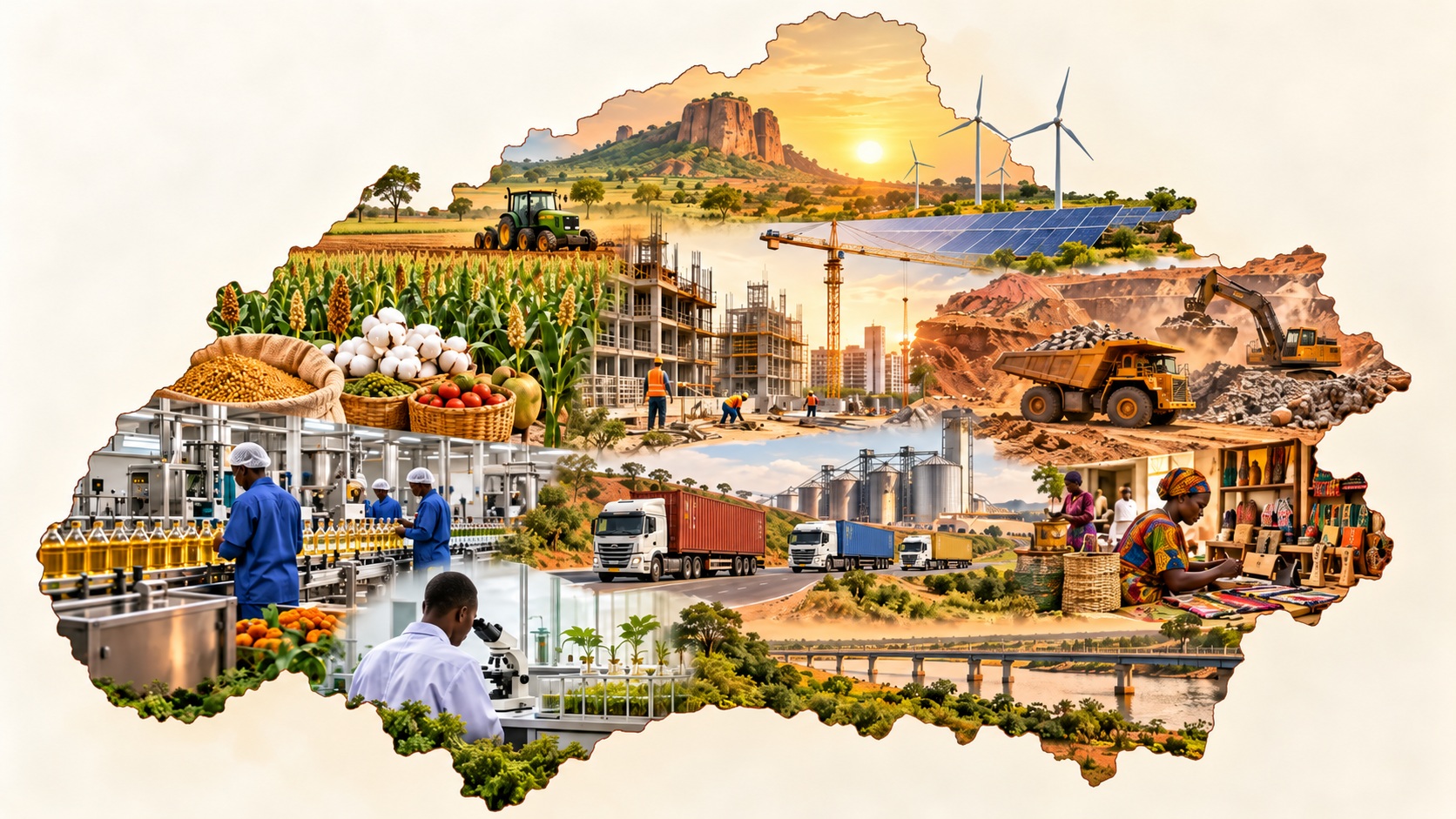
Burkina Faso’s Next Test Is Not Political. It Is Productive.
🌍 Vous lisez le réseau africain de l’innovation
EcoTech est un espace en croissance pour les agriculteurs, innovateurs, scientifiques, investisseurs et contributeurs qui construisent des solutions pratiques de durabilité.
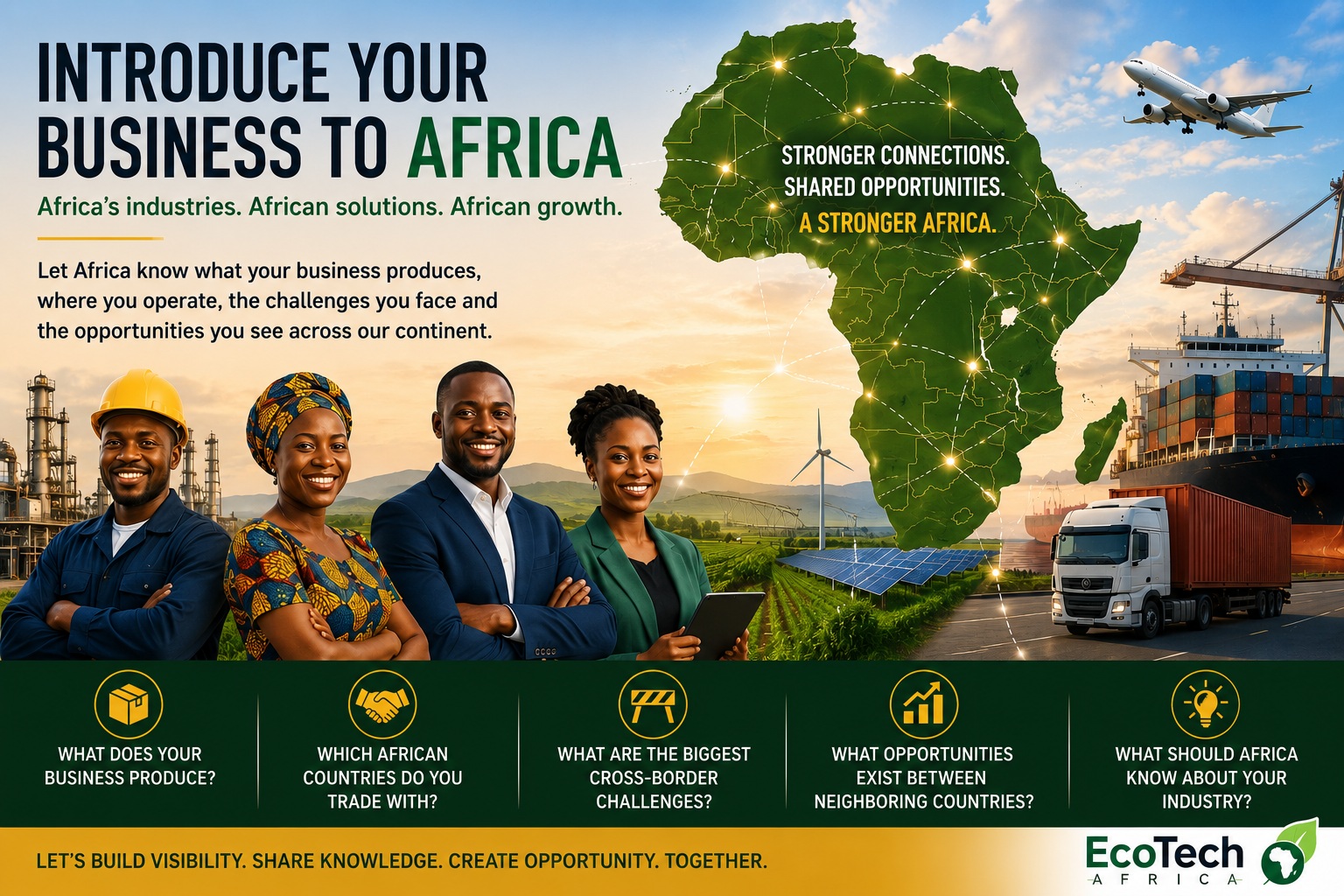
🌍 Connect With Burkina Faso’s Productive Economy
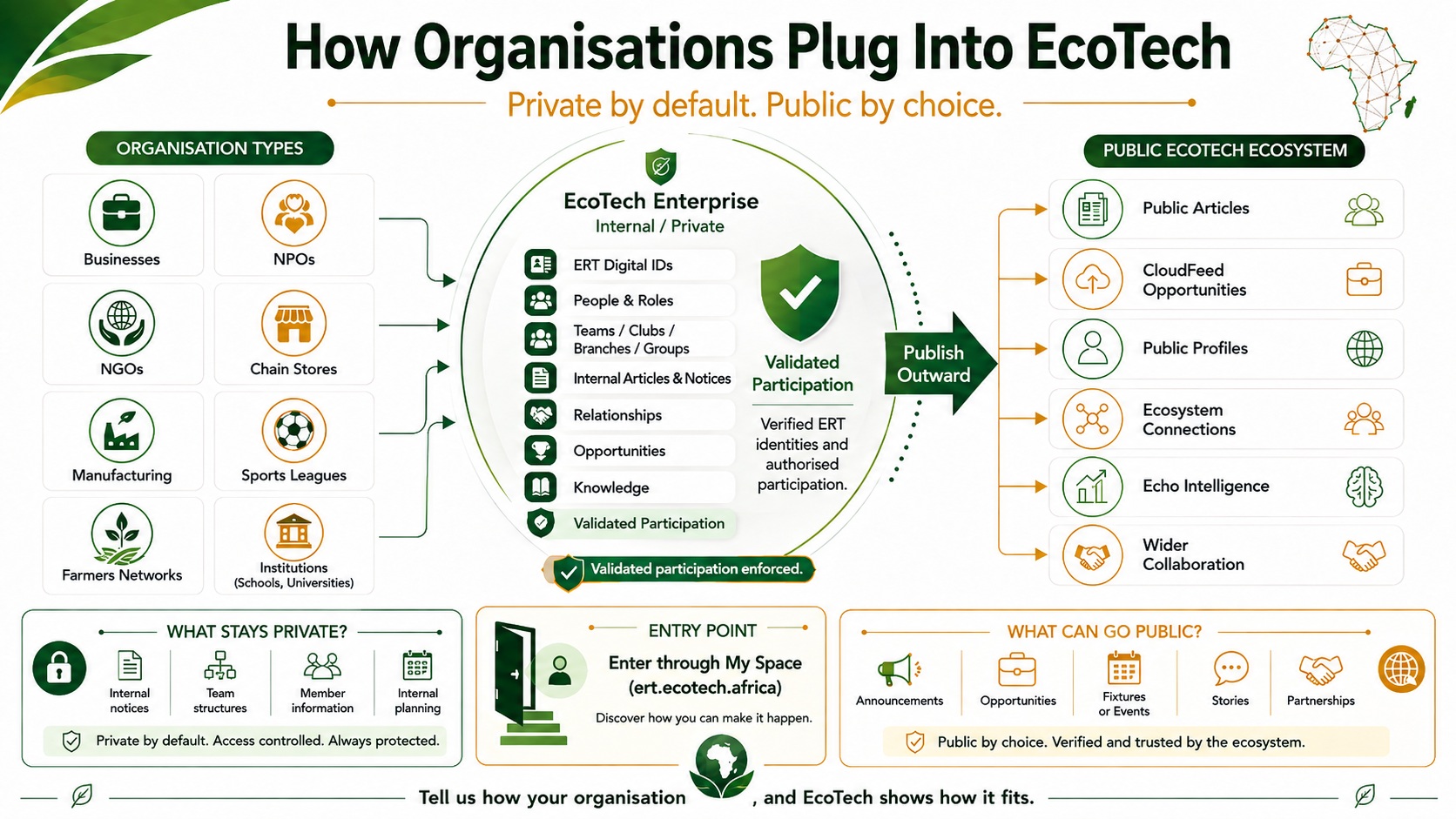
EcoTech invites businesses, producers, researchers, suppliers, investors and diaspora participants interested in Burkina Faso to identify capabilities, needs and potential partnerships across agriculture, processing, mining services, technology and regional trade.
Voir le parcours de participationGrowth becomes meaningful when it turns into stronger enterprises, processing, jobs, markets, knowledge and relationships that Burkinabè businesses can own.
Burkina Faso is entering an important economic moment.
The country has resources. It has farmers. It has entrepreneurs. It has young people looking for productive opportunity. It has mineral wealth, agricultural production, regional markets and a diaspora whose knowledge and commercial relationships extend far beyond its borders.
The question is no longer simply whether economic activity can grow.
The more important question is what Burkina Faso does with that growth.
Can agricultural production become processing businesses?
Can minerals create more local services, suppliers, skills and industrial capability?
Can small enterprises become visible enough to find customers, partners and finance?
Can researchers connect with producers?
Can businesses in Ouagadougou, Bobo-Dioulasso and other centres find counterparts elsewhere in Africa without first passing through networks outside the continent?
Can Burkinabè professionals abroad contribute knowledge, investment, markets and relationships back into productive activity at home?
Those are business questions.
And increasingly, they are the questions that will determine whether economic growth becomes something people can actually participate in.
Growth is already visible
Burkina Faso's economy has been showing resilience.
The World Bank estimates that real GDP expanded by 5.3% in 2025, compared with 4.8% in 2024. Agriculture benefited from favourable conditions and increased production, while services remained resilient and mining expanded significantly. Gold production reached about 94 tonnes in 2025, compared with 61 tonnes the previous year. World Bank
That matters.
But GDP growth on its own does not tell us whether a farmer gained access to a processor, whether an SME found a regional buyer or whether a young engineer found a company that needed her capability.
Those connections happen at a much more practical level.
Economic development becomes tangible when production becomes a relationship:
producer > processor > transporter > financier > buyer > market.
When those links are weak, value leaks out of the chain.
When they are strong, an economy begins to deepen.
Burkina Faso cannot stop at production
Agriculture offers one of the clearest examples.
Burkina Faso already produces.
The larger opportunity is to continually increase the amount of that production that moves into processing, packaging, logistics, technology, finance and market access.
In March 2026, the World Bank approved a $215.9 million agricultural transformation project for Burkina Faso aimed specifically at productivity, processing infrastructure, access to markets, private investment and technology adoption, with rice and maize among the priority value chains. World Bank
That direction is significant.
The economic opportunity is not simply to grow more maize.
It is also to mill it.
Package it.
Store it.
Transport it.
Finance it.
Supply equipment to the businesses processing it.
Develop technology around the supply chain.
Build quality assurance.
Create brands.
Find buyers.
Connect producers with markets inside Burkina Faso and beyond it.
The same principle applies across cotton, livestock, shea, horticulture and other productive sectors.
The World Bank's broader work on Burkina Faso has similarly argued for stronger links between agriculture and processing, greater livestock value addition and more off-farm economic activity. World Bank
That is where production begins to become an ecosystem.
Gold should create more than gold exports
Mining presents a similar question.
Burkina Faso is one of Africa's significant gold-producing economies, and rising production has been an important contributor to recent economic performance. World Bank
But a mining economy should not be measured only by how many tonnes leave the ground.
There is another economy around every mine.
Engineering.
Maintenance.
Water.
Environmental services.
Transport.
Protective equipment.
Laboratories.
Construction.
Data.
Food supply.
Energy.
Training.
Security systems.
Professional services.
Equipment repair.
Research.
Waste management.
Financial services.
The strategic business opportunity is therefore larger than mining itself.
It is the development of Burkinabè enterprises capable of supplying the mining economy.
That is how a resource sector begins supporting a broader industrial base.
A country does not have to manufacture every piece of mining equipment immediately.
It can begin by making more of the surrounding value chain visible, capable and connected.
The missing infrastructure is often the relationship
Africa frequently talks about finance as though lack of money is the only barrier facing smaller businesses.
It is not.
A business can also be constrained because the right people simply do not know that it exists.
A farmer may have production but no processor.
A processor may need supply but not know the producer.
A researcher may have knowledge but no commercial partner.
An entrepreneur may need equipment available from another African country but have no trusted route to the supplier.
An investor may be interested in Burkina Faso but struggle to identify credible enterprises.
A diaspora professional may want to participate but not know where his or her skills are actually needed.
These are relationship failures.
And relationship failures carry an economic cost.
For Burkina Faso, improving the business environment therefore involves more than roads, electricity and access to finance.
Those things are essential.
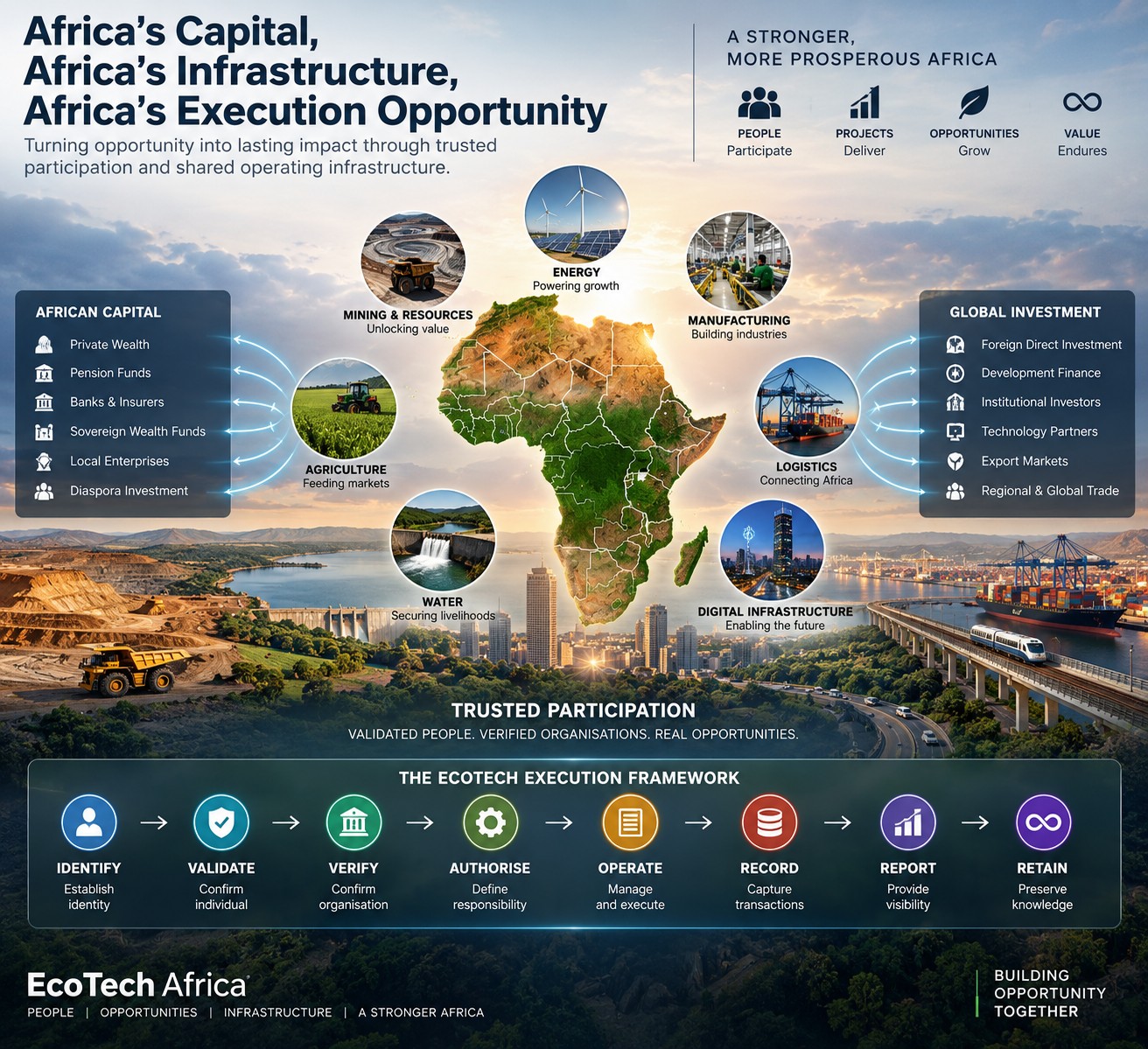
But productive economies also require identity, visibility, trust and structured connection.
Who is this business?
What does it actually do?
Where does it operate?
Who represents it?
What can it supply?
What does it need?
What relationships does it already have?
What opportunity is it looking for?
What evidence supports its claims?
Without answers to those questions, African businesses remain difficult to discover even when they are perfectly capable of doing the work.
Small enterprises need to become economically visible
This is particularly important for SMEs.
The World Bank Group's current Burkina Faso strategy places significant emphasis on private-sector development, SME finance, supply chains and job creation. IFC is also working with SMEs through initiatives intended to strengthen local firms and help promising companies become stronger national and regional economic players. World Bank
But strengthening SMEs requires more than financing them.
It requires bringing them into networks of actual economic activity.
A small agricultural processor should be able to discover producers.
A renewable-energy installer should be discoverable by businesses requiring power solutions.
A research organisation should be able to identify companies that could commercialise its work.
A mining-services company should be able to present its capabilities to customers outside the relationships it already knows.
An enterprise should be able to move from:
“We exist.”
to:
“This is what we can do, this is what we need, and these are the people with whom we can create value.”
That is a very different economic position.
The diaspora should become part of the productive network
Burkina Faso's economic network does not end at its borders.
Neither does Africa's.
Burkinabè professionals, entrepreneurs and families abroad can bring capital, technical knowledge, market access and relationships.
But diaspora engagement becomes far more useful when it moves beyond broad appeals to "invest back home."
Investment usually follows something concrete.
A business.
A project.
A person.
A capability.
A market.
A relationship.
Imagine a Burkinabè food processor being able to find a packaging specialist in Côte d'Ivoire, a logistics company in Ghana, an equipment supplier in South Africa and a diaspora market connection anywhere in the world. While each participant can see enough trusted information to know with whom they are dealing.
That is not an abstract continental integration project.
That is a supply chain.
And once businesses begin forming those relationships repeatedly, continental integration stops being a slogan and starts becoming ordinary commercial behavior.
French and English Africa need to meet each other economically
There is another barrier worth confronting.
Language.
Africa's businesses often operate inside linguistic corridors inherited from history.
Francophone networks interact heavily with Francophone markets.
Anglophone businesses do the same.
Yet agriculture, energy, mining, manufacturing, biotechnology, logistics and investment do not naturally belong to one language.
Burkina Faso may find a technology partner in Kenya.
A Ghanaian company may need a Burkinabè supplier.
A South African manufacturer may find an opportunity in Ouagadougou.
A Senegalese researcher may collaborate with a Ugandan institution.
The commercial relationship matters more than the colonial language dividing the two participants.
This is why the digital layer around African business matters.
Language should increasingly become something infrastructure helps people cross, rather than another reason for productive participants never to discover one another.
A practical test
The argument can be tested without trying to digitise an entire country.
Start smaller.
Take perhaps 20 to 50 genuine Burkinabè participants across agriculture, processing, SMEs, research, mining services and renewable energy.
Establish who they are.
Establish what businesses they operate.
Make their capabilities visible.
Identify what each one needs.
Connect them to industries.
Connect them to knowledge.
Connect them to opportunities.
Connect them to credible participants elsewhere in Africa and in the diaspora.
Then measure something much more useful than registrations.
Measure relationships.
Did a producer meet a processor?
Did a company identify a supplier?
Did a researcher meet an enterprise?
Did an SME receive an enquiry?
Did a business discover an opportunity outside Burkina Faso?
Did a diaspora participant make a productive local connection?
Those outcomes would tell us far more about whether digital infrastructure is contributing to economic development than the number of people who created accounts.
Burkina Faso's opportunity is productive depth
Economic resilience gives Burkina Faso something valuable: room to build.
The opportunity now is to deepen what already exists.
Agriculture can create processing.
Mining can create suppliers.
Entrepreneurship can create employment.
Research can create commercial applications.
Diaspora relationships can create markets and investment.
Digital infrastructure can make participants visible to one another.
And regional trade can turn individual businesses into value chains.
The most important measure will therefore not be whether Burkina Faso produces more.
It will be whether more Burkinabè people and enterprises participate in the value created by that production.
That is the productive test.
And it is one that matters far beyond Burkina Faso.
🚀 Connect With Burkina Faso’s Productive Economy
EcoTech invites businesses, producers, researchers, suppliers, investors and diaspora participants interested in Burkina Faso to identify capabilities, needs and potential partnerships across agriculture, processing, mining services, technology and regional trade.
Ce parcours est directement lié à cet article publié. Parcourez les opportunités EcoTech pour voir celle-ci et d’autres parcours de participation actifs aux côtés des opportunités CloudFeed.
Commentaires (0)
Rejoindre la conversation
Que pensez-vous de cet article ? Partagez votre point de vue, un exemple pratique ou une objection respectueuse.
Les commentaires font partie de la couche de participation EcoTech. Rejoindre à partir de R49, paiement unique to participate, or se connecter si vous avez déjà un compte.