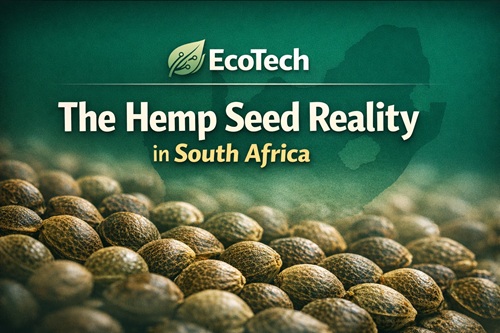
Is Your Hemp Seed Legal in South Africa?
🌍 You’re reading Africa’s innovation network
EcoTech is a growing space for farmers, innovators, scientists, investors and contributors building practical sustainability solutions.
A Growing Industry… Built on Uncertain Foundations
South Africa’s hemp industry is expanding rapidly. From CBD extraction projects to large-scale cultivation plans, interest has never been higher.
But behind the growth lies a critical question few are openly addressing:
Is the hemp seed being used actually compliant?
Recent public statements from suppliers claiming to import “several tons of hemp seed for growers” have raised important questions within the industry, particularly around compliance, traceability, and long-term risk.
Understanding the Legal Framework
Hemp seed in South Africa is regulated under strict agricultural laws, primarily:
• The Plant Improvement Act
• Oversight from the Registrar of Plant Improvement
For seed to be legally sold commercially:
• It must be registered on the national variety list, or
• Imported under specific permits (typically for trials or controlled projects)
This distinction is critical.
Imported does not automatically mean approved for commercial sale.
The Grey Area Hiding in Plain Sight
Due to limited locally registered seed varieties, a gap has formed in the market.
This has led to a growing grey zone where:
• Seed is legally imported
• But then redistributed outside permitted channels
In many cases, growers are unaware of the difference.
The result:
• Projects operating in regulatory uncertainty
• Increased risk for investors
• Potential non-compliance with hemp permits
The Hidden Risks for Growers
Using non-registered or improperly distributed seed can lead to:
• Permit violations
• Failed compliance audits
• Crop destruction in worst-case scenarios
• Loss of funding or partnerships
For medicinal and CBD-focused operations, this risk is even higher due to stricter traceability requirements.
Why This Problem Exists
The root cause is not bad intent, it’s structural:
• Very few hemp varieties are fully registered in South Africa
• The approval process is slow
• Demand is growing faster than regulation
This creates space for fast-moving suppliers to fill the gap, sometimes ahead of compliance.
The Real Opportunity
While many see a problem, forward-thinking operators will recognise something else:
This is one of the biggest untapped opportunities in the South African hemp industry.
The future belongs to companies that can provide:
• Registered and compliant seed varieties
• Certified genetics adapted to South African conditions
• Full traceability from seed to harvest
• Integration into a structured Quality Management System (QMS)
A Shift Toward Compliance-Based Ecosystems
As the industry matures, compliance will move from optional to essential.
The next phase of growth will be driven by:
• Transparent seed sourcing
• Regulated supply chains
• Investor-grade traceability
• Alignment with global export standards
Final Thought
South Africa doesn’t just need more hemp seed.
It needs trusted, compliant, and scalable seed systems.
Those who build this correctly won’t just participate in the industry, they will define it.
Growers and investors: have you experienced challenges with hemp seed compliance in South Africa?
Share your insights or reach out directly. The future of this industry depends on getting this right.


Comments (0)
Join the Conversation
What do you think about this story? Share your view, a practical example, or a respectful challenge.
Comments are part of the EcoTech participation layer. Join from R49 once-off to participate, or log in if you already have an account.