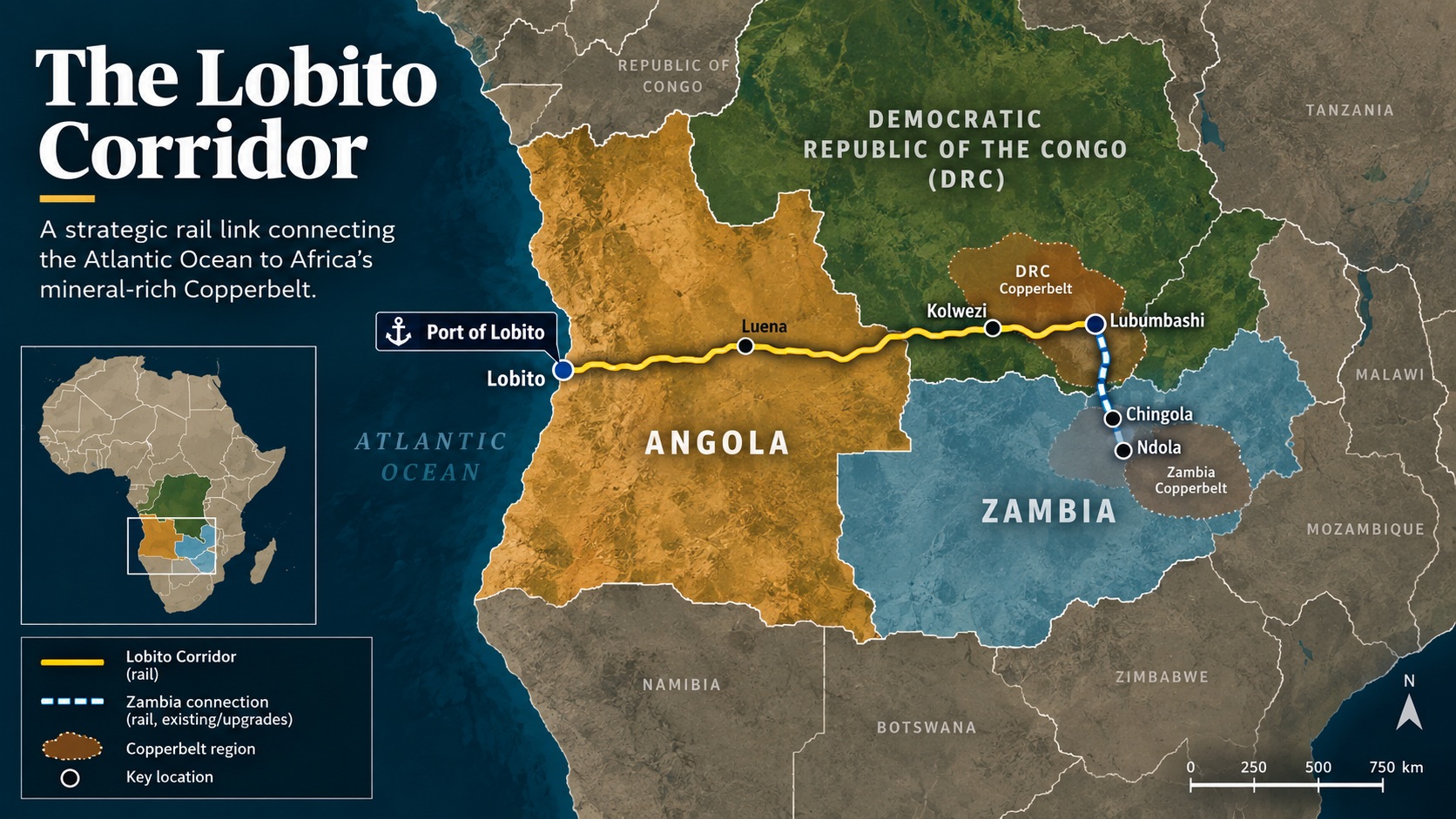
The Lobito Corridor Needs an Economic Map
🌍 You’re reading Africa’s innovation network
EcoTech is a growing space for farmers, innovators, scientists, investors and contributors building practical sustainability solutions.
🌍 Help Map the Lobito Corridor Economy
EcoTech invites businesses, suppliers, manufacturers, processors, researchers and institutions operating in Angola, the DRC and Zambia to identify their Areas of Activity and help build a practical map of African productive capability around the Lobito Corridor.
View Participation PathwayThe Lobito Corridor is usually described as a transport project.
A railway.
A trade route.
A connection between Angola, the Democratic Republic of the Congo and Zambia.
But that description may be too small for what the corridor could become.
The real question is not only:
What will move along the Lobito Corridor?
It is:
What economic activity will grow because the corridor exists?
That is where its long-term African value will be determined.
The corridor is already being designed as more than rail
Current official plans go beyond moving minerals to the Atlantic.
The African Development Bank describes the Lobito initiative as an integrated economic corridor, linking transport infrastructure with trade facilitation, agriculture, energy, urban development and institutional capacity. In August 2026, the Bank approved a US$255 million loan and a US$10 million grant to support Zambia’s participation in that broader corridor programme. Source: Africa Development Bank -
The European Union’s current programme similarly includes rail rehabilitation and expansion, agricultural value chains, renewable energy, vocational training, job creation and critical-mineral value chains. Source: International Partnerships -
That tells us something important.
The ambition is already broader than transport.
The challenge now is making that broader economy visible.
Infrastructure creates opportunity only when people can participate
Imagine the corridor operating at full capacity.
Trains move efficiently.
Border processes improve.
Freight reaches the Port of Lobito more quickly.
Minerals travel.
Agricultural goods move.
Industrial products begin moving across borders.
All of that matters.
But around every kilometre of infrastructure sits another economy.
Someone must manufacture components.
Someone must repair equipment.
Someone must provide transport.
Someone must feed workers.
Someone must provide warehousing.
Someone must process agricultural products.
Someone must maintain electrical systems.
Someone must supply protective equipment.
Someone must train technicians.
Someone must test minerals.
Someone must build roads.
Someone must provide water.
Someone must manage waste.
Someone must develop software.
Someone must provide finance.
The corridor therefore contains far more economic activity than the railway itself.
The problem is that much of that capability may be difficult to see.
The next question is: who can actually do the work?
Suppose a company operating along the corridor needs a steel fabricator.
Where does it find one?
A mineral processor needs laboratory services.
Who is available within the region?
A logistics business needs truck maintenance.
A farming cooperative needs cold storage.
A construction contractor needs electrical suppliers.
A training institution wants to partner with companies requiring welders, technicians and mechanics.
The opportunity may already exist.
The supplier may already exist.
The skill may already exist.
But unless those participants can discover one another, economic potential remains fragmented.
This is why the Lobito Corridor needs an economic map.
Not only a geographic map showing where the railway runs.
A map of capability.
Start with Industry
The first level is broad.
Agriculture
Manufacturing & Industry
Mining & Resources
Infrastructure
Renewable Energy
Water & Sanitation
Education & Skills
Investment & Development
These categories tell us where activity belongs.
But they are not detailed enough to connect supply and demand.
Then identify the Area of Activity
Under Manufacturing & Industry, for example:
Steel Fabrication.
Machining.
Industrial Pumps.
Electrical Components.
Packaging.
Agricultural Machinery.
Rail Components.
Industrial Maintenance.
Under Mining & Resources:
Mineral Processing.
Geological Services.
Assaying and Laboratories.
Mining Equipment.
Protective Equipment.
Environmental Rehabilitation.
Engineering.
Under Agriculture:
Grain Production.
Horticulture.
Cold Chain.
Agro-processing.
Irrigation.
Agricultural Logistics.
Food Manufacturing.
These are Areas of Activity.
And this is where the corridor starts becoming economically visible.
Imagine the Lobito Corridor as a living economic network
Instead of seeing only:
Angola > DRC > Zambia
imagine seeing:
Angola
Manufacturing & Industry
> Steel Fabrication
> Food Processing
> Industrial Maintenance
Agriculture
> Grain Production
> Horticulture
> Agro-processing
Transport & Logistics
> Freight
> Warehousing
> Vehicle Maintenance
Then:
DRC
Mining & Resources
> Copper
> Cobalt
> Mineral Processing
> Laboratories
> Engineering
Manufacturing & Industry
> Metal Fabrication
> Equipment Repair
> Industrial Supplies
Then:
Zambia
Mining & Resources
> Copper Services
> Mine Engineering
> Environmental Services
Agriculture
> Commercial Farming
> Food Processing
> Agricultural Equipment
Infrastructure
> Civil Works
> Roads
> Rail Support Services
Suddenly the corridor becomes more than infrastructure.
It becomes a network of people and enterprises.
Then we can see the gaps
This may be the most valuable part.
Imagine being able to see:
Lobito Corridor — Manufacturing & Industry
42 participating businesses
11 Areas of Activity
6 strong capability clusters
5 areas with limited local participation
Now we can ask useful questions.
Why are rail components still being imported?
Why is there limited cold-chain capacity?
Why are local equipment repair businesses not entering supply chains?
Where is laboratory capacity missing?
Where is training not aligned to actual industrial demand?
Which opportunities could be filled by businesses from neighbouring African countries?
A map like this does not merely show what exists.
It shows what is missing.
And missing capability is opportunity
That changes development planning.
Instead of saying:
“Africa needs more manufacturing.”
we can identify:
The corridor needs additional industrial pump suppliers.
Instead of:
“Young people need skills.”
we can identify:
Rail maintenance technicians, welders and electrical specialists are required in specific corridor locations.
Instead of:
“SMEs should participate.”
we can identify:
These particular Areas of Activity currently have insufficient local suppliers.
Now participation becomes practical.
The corridor is already generating real procurement activity
This is not theoretical.
In September 2026, the African Development Bank published requests for expressions of interest connected to construction supervision for sections of Zambia’s Mwinilunga–Jimbe Road under the Lobito Integrated Economic Corridor Development Project. Source: African Devlopment Bank -
Those procurement notices are examples of the economic activity that begins forming around major infrastructure.
But procurement is only one layer.
Around those formal opportunities sit subcontractors, suppliers, accommodation providers, equipment companies, food producers, transporters and specialist services.
That wider network is often much harder to identify.
A corridor should build production, not only movement
The World Bank has cautioned that infrastructure-first corridor development can produce uneven local benefits when broader economic integration is neglected. Its analysis of the Lobito Corridor argues that successful corridor development requires spatial development, integration of economic activities and stronger local economic participation rather than focusing only on the movement of commodities. Source: World Bank -
That is the deeper opportunity.
The railway should move goods.
But the economy around the railway should grow.
A mineral train should create demand for engineering.
Agricultural exports should create food-processing capacity.
Logistics should create warehousing.
Transport should create maintenance businesses.
Industry should create training.
Investment should create suppliers.
Those relationships are how infrastructure becomes development.
The map should be co-created
No central institution can realistically list every business and economic activity along a corridor stretching across three countries.
The participants themselves have to help build the picture.
A business should be able to say:
We operate in Zambia.
Our Industry is Manufacturing & Industry.
Our Area of Activity is Steel Fabrication.
We can supply projects within 300 kilometres of the corridor.
Another may say:
We operate in Angola.
Our Industry is Agriculture.
Our Area of Activity is Agro-processing.
Another:
DRC.
Mining & Resources.
Laboratory Services.
Over time, the economic map grows from real participation.
That is more valuable than trying to predict every possible category in advance.
Then Africa can measure something new
We already measure:
Rail kilometres.
Investment amounts.
Cargo volumes.
Export values.
Jobs.
Construction progress.
Those measures remain important.
But we should also begin measuring:
How many African businesses participate?
How many Areas of Activity are represented?
How many local suppliers are entering the value chain?
Where are the capability gaps?
How many cross-border business relationships are forming?
How much processing takes place before raw materials leave?
How much productive capacity remains because the corridor exists?
That gives us a much clearer picture of whether infrastructure is strengthening the economy around it.
From transport corridor to production corridor
The Lobito Corridor has the potential to become one of Africa’s most important regional economic connections.
Its value should not be measured only by how quickly copper reaches the Atlantic.
It should also be measured by what develops alongside the route.
Factories.
Processing businesses.
Farms.
Engineering companies.
Training centres.
Logistics firms.
Technology providers.
Suppliers.
Small businesses.
Regional partnerships.
And new productive capability.
Perhaps the most important map of the Lobito Corridor will therefore not show the railway at all.
It will show who can produce, supply, repair, process, transport, train and build because the railway is there.
That is the economic map Africa now has an opportunity to create.
And if we can see that map clearly, we can begin connecting what already exists, identifying what is missing, and turning infrastructure into wider African participation.
🚀 Help Map the Lobito Corridor Economy
EcoTech invites businesses, suppliers, manufacturers, processors, researchers and institutions operating in Angola, the DRC and Zambia to identify their Areas of Activity and help build a practical map of African productive capability around the Lobito Corridor.
This pathway is linked directly to this published story. Browse EcoTech Opportunities to see this and other active participation pathways alongside CloudFeed opportunities.





Comments (0)
Join the Conversation
What do you think about this story? Share your view, a practical example, or a respectful challenge.
Comments are part of the EcoTech participation layer. Join from R49 once-off to participate, or log in if you already have an account.