
One Ecosystem, Different Structures — How EcoTech Fits African Business Together
🌍 You’re reading Africa’s innovation network
EcoTech is a growing space for farmers, innovators, scientists, investors and contributors building practical sustainability solutions.
Africa's economy is not made up of one kind of organisation.
A continent-wide business ecosystem has to accommodate the person running a single business, a company with several branches, an organisation divided into departments, an industry body representing hundreds or thousands of members, and affiliated partners working alongside one another without becoming part of the same company.
Those structures are very different.
EcoTech is being built so they do not have to be treated as though they are the same.
The principle is simple:
Every participant should be able to enter EcoTech as they actually exist.
A single-owner business should not need an artificial corporate structure simply to participate.
A large Enterprise should not have to flatten its branches, departments and authorised people into one basic Business Profile.
And an industry association should be able to connect its members and affiliated organisations without pretending that it owns or controls those businesses.
That distinction is important if EcoTech is going to reflect the way Africa really operates.
The single business remains important
At one end of the ecosystem may be an entrepreneur operating one business from one location.
That business can establish its own trusted presence within EcoTech.
It can have its Business Profile, relationships, documents, commercial activity, publishing presence and opportunities without needing to create departments or multiple branches that do not exist.
The platform should grow with the business rather than requiring the business to grow into the platform first.
That makes participation practical for SMEs, owner-managed businesses and emerging enterprises.
A single business is not a smaller version of something more important.
It is a complete participant in its own right.
Enterprise allows complexity when complexity is real
At the other end may be an organisation operating across several locations.
It might have a head office, provincial offices, retail branches, factories, research facilities or operations in several African countries.
It may also have departments such as finance, human resources, operations, research, sales or procurement.
EcoTech's Enterprise model is intended to represent that organisational reality.
The Enterprise becomes the broader authorised environment.
Branches can exist within the organisation.
Departments can represent functional structures.
People can be associated with the Enterprise in different capacities.
Permissions can determine what those people are allowed to see and operate.
Documents and commercial activity can remain within the appropriate organisational context.
This avoids a common digital problem where a complex organisation is reduced to one username, one profile and one undifferentiated set of information.
EcoTech instead needs to understand the structure behind the organisation.
A branch is connected without becoming a separate universe
Branches are particularly important.
An Enterprise with many branches should be able to preserve the identity of the wider organisation while recognising the operational reality of individual locations.
A branch may have its own people, activity, responsibilities, opportunities and relationships while still forming part of the same Enterprise.
That creates a hierarchy without creating unnecessary fragmentation.
The same principle applies to departments.
A finance department and a research department may belong to the same Enterprise while having very different responsibilities and permissions.
EcoTech can therefore connect them at organisational level while still respecting their operational boundaries.
Industries create another kind of connection
Industry structure is different again.
An industry is not necessarily an Enterprise.
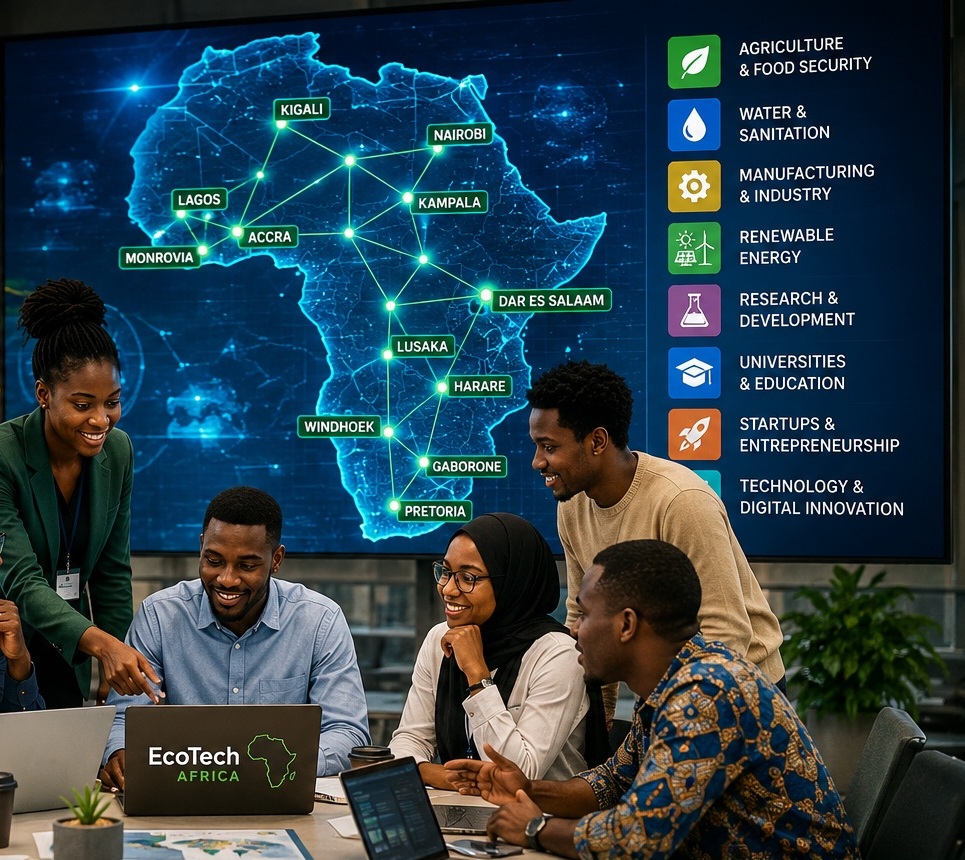
Agriculture, water and sanitation, biotechnology, manufacturing, renewable energy and other sectors are wider economic environments containing many independent participants.
EcoTech uses industries to help organise discovery, knowledge, relationships, publishing and opportunity around common areas of activity.
A business can therefore belong within an industry context without being owned by that industry.
A large Enterprise and a single-owner business can appear alongside one another because both participate in the same economic sector.
A researcher may contribute knowledge to that industry.
An investor may search for opportunities within it.
An industry body may connect organisations operating across it.
The industry becomes a point of connection and discovery, not a corporate owner.
Affiliation is not the same as ownership
The same distinction matters for partners and associations.
An organisation may be affiliated with another organisation without becoming one of its branches.
A chamber, industry body, research network or development organisation may have relationships with hundreds of businesses.
Those businesses should remain independent.
EcoTech therefore needs to distinguish between:
ownership, organisational authority and affiliation.
An Enterprise controls its own authorised structure.
An affiliated organisation has a relationship.
Those two things should never automatically mean the same thing.
That allows EcoTech to represent networks without destroying the independence of the organisations inside those networks.
Imagine an African industry inside EcoTech
Consider what this could look like in practice.
An industry space may contain a major Enterprise operating through twenty branches.
Alongside it could be a family-owned company with one location.
A university research unit could contribute research.
An industry association could connect participating businesses.
A development organisation could be affiliated with several programmes.
An investor could discover businesses seeking capital.
A supplier could find potential customers.
Each participant remains itself.
What connects them is the ecosystem around them.
That is fundamentally different from trying to place everyone inside one organisational hierarchy.
EcoTech is not trying to make Africa into one company.
It is building infrastructure through which different African organisations can find one another and operate together while remaining independent.
Identity remains underneath everything
The structure begins with the individual.
People establish their own EcoTech identity.
From there, relationships can connect them to businesses, Enterprises, branches, departments and other organisations.
But a relationship does not automatically create authority.
Someone may be affiliated with an organisation without being permitted to operate it.
Someone may work in one department without having access to another.
Someone may manage a branch without controlling the entire Enterprise.
That is why EcoTech separates:
identity, relationship and authority.
The distinction becomes increasingly important as organisational structures become larger.
Small and large organisations can therefore coexist
This architecture gives EcoTech an important characteristic.
The same ecosystem can accommodate very different scales of participation.
A sole owner does not need twenty corporate features they will never use.
A multinational Enterprise does not have to operate as though it were a single-location SME.
An industry organisation does not have to own its members.
An affiliated partner does not have to surrender its own identity.
And branches and departments can remain connected to the organisation they actually belong to.
The platform adapts to the structure rather than forcing the structure to adapt to the platform.
Connecting Africa without flattening Africa
Continental connection does not require uniformity.
Africa's organisations vary enormously in scale, ownership, structure and purpose.
Some are young businesses.
Some are family enterprises.
Some operate nationally.
Some span several countries.
Some represent entire sectors.
Some exist primarily to research, invest, develop or connect others.
A useful continental ecosystem has to preserve those differences while making relationships between them easier.
That is the direction EcoTech is taking.
One individual can have one trusted identity.
A single business can participate as itself.
An Enterprise can organise its branches, departments and authorised people.
Industry spaces can connect independent participants.
Affiliated partners can build relationships without losing their independence.
And all of them can exist inside the same connected EcoTech ecosystem.
Because connecting Africa should not mean making every African organisation look the same.
It should mean giving very different organisations a trusted way to find one another, understand one another and work together.



Comments (0)
Join the Conversation
What do you think about this story? Share your view, a practical example, or a respectful challenge.
Comments are part of the EcoTech participation layer. Join from R49 once-off to participate, or log in if you already have an account.