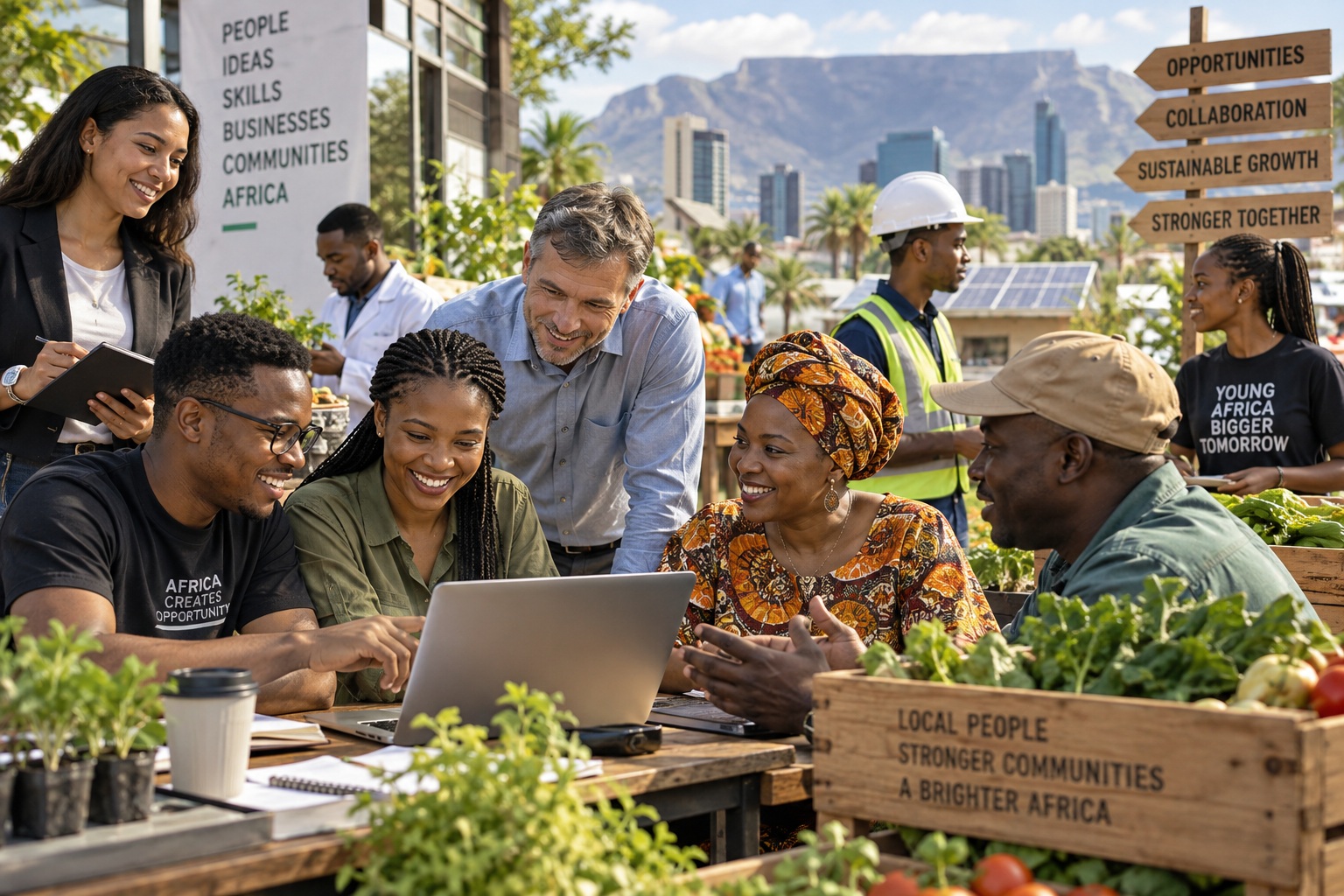
People Are the Network Connecting Africa
🌍 Vous lisez le réseau africain de l’innovation
EcoTech est un espace en croissance pour les agriculteurs, innovateurs, scientifiques, investisseurs et contributeurs qui construisent des solutions pratiques de durabilité.
🌍 Help Connect Africa’s Existing Networks
Are you part of a business, professional association, community organisation, university, faith community, farmer network, youth organisation or other African network? Share how your community already connects people and where practical digital tools, knowledge sharing or cross-border collaboration could make those relationships more useful.
Voir le parcours de participationAfrica is investing in fibre, roads, power, data centres, artificial intelligence, logistics and cross-border trade systems.
All of these matter.
But infrastructure becomes economically meaningful only when people can use it.
Across the continent there are already millions of people connected through businesses, professional associations, chambers, universities, faith communities, farmer organisations, youth networks, cooperatives, civil society organisations and community institutions.
These networks are often discussed socially or institutionally.
Perhaps they should also be understood as human infrastructure.
They already contain trust.
They already contain relationships.
They already contain skills, businesses, local knowledge, customers, suppliers, mentors, professionals and young people looking for opportunities.
The next stage of Africa's development may therefore depend not only on building new infrastructure, but on making the networks we already have more capable of participating in what is being built.
That means helping a small business in Zambia discover a customer in Kenya.
Helping a professional in South Africa mentor an entrepreneur in Rwanda.
Helping a manufacturer in Ghana identify a supplier elsewhere on the continent.
Helping a young person in Uganda discover training or employment beyond the boundaries of the community immediately around them.
And helping trusted organisations connect their people to economic activity without having to rebuild the same administrative and digital infrastructure repeatedly.
Africa does not need to manufacture every relationship from the beginning.
Many of the relationships already exist.
The opportunity is to make them more useful to the people inside them.
Why this matters to Africa
Africa's continental ambitions increasingly depend on participation.
The African Continental Free Trade Area can create market access.
Fibre can provide connectivity.
Artificial intelligence can expand capability.
Digital payments can move money.
Transport infrastructure can move goods.
But none of these automatically creates economic participation.
People, businesses and institutions still need to discover one another, establish trust, exchange information and turn opportunity into activity.
That is why human infrastructure deserves the same attention we give physical and digital infrastructure.
EcoTech Insight
Africa does not only need more networks. It needs existing networks to become more useful.
Digital infrastructure should strengthen human relationships rather than attempt to replace them.
The opportunity is to connect trusted communities to practical tools for identity, enterprise, knowledge, communication and market participation.
TRADE & ENTERPRISEAfrica’s Small Businesses Are Being Prepared to Trade Across Borders
The UN Economic Commission for Africa and DHL Express Sub-Saharan Africa have signed an agreement aimed at helping African micro, small and medium-sized enterprises participate more effectively in cross-border trade.
The programme will be delivered through DHL's GoTrade initiative and will focus on practical areas including logistics, digital trade, customs procedures and market access.
Women- and youth-led businesses will receive particular attention.
The initiative is designed to help SMEs participate both through Africa's regional economic communities and through the African Continental Free Trade Area.
This addresses an important gap in Africa's trade conversation.
Opening a continental market is one achievement.
Helping an ordinary business understand how to reach that market is another.
For many SMEs, the barrier is not a lack of products or ambition. It is the practical complexity between having something to sell and getting it into another market.
Documentation, logistics, customs, payments, visibility and finding customers all sit between those two points.
Reducing that complexity could bring substantially more African businesses into intra-African trade.
Why this matters to Africa
AfCFTA will ultimately be judged not only by the movement of major corporations across borders, but by whether ordinary African enterprises can participate.
A continental market becomes more meaningful when a small manufacturer, farmer, service provider or retailer can find and serve customers beyond their home market.
EcoTech Insight
Market access must eventually become usable access.
Businesses need more than trade agreements. They need identity, visibility, information, distribution, documentation and practical ways to connect with customers and partners.
TECHNOLOGY & DIGITAL INFRASTRUCTUREA Korea–Africa AI Hub Moves From Discussion Toward Practical Cooperation
The African Development Bank and the Republic of Korea have agreed to establish a Korea–Africa Hub for Artificial Intelligence.
The initiative is intended to bring together governments, financial institutions, research centres, universities and businesses around AI and digital projects in Africa.
The agreement follows the Korea-Africa Economic Cooperation Ministerial Conference held in Seoul earlier this month and forms part of a wider programme focused on artificial intelligence, digital infrastructure and human-capital development.
This is important because Africa's AI conversation cannot remain limited to access to foreign technology.
The continent needs researchers.
It needs technical skills.
It needs datasets.
It needs businesses capable of applying AI.
And it needs institutions capable of understanding how these technologies affect African economies and societies.
The AfDB has also entered into a cooperation framework with Korea's KAIST focused on AI, digital governance, research, knowledge transfer and training African public officials, researchers and technical specialists.
The infrastructure around AI is therefore beginning to expand beyond computing capacity.
It is increasingly becoming an ecosystem of people, research, institutions and investment.
Why this matters to Africa
Technology becomes economically valuable when African institutions and businesses develop the capability to use, adapt and govern it.
Africa should not participate in the AI economy only as a consumer.
EcoTech Insight
Digital infrastructure without human capability remains underused infrastructure.
Africa's technology investment must connect computing, research and connectivity with the people and enterprises capable of turning those resources into practical activity.
YOUNG AFRICAAsk Young Africans About the Job They Hope For
The World Bank has launched The Job I Hope For, an initiative inviting young Africans to describe the jobs they hope to have, what inspires those ambitions and what they believe they need to get there.
Participants will also receive introductory artificial-intelligence training.
The programme is open across Africa, with English and French sessions planned for October.
The World Bank notes that more than 600 million young people are expected to enter Africa's labour market between now and 2050.
That number is enormous.
But the more important question is what those young people will actually be able to do.
Africa's youth challenge cannot be addressed only by telling people to acquire skills.
There has to be somewhere for those skills to go.
Education therefore has to become increasingly connected to businesses, entrepreneurship, markets, technology and real economic demand.
A young person's ambition should not disappear into a database after training is completed.
It should become visible to the environments where opportunity exists.
Why this matters to Africa
Africa's demographic advantage becomes an economic advantage only when young people can translate ability into meaningful participation.
Skills development and opportunity discovery must therefore become increasingly connected.
EcoTech Insight
Training is only half of the journey. Discovery is the other half.
Africa needs better ways for young people, employers, businesses, mentors and institutions to find one another.
HEALTH & SAFETYEbola: Progress in Some Areas, But the DRC Outbreak Remains Serious
There are encouraging signs in parts of the Democratic Republic of the Congo's Ebola response, but health authorities are warning that the outbreak remains far from over.
The World Health Organization reported that transmission has declined in some areas, particularly Ituri, while other regions remain under serious pressure.
By 7 September, WHO had recorded 6,757 confirmed cases and 3,267 deaths in the DRC, affecting 61 health zones across six provinces. Subsequent WHO reporting showed the outbreak expanding further, including into a seventh province.
WHO and Congolese authorities have continued surveillance, vaccination and frontline response efforts, while scientists are also working to understand how effectively existing and candidate vaccines can address the Bundibugyo strain responsible for the outbreak.
The lesson extends beyond one outbreak.
Disease does not respect provincial or national borders.
Health preparedness therefore depends increasingly on information moving quickly between communities, health workers, laboratories and countries.
Why this matters to Africa
Regional health security requires strong local systems.
Early detection, trusted communication, trained health workers, reliable data and cross-border cooperation remain as important as emergency intervention after an outbreak has already expanded.
EcoTech Insight
Health resilience is also information infrastructure.
The faster trusted information can move between people, institutions and countries, the earlier communities can respond.
OPPORTUNITY & INVESTMENTAfrica Is Attracting Capital — The Question Is Where It Reaches
International development finance is placing increasing emphasis on mobilising private capital into infrastructure and development.
The World Bank reported that it mobilised a record $112 billion in private capital during its 2026 fiscal year, with infrastructure representing a substantial component of its financing activity.
At the same time, African institutions are pursuing more targeted investment partnerships.
The African Development Bank and Korea's Export-Import Bank have strengthened their co-financing framework around areas including AI, digital infrastructure, energy, transport and critical minerals.
The AfDB says earlier Korea-Africa cooperation has helped develop an investment pipeline exceeding $6 billion and mobilise approximately $4 billion in financing.
Capital is therefore looking toward Africa.
But large investment announcements should always lead to another question:
How much economic activity develops around that investment?
A data centre creates greater value when local businesses can use the infrastructure around it.
A transport corridor creates greater value when enterprises along the corridor can reach new markets.
Digital infrastructure creates greater value when entrepreneurs can build on top of it.
The investment itself is therefore only the beginning.
Why this matters to Africa
Africa should measure investment not only by capital committed, but by the economic participation that develops around it.
EcoTech Insight
Infrastructure investment should create participation around the infrastructure.
The opportunity is not only to finance major projects, but to connect African enterprises and communities to the economic activity those projects make possible.
PARTICIPATIONWe May Already Be More Connected Than We Realise
Africa is often described as fragmented.
Fifty-four countries.
Thousands of communities.
Multiple languages, currencies, legal systems and markets.
Yet another Africa exists underneath those boundaries.
People belong to professional associations that cross borders.
Farmers belong to agricultural organisations.
Businesses belong to chambers.
Students and academics belong to university networks.
People belong to faith communities.
Young people participate in continental organisations.
Families live across several countries.
Professionals collaborate internationally every day.
These networks rarely appear on infrastructure maps.
But they are infrastructure nonetheless.
They contain relationships through which knowledge can travel.
Trust can travel.
Opportunity can travel.
Business can travel.
Mentorship can travel.
And ideas can become practical action.
Africa therefore does not always need to begin by asking:
How do we connect everyone?
Sometimes the better question is:
Who is already connected — and what would happen if we gave those people better ways to participate together?
That is a very different development model.
Instead of attempting to manufacture communities digitally, technology can strengthen communities that already exist.
Instead of replacing relationships, it can make those relationships more capable.
Instead of counting users, we can begin counting useful outcomes.
A business found.
A supplier discovered.
A mentor connected.
A document shared.
A customer reached.
An opportunity identified.
A young person introduced to someone who can help them move forward.
That is where infrastructure becomes participation.
Closing Thought
Africa is building roads.
Africa is building fibre.
Africa is building data centres.
Africa is building payment systems.
Africa is building trade corridors.
Africa is investing in artificial intelligence.
But perhaps one of the continent's greatest assets has been sitting in plain sight throughout this process:
Africans are already connected to Africans.
The next opportunity is to make those connections more useful.
🚀 Help Connect Africa’s Existing Networks
Are you part of a business, professional association, community organisation, university, faith community, farmer network, youth organisation or other African network? Share how your community already connects people and where practical digital tools, knowledge sharing or cross-border collaboration could make those relationships more useful.
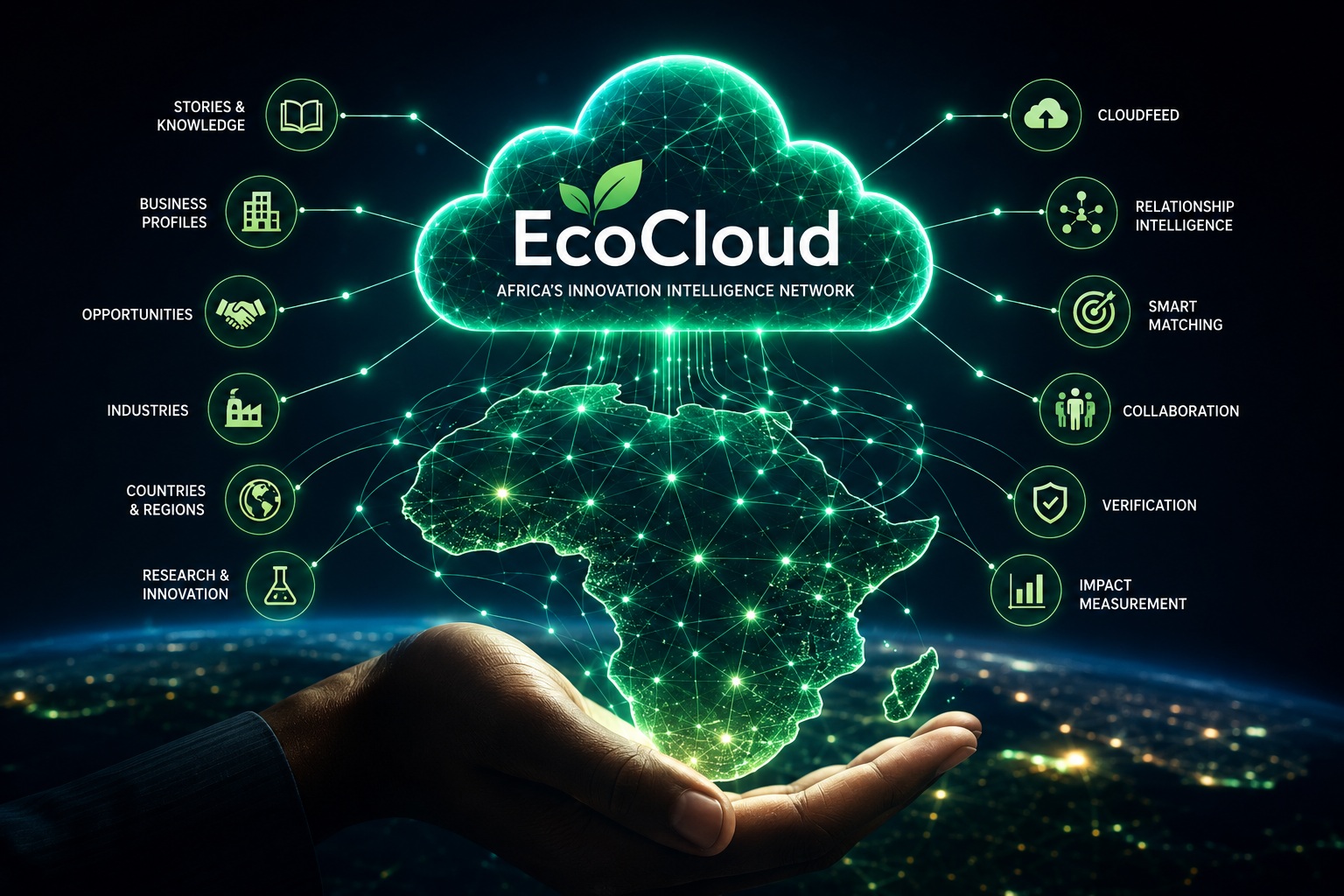
Ce parcours est directement lié à cet article publié. Parcourez les opportunités EcoTech pour voir celle-ci et d’autres parcours de participation actifs aux côtés des opportunités CloudFeed.



Commentaires (0)
Rejoindre la conversation
Que pensez-vous de cet article ? Partagez votre point de vue, un exemple pratique ou une objection respectueuse.
Les commentaires font partie de la couche de participation EcoTech. Rejoindre à partir de R49, paiement unique to participate, or se connecter si vous avez déjà un compte.