What Knowledge Does Africa Lose When Nobody Funds the Proof?
🌍 You’re reading Africa’s innovation network
EcoTech is a growing space for farmers, innovators, scientists, investors and contributors building practical sustainability solutions.
🌍 Help Identify African Knowledge Worth Testing
Do you know of a traditional practice, plant, agricultural method, natural material, water-treatment approach or community innovation that deserves scientific investigation? Researchers, communities, institutions and investors can express interest in documenting, testing or supporting promising African knowledge through structured research and validation.
View Participation PathwayThere is a story that circulates often online.
It usually goes something like this:
More than a century ago, powerful financiers helped reshape medicine around pharmaceutical drugs, while natural and traditional approaches were pushed aside.
It is an attractive story because it contains elements of truth.
But the history is more complicated.
The 1910 Flexner Report played a major role in transforming medical education in North America. It pushed medical schools toward university affiliation, laboratory science, clinical training, stronger academic standards and formal accreditation.
At the same time, many proprietary, homeopathic, eclectic and other medical schools disappeared in the decades that followed.
Large philanthropic institutions, including those associated with Carnegie and Rockefeller, helped finance the new scientific model of medical education.
That part of the history is important.
But it does not prove the much stronger claim that modern medicine was deliberately designed around repeat prescriptions purely to create permanent pharmaceutical customers.
The reforms also addressed a genuine problem.
At the beginning of the twentieth century, many medical schools operated with weak academic standards, limited laboratory facilities and inconsistent clinical training.
Science improved medicine enormously.
That should not be dismissed.
But there is another question hidden inside this history.
And it may matter much more to Africa.
What Happens When Only One Knowledge System Receives Enough Support to Survive?
Knowledge does not become accepted simply because it is correct.
It often requires institutions.
It requires research funding.
It requires laboratories.
It requires universities.
It requires researchers.
It requires journals.
It requires intellectual property protection.
It requires clinical or technical validation.
And, perhaps most importantly, it requires somebody willing to finance the process long enough for evidence to emerge.
When one system receives those resources and another does not, the difference between them can eventually appear to be a difference between “knowledge” and “belief.”
Sometimes it is.
But sometimes the difference is simply that one idea received the resources required to prove itself.
That is an important distinction for Africa.
Africa Has Knowledge That Has Never Had the Chance to Become EvidenceAcross the continent, communities have accumulated knowledge over generations.
Knowledge about plants.
Knowledge about soils.
Knowledge about water.
Knowledge about food preservation.
Knowledge about healing practices.
Knowledge about biodiversity.
Knowledge about farming systems.
Knowledge about natural materials.
Knowledge about local manufacturing methods.
Knowledge about how particular environments behave.
Some of that knowledge may prove scientifically valuable.
Some of it may not.
That is precisely the point.
We should find out.
Africa should not be forced into a false choice between accepting traditional knowledge blindly and rejecting it automatically.
There is a much stronger third option:
Test it.
Document it.
Study it.
Validate it.
Improve it.
Preserve what works.
Reject what does not.
And where something proves valuable, build the intellectual property, manufacturing capacity and enterprise around it.
That is not anti-science.
That is science.
Traditional Knowledge Should Not Be Protected From TestingThere is sometimes a tendency to treat indigenous or traditional knowledge as something that must simply be respected because it is old.
That is not enough.
If a plant is claimed to have a medical, agricultural or industrial property, that claim should be investigated.
If a natural material appears capable of purifying water, it should be characterised.
If a traditional agricultural method improves soil performance, it should be measured.
If a local food has nutritional properties, they should be quantified.
If a community practice does not work, we should be willing to say so.
Respect for knowledge does not mean protecting it from scrutiny.
It means taking it seriously enough to investigate.
The Funding QuestionThis is where the larger question begins.
Who funds the proof?
A researcher may recognise something promising.
A farmer may have observed it for decades.
A community may have used it for generations.
But moving from observation to accepted knowledge can require years of work.
Samples need to be collected.
Experiments need to be designed.
Variables need to be controlled.
Laboratories need to be used.
Results need to be repeated.
Safety needs to be established.
Researchers need to be paid.
Regulatory processes may need to be followed.
Products need to be developed.
Manufacturing methods need to be established.
Intellectual property needs to be protected.
Without that infrastructure, promising knowledge can remain exactly where it began:
inside a community.
And eventually, it may disappear.
Africa Should Not Export Knowledge Before It Understands Its ValueThere is another risk.
African biological resources and traditional knowledge have often attracted outside interest.
Once something becomes commercially valuable, the companies with the strongest research capability, capital and intellectual-property systems are often the ones best positioned to turn it into a product.
The original knowledge may have come from an African community.
The raw material may have come from African biodiversity.
But the patent, manufacturing, brand and commercial value may ultimately sit somewhere else.
This is why scientific validation and economic participation should be connected.
Research should not end with a published paper.
Where appropriate, it should create a pathway:
community knowledge ? documentation ? research ? scientific validation ? intellectual property ? enterprise ? manufacturing ? market participation
That chain matters.
Without it, Africa risks contributing the knowledge while somebody else builds the industry.
Natural Does Not Automatically Mean BetterIt is equally important not to romanticise natural products.
Nature contains medicines.
Nature also contains poisons.
Traditional knowledge can contain valuable insights.
It can also contain assumptions that do not survive scientific testing.
Modern pharmaceuticals can save lives.
They can also be overused, poorly prescribed or developed within commercial systems that deserve scrutiny.
The question should therefore never be:
Natural or pharmaceutical?
The better question is:
What does the evidence show?
That standard protects both science and society.
Africa Needs Infrastructure for ProofMuch of Africa's development conversation focuses on physical infrastructure.
Roads.
Ports.
Electricity.
Fibre.
Data centres.
Water systems.
All of these are essential.
But there is another kind of infrastructure Africa needs:
infrastructure that allows an idea to become evidence.
Research institutions.
Shared laboratories.
Bioprocessing facilities.
Universities.
Field trials.
Research databases.
Scientific publishing.
Regulatory expertise.
Intellectual-property support.
Enterprise development.
Funding mechanisms willing to support early-stage investigation.
Without these systems, potentially valuable African knowledge can remain invisible to the formal economy.
A Different Development ModelImagine a farmer identifies a plant characteristic that appears useful.
Instead of that knowledge remaining local, it is documented.
A university or research institution investigates it.
The results are tested independently.
A business develops an application.
Intellectual property is protected appropriately.
Local manufacturing is established.
Farmers become suppliers.
Researchers continue improving the technology.
Communities participate in the resulting value chain.
That is not simply the preservation of traditional knowledge.
It is the creation of new African industry.
The Question Africa Should AskThe lesson from the history of medical education is not that science should be rejected.
Science should be strengthened.
But we should also recognise that institutions determine which questions receive serious attention.
Funding determines which experiments are possible.
Infrastructure determines which ideas can be tested.
And commercial systems often determine which discoveries eventually reach society.
Africa therefore needs to ask a difficult question:
How much potentially valuable knowledge has disappeared because nobody funded the proof?
The answer may never be known.
But we can decide what happens next.
We can build systems that allow African knowledge to be examined rather than ignored.
We can connect communities with researchers.
We can connect researchers with laboratories.
We can connect validated knowledge with enterprise.
And we can ensure that when African knowledge creates economic value, Africans are able to participate in that value.
The objective should not be to choose between tradition and science.
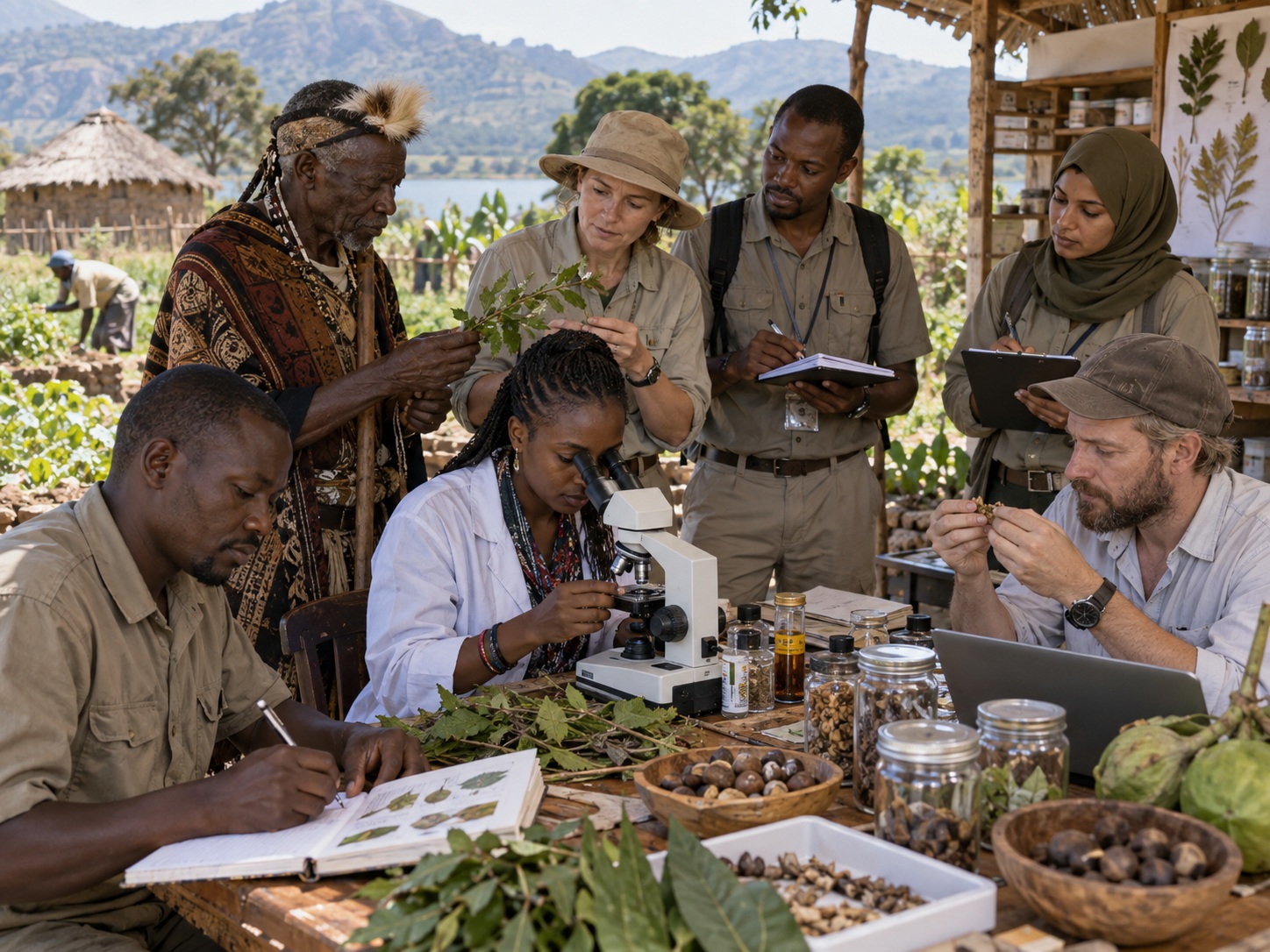
It should be to bring the two into the same room.
Then let the evidence decide.
EcoTech Insight
Africa needs more than systems for storing information.
It needs infrastructure that helps knowledge move from observation to evidence and from evidence to practical use.
A trusted digital environment can help document research leads, connect communities with researchers, preserve authorised knowledge, identify collaboration opportunities and create pathways between research, enterprise and investment.
The long-term opportunity is not simply to preserve African knowledge.
It is to help Africa prove, protect and apply what works.
🚀 Help Identify African Knowledge Worth Testing
Do you know of a traditional practice, plant, agricultural method, natural material, water-treatment approach or community innovation that deserves scientific investigation? Researchers, communities, institutions and investors can express interest in documenting, testing or supporting promising African knowledge through structured research and validation.
This pathway is linked directly to this published story. Browse EcoTech Opportunities to see this and other active participation pathways alongside CloudFeed opportunities.


Comments (0)
Join the Conversation
What do you think about this story? Share your view, a practical example, or a respectful challenge.
Comments are part of the EcoTech participation layer. Join from R49 once-off to participate, or log in if you already have an account.