Who Is Actually Keeping Africa Connected?
🌍 You’re reading Africa’s innovation network
EcoTech is a growing space for farmers, innovators, scientists, investors and contributors building practical sustainability solutions.
🌍 Help Map the Networks Keeping Africa Connected
EcoTech invites businesses, chambers, institutions, researchers, farmers, logistics providers, financiers, infrastructure operators, diaspora professionals and development partners across Africa to identify the networks they belong to and the capabilities they provide, helping build a clearer picture of how the continent already works — and where stronger connections are still needed.
View Participation PathwayAfrica is not held together by one government.
It is not held together by the African Union alone.
It is not held together by Europe, the United States, China, the Gulf, the World Bank, the United Nations, or any single external partner.
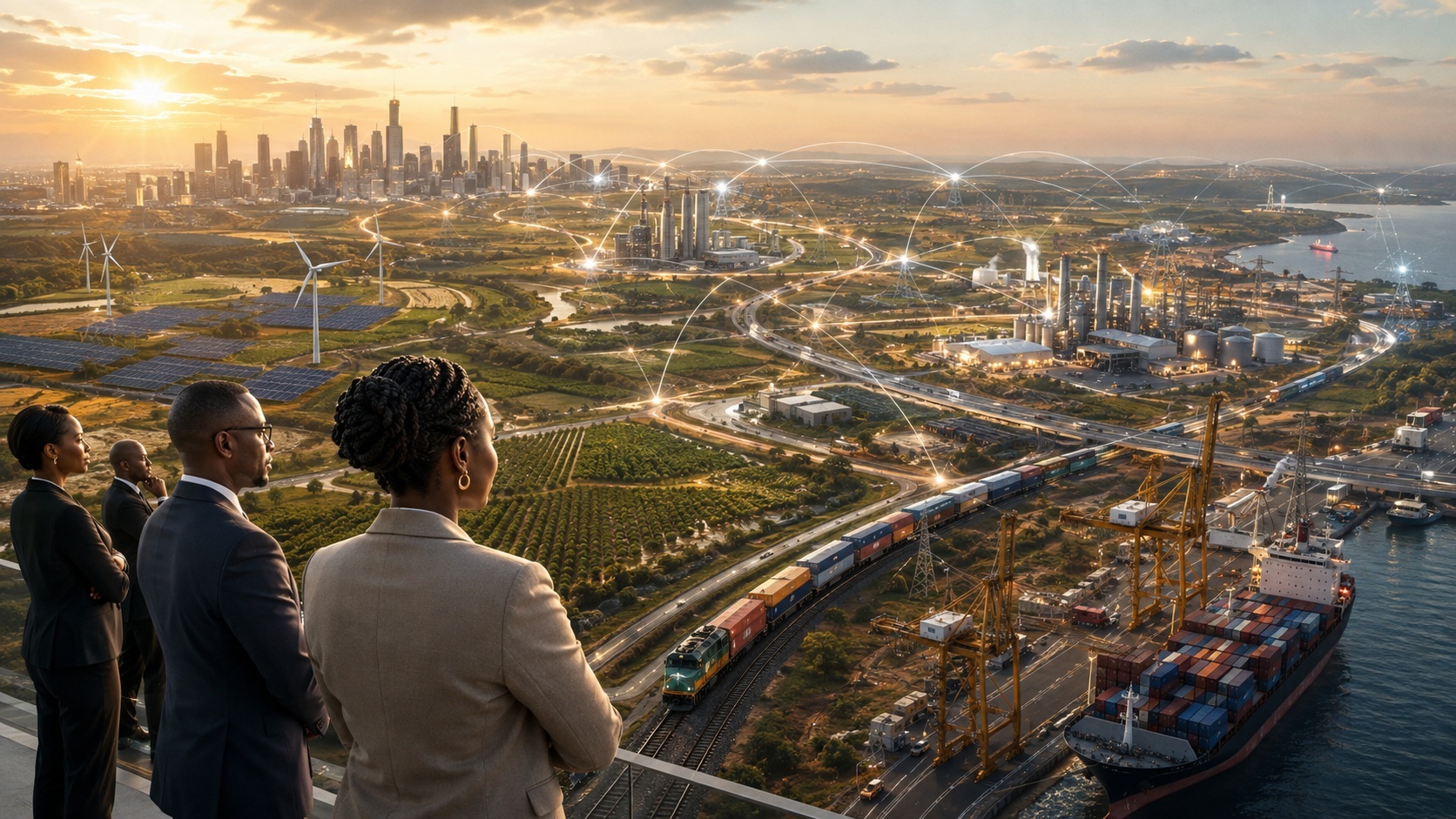
Africa is held together every day by an enormous web of overlapping systems.
Political systems.
Transport systems.
Energy systems.
Financial systems.
Trade systems.
Digital systems.
Agricultural systems.
Health systems.
Research systems.
Business systems.
Human relationships.
Most Africans interact with pieces of this network every day without ever seeing the whole thing.
A truck crosses a border.
A farmer sends produce to a market.
A bank settles a payment.
A mobile network connects a customer.
A port moves cargo.
A university trains an engineer.
A nurse serves a rural clinic.
A development bank finances a road.
A diaspora investor sends capital home.
A customs officer clears goods.
A regional body harmonises rules.
A telecommunications company extends fibre.
A small manufacturer supplies a larger business.
None of these actions looks like "keeping Africa together."
But together, that is exactly what they are doing.
Africa is already connected
We often speak about African integration as though it is something that has not yet begun.
That is not entirely true.
Africa is already connected.
The real problem is that its connections remain incomplete, fragmented and difficult to see.
The African Union provides the continental political framework. Agenda 2063 explicitly includes the ambition for world-class infrastructure to crisscross Africa and for the continent to become more politically and economically integrated. Source: African Union -
Regional Economic Communities then translate much of that ambition into regional work.
SADC.
EAC.
ECOWAS.
COMESA.
IGAD.
ECCAS.
AMU.
These bodies are not abstract acronyms.
They help coordinate trade, infrastructure, customs, transport, security, energy, mobility and regional policy.
Then there is the African Continental Free Trade Area.
AfCFTA is one of the most important attempts ever made to reduce the economic distance between African countries.
But the agreement itself is only the beginning.
The World Bank now argues that Africa's next integration challenge is not simply creating trade agreements, but making the systems underneath them work together: customs, transport, standards, payments, energy, finance, digital platforms and data. Source: World Bank -
That is the real issue.
A continent is connected by systems, not speeches
You can sign a continental agreement.
But if a truck waits days at a border, trade is still disconnected.
You can establish a regional market.
But if payment systems cannot talk to each other, commerce is still fragmented.
You can build a railway.
But if local businesses cannot supply, process, repair, manufacture or participate around it, the economic network remains thin.
You can install fibre.
But if businesses do not have the skills, tools or platforms to use it, the digital economy remains uneven.
This is why infrastructure must be understood more broadly.
Infrastructure is not only concrete and steel.
It is also interoperability.
Standards.
Data.
Trust.
Payments.
Identity.
Documents.
Logistics.
Knowledge.
Relationships.
The African Development Bank is part of the backbone
One of the institutions quietly doing an enormous amount of this work is the African Development Bank.
In 2025, the Bank approved about $10.9 billion in new operations and mobilised billions more from partners and investors. Its completed operations supported nearly 2,000 km of roads, electricity access, agricultural technologies and improved food security across millions of people. Source: African Development Bank -
Those numbers matter.
But what matters even more is what they represent.
A road is not only a road.
It is a connection between a farm and a market.
Between a factory and a port.
Between a community and a hospital.
Between a worker and a job.
Between one country and another.
Europe is deeply embedded in Africa's infrastructure network
The European Union has become one of the major external financiers of infrastructure, energy, transport, digital systems, education, health and private-sector development across Africa.
Its Global Gateway programme aims to mobilise large-scale investment into African infrastructure and economic development.
That means Europe is part of Africa's operating network.
So is the United States.
So is China.
So are Gulf states.
So are India and Türkiye.
So are multinational companies.
That reality should not be treated emotionally.
It should be understood practically.
Africa is deeply connected to global capital, technology, trade and institutions.
The more important question is:
What does Africa gain from those connections beyond the transaction itself?
Does a project build local suppliers?
Does it leave skills behind?
Does it create manufacturing?
Does it increase African ownership?
Does it improve infrastructure?
Does it strengthen regional trade?
Does it connect African businesses into wider value chains?
That is the test.
China is part of the network too
China has built, financed or participated in roads, railways, ports, energy systems, mines, telecommunications and construction projects across Africa for decades.
Whatever political interpretation one attaches to that relationship, the physical reality is undeniable:
Chinese capital, engineering, equipment and businesses are deeply embedded in African infrastructure.
The question is not whether China is present.
The question is what African capability grows around that presence.
The same question should be asked of Europe.
The same question should be asked of the United States.
The same question should be asked of Gulf investors.
And the same question should be asked of African investors.
External partners are not Africa's operating system
This distinction matters.
External partners can finance.
Build.
Invest.
Trade.
Advise.
Partner.
But they do not replace Africa's own networks.
The continent still runs because African institutions, businesses and people operate every day underneath these larger partnerships.
Ports are staffed.
Trucks are driven.
Banks settle transactions.
Farmers produce food.
Health workers treat patients.
Businesses manufacture.
Engineers maintain infrastructure.
Teachers train the next generation.
Telecom companies keep networks alive.
Airlines move people.
Small traders move goods.
These people rarely appear in grand development announcements.
But without them, the continent stops.
The invisible infrastructure
Some of Africa's most important infrastructure is not visible from the air.
It is institutional.
A customs platform that allows data to move.
A banking network that settles regional payments.
A regulatory system that recognises standards.
A professional body that recognises qualifications.
A digital identity system.
A trusted business registry.
A document system.
A marketplace.
A logistics network.
A supplier database.
These systems determine whether infrastructure actually becomes economic activity.
UNECA has recently stressed that digital trade requires not only fibre and electricity, but also digital skills, online platforms, financial inclusion and supportive policy frameworks. Source: UNECA -
That matters.
Because a cable alone does not create a digital economy.
A road alone does not create trade.
A port alone does not create industry.
A railway alone does not create manufacturing.
Systems have to connect.
Why does Africa still feel disconnected?
This is the uncomfortable part.
Africa does not suffer from a total absence of networks.
It suffers from networks that do not see one another.
A farmer may be part of an agricultural network but invisible to a processor.
A manufacturer may be capable of supplying a project but invisible to the procurement chain.
A researcher may have knowledge that a business needs but no route into industry.
An investor may want to participate but lack a trustworthy map of opportunities.
A university may train graduates without knowing which industries need those skills.
A regional road may exist while local businesses remain economically disconnected from the corridor it creates.
The systems exist.
But they are not always interoperable.
The World Bank's recent work makes this point clearly: African integration increasingly depends on making customs, standards, payments, transport, energy, digital systems and services work together across borders. Source: World Bank -
That is the real frontier.
Africa's diaspora is part of this network
Africa's operating network does not end at the coastline.
Millions of Africans living abroad carry:
skills,
capital,
relationships,
technology,
research capability,
professional experience,
market access,
and influence.
The diaspora is already part of Africa's economic system.
It sends remittances.
Invests.
Builds businesses.
Shares expertise.
Connects markets.
Mentors founders.
Supports families.
Forms partnerships.
But the diaspora often faces the same problem:
where does its capability connect?
A professional in London may want to support a business in Zambia.
An engineer in Toronto may want to participate in a project in Ghana.
A doctor in Australia may want to collaborate with a health institution in Kenya.
A manufacturer in Dubai may want to source from Africa.
The willingness exists.
The connection often does not.
The problem is not lack of people
Africa has people.
It has businesses.
It has farmers.
Researchers.
Engineers.
Entrepreneurs.
Investors.
Universities.
Institutions.
Communities.
The problem is that these capabilities are often scattered across systems that do not talk to one another.
That fragmentation is expensive.
Every disconnected system creates friction.
Repeated paperwork.
Repeated verification.
Repeated searches for suppliers.
Repeated searches for investors.
Repeated searches for expertise.
Repeated searches for buyers.
Repeated rebuilding of the same relationships.
That is a hidden cost of fragmentation.
This is where infrastructure becomes economic intelligence
Imagine if Africa could see itself more clearly.
Country.
Industry.
Area of Activity.
Participant.
Capability.
Product.
Service.
Opportunity.
Investor.
Research institution.
Supplier.
Buyer.
Now imagine that across all 54 countries.
Not as one giant database controlled by one institution.
But as connected, trusted layers of information that allow people to discover one another.
That changes things.
A railway corridor becomes more than a transport route.
It becomes a map of manufacturers, logistics firms, processors, suppliers and training institutions.
A farming region becomes more than agricultural land.
It becomes a network of farmers, irrigation suppliers, processors, buyers, lenders, researchers and transport providers.
A city becomes more than a geographic place.
It becomes visible capability.
That is the next layer of infrastructure Africa needs.
Infrastructure should make capability visible
Traditional infrastructure connects places.
The next generation of infrastructure must connect capability.
That means not only asking:
Where is the road?
But:
Who can use it?
Who can supply it?
Who can maintain it?
Who can manufacture around it?
Who can finance activity around it?
Who can train workers around it?
Who can build businesses because it exists?
This is where Africa's integration becomes practical.
The continent already has the pieces
This may be the most important point.
Africa does not need to invent everything from zero.
The continent already has:
regional institutions,
banks,
telecom networks,
trade agreements,
development banks,
universities,
farm organisations,
business chambers,
diaspora networks,
ports,
railways,
airlines,
mobile-money systems,
energy pools,
research centres,
digital platforms,
and millions of enterprises.
The pieces exist.
The challenge is connection.
The question is not who controls Africa
Public conversations often become obsessed with asking which outside power controls or influences Africa.
Europe.
China.
America.
Russia.
The Gulf.
That question has some relevance.
But it is not the most useful question.
The more useful one is:
How do Africans become more capable of seeing, connecting and using their own networks?
Because the stronger Africa's internal systems become, the more confidently it can work with every external partner.
Not from isolation.
From capability.
The network underneath the continent
Africa is being held together every day.
By institutions.
By infrastructure.
By money.
By trade.
By fibre.
By roads.
By ports.
By farms.
By businesses.
By knowledge.
By people.
The network exists.
The problem is that too much of it remains invisible.
And when networks remain invisible, opportunities disappear between them.
Africa does not only need more infrastructure.
It needs infrastructure that allows the continent to understand itself.
To see its capabilities.
To see its gaps.
To see its suppliers.
To see its investors.
To see its researchers.
To see its farmers.
To see its businesses.
To see its diaspora.
And to connect them.
Because the question is no longer whether Africa is connected.
It already is.
The question is whether we can see those connections clearly enough to use them.
And when we can, Africa stops looking like 54 separate markets trying to find one another.
It starts looking like what it already is:
a living continental network waiting to become visible.
🚀 Help Map the Networks Keeping Africa Connected
EcoTech invites businesses, chambers, institutions, researchers, farmers, logistics providers, financiers, infrastructure operators, diaspora professionals and development partners across Africa to identify the networks they belong to and the capabilities they provide, helping build a clearer picture of how the continent already works — and where stronger connections are still needed.
This pathway is linked directly to this published story. Browse EcoTech Opportunities to see this and other active participation pathways alongside CloudFeed opportunities.



Comments (0)
Join the Conversation
What do you think about this story? Share your view, a practical example, or a respectful challenge.
Comments are part of the EcoTech participation layer. Join from R49 once-off to participate, or log in if you already have an account.